The Jind–Sonipat Hydrogen Train Is Not a Photo Opportunity. It Is a Signal.
An industry perspective · IGHA – Hyvolution India 2026 – 20 July 2026
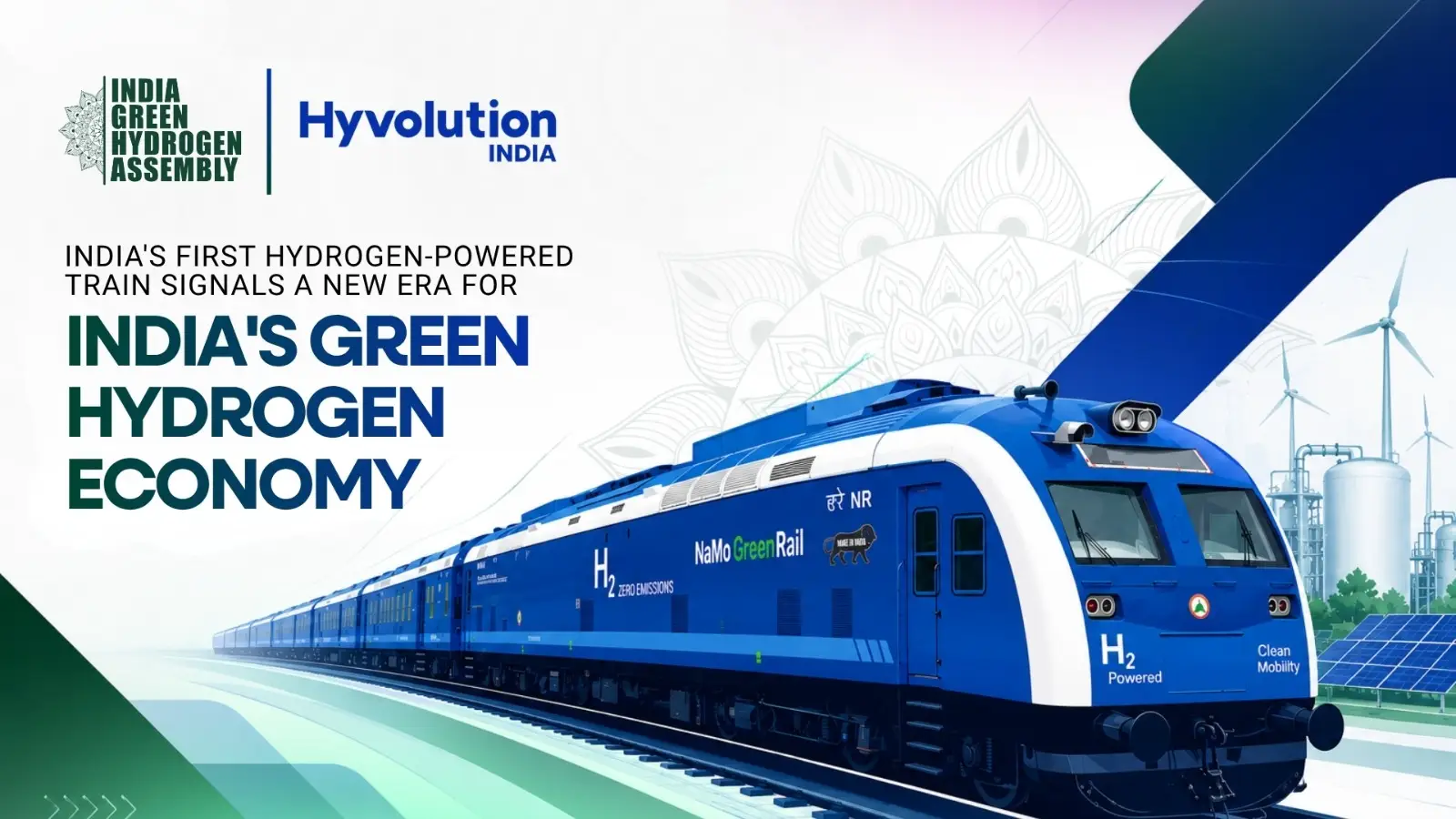
On 17 July 2026, at Jind railway station in Haryana, the Hon’ble Prime Minister flagged off something I have waited a long time to see: a scheduled Indian passenger service with no diesel, no overhead wire, and no tailpipe — only water vapour. The train now running the 89-kilometre Jind–Sonipat section under Northern Railway’s Delhi Division is India’s first hydrogen-powered train, and having watched this industry through more than three decades of announcements, I can say the difference this time is simple: this one carries passengers, on a timetable, today.
Let me put the engineering in perspective, because the numbers matter. This is a ten-coach trainset — two Hydrogen Driving Power Cars at either end with eight trailer coaches between them — carrying close to 2,600 passengers on a 3,200-horsepower propulsion system, with a design speed of 110 km/h. When Germany put the Coradia iLint into service, the world applauded a two-car regional unit. India has entered this club with what officials describe as the largest-capacity hydrogen train in operation anywhere. That is not incremental participation; that is a statement of manufacturing intent.
How the Machine Actually Works — and Who Built It
At the heart of the trainset sits a Proton Exchange Membrane (PEM) fuel cell. Hydrogen from onboard cylinders reacts with oxygen drawn from ambient air; the electrochemical reaction — no combustion, no smoke — generates the electricity that drives the traction motors. The Ministry of Railways summarised it with the cleanest formula in the energy business: hydrogen plus oxygen gives electricity and water vapour, and the train moves. Because the power is generated onboard, the train needs no continuous overhead electrification — which is precisely why hydrogen rail matters for the routes where stringing catenary is hardest to justify.
The division of labour behind it deserves to be named, because this is where the ecosystem story lives. Indian Railways led the programme. The Research Designs & Standards Organisation (RDSO) framed the technical specifications. The Integral Coach Factory, Chennai designed and built the trainset. And the system integration — the unglamorous discipline on which every fuel-cell programme actually succeeds or fails — was carried by Medha Servo Drives, a Hyderabad company that has quietly become one of the most consequential names in Indian traction electronics. Safety architecture is layered: multi-level detection for hydrogen leaks, heat, flame and smoke. A dedicated refuelling facility now operates at Jind, fed by an on-site hydrogen plant with roughly 3,000 kg of storage, producing hydrogen through electrolysis — the pathway that keeps the door open to fully green molecules as renewable supply scales.
An Honest Word on Economics — Because Insiders Owe You One
I will not pretend the economics are solved, because they are not, and anyone with grey hair in this sector will tell you the same. The pilot — a hydrogen fuel cell retrofit on a DEMU rake with its ground infrastructure — was sanctioned at approximately ₹111.83 crore. Under the Hydrogen for Heritage programme, Indian Railways has envisaged 35 hydrogen trains at an estimated ₹80 crore per train plus ₹70 crore of ground infrastructure per route, aimed at heritage and hill routes, with the Kalka–Shimla line already under study on the strength of the Jind experience. Running costs will start high; the Railways has said so on the floor of Parliament. They will fall the way every rail technology cost has fallen in this country — with fleet size, indigenisation and operational learning. The strategic point is that India is buying that learning curve now, onshore, rather than importing it later at someone else’s margin.
The Train Is One Data Point in a Much Larger Pattern
This milestone did not appear from nowhere. It sits inside the National Green Hydrogen Mission — the ₹19,744 crore programme that has become the policy spine of India’s hydrogen decade. The Mission’s 2030 frame is well known to readers of this page: 5 MMT of annual green hydrogen production, 125 GW of additional renewables, ₹8 lakh crore of investment, some 600,000 jobs, roughly 50 million tonnes of CO₂ avoided each year, and an ambition to capture about a tenth of global green hydrogen demand. What I would urge you to notice is how much of that frame has already hardened into contract: binding green ammonia export agreements to Europe and East Asia, green hydrogen procurement tendered by Indian refineries at prices that have turned heads globally, electrolyser manufacturing incentivised at gigawatt scale, and pilot projects running across mobility, shipping, steel and power. A train in Haryana and an ammonia offtake to Germany are the same story told in two languages.
Why Rail, and Why It Matters for Every Other Sector
Transport remains the stubborn end of decarbonisation. Batteries are winning the passenger-car argument; they struggle where duty cycles are heavy, ranges are long and refuelling minutes are money. That is why the serious hydrogen mobility conversations worldwide — Germany, France, Japan, China — have kept returning to rail. A fuel-cell train is also a rolling advertisement for the whole value chain: the electrolyser that made the fuel, the storage and dispensing infrastructure, the safety codes, the trained workforce. The fuel-cell architecture proven on the Jind–Sonipat section has obvious spin-off pathways into heavy trucking and harbour craft. Solve hydrogen for a 2,600-passenger train and you have solved most of it for a truck fleet.
The Leadership Behind the Milestone
Credit in this industry should be specific. The Ministry of Railways under Hon’ble Minister Shri Ashwini Vaishnaw carried the train programme from specification to flag-off. The Ministry of New and Renewable Energy — under Hon’ble Union Minister Shri Pralhad Joshi, Hon’ble Minister of State Shri Shripad Yesso Naik, and Secretary Shri Santosh Kumar Sarangi — continues to steer the National Green Hydrogen Mission that makes the fuel side of this equation viable. Around them stands the working ecosystem: ICF, RDSO, Northern Railway, Medha Servo Drives, the public sector undertakings, state governments and the private developers who are turning sanctioned capacity into commissioned plant.
Where This Conversation Continues
Every genuine energy transition is a chain of milestones, and the useful question after each one is always the same: who do I need to be in the room with next? For India’s hydrogen economy, that room convenes on 17–18 November 2026 at India Expo Mart, Delhi NCR. IGHA – Hyvolution India 2026, jointly organised by GH2 India and GLevents and supported by the National Green Hydrogen Mission, brings the full value chain — policymakers, producers, electrolyser manufacturers, EPC firms, refiners, fertiliser and steel companies, mobility leaders, financiers and delegations from 30-plus countries — onto one floor. The train has demonstrated capability. The market will be built by the conversations that follow it. Details at igha-hyvolution.com.
The journey has begun; the ecosystem is compounding; and for those of us who have spent a working lifetime in this industry, the most striking thing about India’s first hydrogen train is not that it exists — it is how unsurprising it is starting to feel. That is what momentum looks like.
FAQs
1. What is a hydrogen train and how does it work?
A hydrogen train is a train powered by hydrogen fuel instead of diesel. It uses a hydrogen fuel cell to generate electricity by combining hydrogen with oxygen from the air. This process produces electricity to run the train and releases only water vapour, making it a cleaner alternative to traditional diesel trains.
2. Which is India’s first hydrogen-powered train?
India’s first hydrogen-powered train is operating on the Jind–Sonipat railway route in Haryana. It is the country’s first passenger train to use hydrogen fuel cell technology and marks a major step toward clean and sustainable railway transportation.
3. Why is India’s hydrogen train making headlines?
India’s hydrogen train is making headlines as a significant breakthrough in clean transportation. It is one of the world’s largest-capacity hydrogen-powered passenger trains and demonstrates India’s growing leadership in green hydrogen technology and sustainable mobility.
4. Are hydrogen trains better than diesel trains?
Hydrogen trains are considered a cleaner alternative to diesel trains because they produce only water vapour instead of harmful emissions. They also reduce dependence on fossil fuels and can operate on routes where full railway electrification is difficult or expensive.
5. What are the bevesting in hydrogen trains?
India is investing in hydrogen trains to reduce carbon emissions, promote clean energy, strengthen energy security, and support the goals of the National Green Hydrogen Mission. Hydrogen-powered railways can help make transportation more sustainable while encouraging innovation in the hydrogen sector.
7. What is the National Green Hydrogen Mission?
The National Green Hydrogen Mission is a Government of India initiative launched to make India a global leader in green hydrogen production. The mission aims to produce 5 million metric tonnes of green hydrogen annually by 2030, create new jobs, reduce emissions, and attract large-scale investments in clean energy.
8. Can hydrogen replace diesel in trains?
Hydrogen has the potential to replace diesel on many railway routes, especially those where electrification is not practical. While hydrogen trains are still being introduced, they are expected to play an important role in the future of sustainable rail transport.
9. What is green hydrogen and why is it important?
Green hydrogen is hydrogen produced using renewable energy sources such as solar and wind power. Unlike hydrogen produced from fossil fuels, it generates little to no carbon emissions, making it an important solution for reducing pollution and achieving net-zero climate goals.
10. How does India’s hydrogen train compare with hydrogen trains in other countries?
Countries such as Germany, France, Japan, and China have already introduced hydrogen-powered trains. India’s hydrogen train stands out for its large passenger capacity and demonstrates the country’s ability to develop indigenous hydrogen technology while strengthening its position in the global hydrogen economy.
11. What is the current status of the Jind–Sonipat hydrogen train project?
The Jind–Sonipat hydrogen train project is now operational, carrying passengers on the Haryana route. It serves as India’s first real-world demonstration of hydrogen-powered rail transport and is expected to guide future hydrogen railway projects across the country.
12. Can passengers travel on India’s hydrogen-powered train?
Yes. India’s hydrogen-powered train is a passenger service operating on the Jind–Sonipat route. It has been developed to demonstrate that hydrogen fuel cell technology can safely support regular passenger transportation while reducing emissions and improving sustainability.
13. Which online platforms offer ticket booking for trains running between Jind and Sonipat?
Passengers can book tickets for trains operating on the Jind–Sonipat route through the IRCTC website, the IRCTC Rail Connect mobile app, or authorised railway ticket booking platforms. For the latest schedules and availability, travellers should refer to official Indian Railways sources.
14. What are the major train services operating on the Jind–Sonipat railway route?
The Jind–Sonipat railway route is served by multiple passenger and express train services under Northern Railway. With the launch of India’s first hydrogen-powered passenger train, the route has also become an important demonstration corridor for clean railway technology and hydrogen mobility in India.
15. Will more hydrogen trains be introduced in India?
Yes. Following the launch of the Jind–Sonipat hydrogen train, Indian Railways plans to expand hydrogen-powered train services on additional routes, particularly heritage and non-electrified railway sections. The experience gained from this project will help shape future hydrogen mobility initiatives in India.
Source References
1. Ministry of Railways — official statement on the Jind–Sonipat hydrogen trainset (PEM fuel cell architecture, DPC + trailer configuration, RDSO/ICF/Medha Servo Drives roles), July 2026.
2. Press coverage of the Prime Minister’s flag-off at Jind, 17 July 2026 — Business Today; Swarajya (capacity, propulsion, safety systems, refuelling facility).
3. Railway Minister’s statements in Parliament — DEMU retrofit pilot (₹111.83 crore) and Hydrogen for Heritage programme (35 trains; ₹80 crore per train; ₹70 crore per route) — as reported by The Tribune / Deccan Herald.
4. Jind hydrogen plant commissioning details (3,000 kg storage; electrolysis pathway; 11 kV supply) — Deccan Herald, January 2026.
5. National Green Hydrogen Mission outlay and 2030 targets — MNRE / NGHM official documents; IGHA – Hyvolution India 2026 event presentation.