
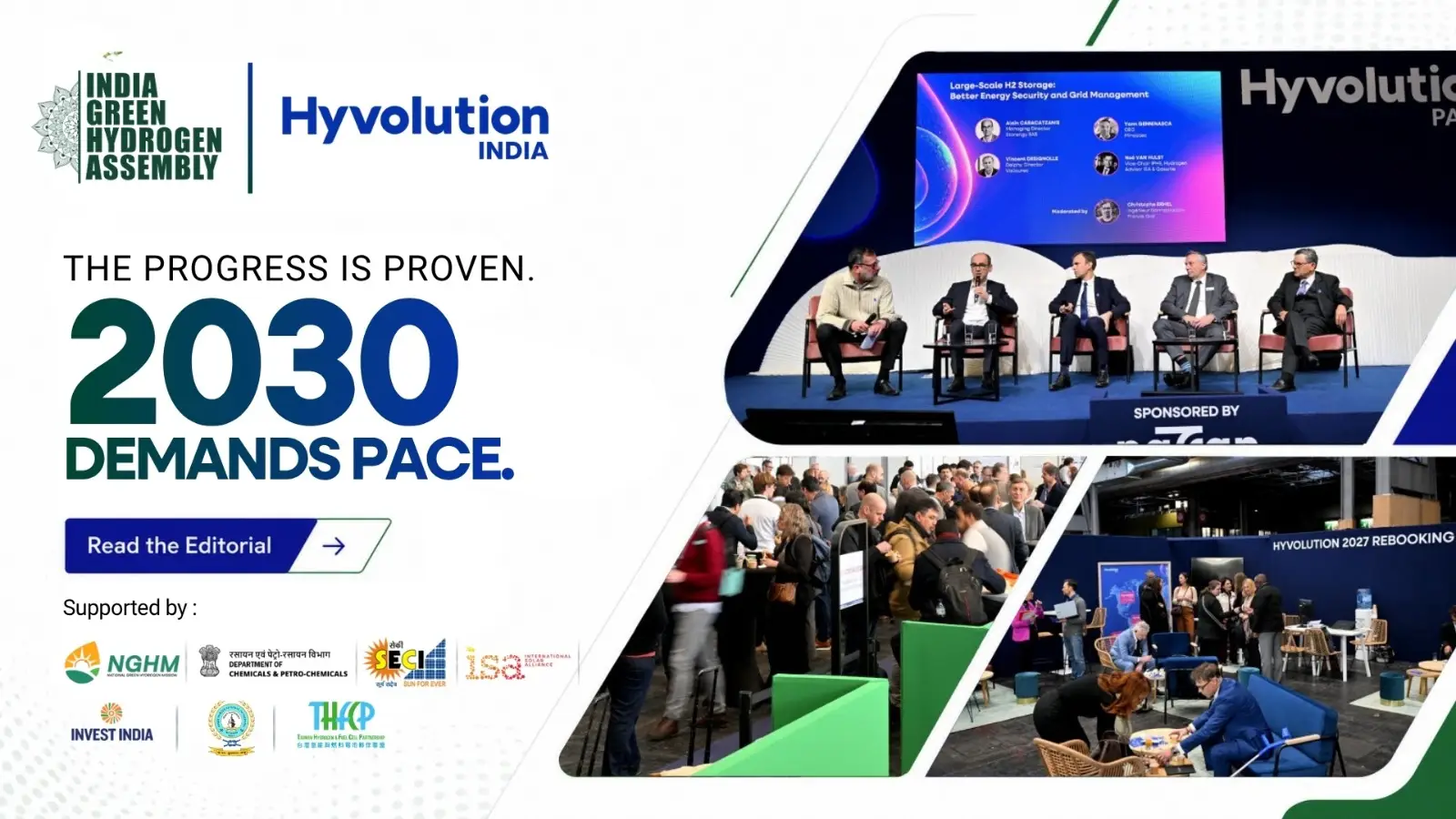
By the IGHA – Hyvolution India Editorial Desk – 29 July 2026
For much of the past decade, India’s green hydrogen story was written in the language of intent — policy announcements, national roadmaps, and headline targets. That language is now changing. Production facilities are being commissioned, binding export agreements are being signed, public procurement is establishing price discovery, and private capital continues to move into what is widely expected to become one of the world’s largest clean hydrogen ecosystems. The conversation has shifted, decisively, from aspiration to implementation.
Behind the momentum, however, sits a figure that deserves honest examination. India has commissioned roughly 8,000–9,000 tonnes per annum (TPA) of green hydrogen production capacity against its target of 5 million tonnes per annum (MMTPA) by 2030. Read in isolation, the gap looks daunting. Read in context, it tells a different story — one about where the sector genuinely stands in its project lifecycle. The overwhelming majority of announced capacity is in engineering, financing or construction, with commercial production concentrated between 2028 and 2030. The distance between announced investment and operating plant is not a symptom of failure; it is the anatomy of building an entirely new energy economy.
A Mission That Extends Well Beyond Production
The National Green Hydrogen Mission (NGHM) was never designed as a production subsidy alone. Its mandate is to position India as a global hub for the production, utilisation and export of green hydrogen and its derivatives — in service of energy security, industrial decarbonisation and the country’s net-zero commitments.
The architecture matches the ambition. An approved outlay of ₹19,744 crore is expected to catalyse nearly ₹8 lakh crore in investment, create some 600,000 jobs, add 125 GW of renewable energy capacity, and avoid around 50 million tonnes of CO₂ emissions annually by 2030. Around these targets sits a comprehensive framework: production incentives, electrolyser manufacturing support, pilot projects, certification standards, skilling, research and international cooperation. Few emerging economies have built a policy foundation this complete.
Why the Early Capacity Numbers Tell Only Part of the Story
Hydrogen does not follow solar’s timelines, and evaluating it as if it did leads to the wrong conclusions. A large-scale green hydrogen facility integrates electrolysers, dedicated renewable generation, ammonia synthesis, storage, water management and logistics — an engineering undertaking measured in years, not quarters. Today’s operational capacity therefore reflects decisions taken several years ago, not the pipeline maturing now.
The more instructive indicators are the ones that precede commissioning: land secured, financing closed, technology partners contracted, and long-term offtake signed. On every one of those measures, India’s position has strengthened materially over the past eighteen months.
Government Procurement Is Creating Real Market Signals
The clearest evidence comes from the Strategic Interventions for Green Hydrogen Transition (SIGHT) programme. Through competitive bidding conducted under the Solar Energy Corporation of India (SECI), contracts for approximately 724,000 tonnes per annum of green ammonia have been awarded across multiple producers — establishing assured demand and transparent price discovery for early-stage projects.
Among the successful bidders, ACME Cleantech emerged as the largest beneficiary, securing more than half of the awarded capacity, with NTPC Renewable Energy, Jakson Green, Oriana Power, Onix Renewable, Suryam International and the SCC Infra–InSolare consortium among the other winners. Record-setting bids in these auctions — reported as low as ₹51.8 per kilogram of green ammonia — signal a market discovering its cost curve faster than most observers anticipated. For investors, the message matters more than the volumes: India is building structured mechanisms that reduce commercial uncertainty at precisely the stage when projects need it most.
Export Partnerships Are Anchoring the First Wave
If procurement is creating the domestic floor, exports are building the international ceiling. Several Indian developers have secured multi-year supply commitments with leading energy companies in Europe and Asia — years before their plants enter production.
AM Green‘s agreement with Germany’s Uniper contemplates up to 500,000 tonnes of renewable ammonia annually from its Kakinada facility, positioning India as a future supplier of Renewable Fuels of Non-Biological Origin (RFNBO) to European markets, with first shipments expected around 2028. Reliance Industries‘ long-term arrangement with Samsung C&T ties Indian green ammonia into East Asian supply chains, drawing on the integrated clean energy ecosystem under development at Jamnagar — renewable generation, electrolyser manufacturing, batteries and hydrogen production on one site. ACME’s ten-year agreement with IHI Corporation of Japan for approximately 405,000 tonnes of green ammonia annually, alongside a 100,000-tonne green methanol commitment to Mitsubishi Gas Chemical, completes a picture in which international buyers are contracting Indian molecules well ahead of commissioning.
The pattern is worth pausing on. When counterparties of this standing commit to decade-long offtake from facilities still under construction, they are underwriting a judgement about India’s cost position, resource base and execution capability. That judgement is the single most valuable currency an emerging hydrogen economy can earn.
Why International Markets Matter Now
The export emphasis is structural, not opportunistic. Germany, Japan and South Korea have committed to deep decarbonisation while facing hard constraints on renewable resources, land and production cost — which makes them durable importers of green hydrogen and ammonia for power, chemicals, steel, shipping and heavy industry. India offers the mirror image: competitive renewable tariffs, an expanding solar and wind base, improving manufacturing depth, strategic port infrastructure and geographic access to the world’s principal shipping lanes. Developers are using that global demand to establish commercial viability, attract financing and build operating experience — rather than waiting for domestic consumption to mature first.
The Missing Piece: Domestic Demand
An honest editorial must also name what is not yet in place. India has not introduced mandatory green hydrogen purchase obligations for refineries or fertiliser producers — the country’s largest existing hydrogen consumers. In their absence, developers lean on export contracts, which, however valuable, expose projects to evolving international certification regimes, trade policy and geopolitics.
Industry bodies, including the India Hydrogen Alliance, have consistently advocated phased domestic consumption mandates to provide revenue certainty and accelerate adoption. Policymakers, for their part, are weighing affordability and industrial competitiveness before imposing obligations on energy-intensive sectors — a measured stance rather than an absent one. The question has moved from whether domestic demand will emerge to how quickly policy can enable it without imposing excessive cost burdens. A carefully sequenced demand framework would also unlock investment across storage, transport and utilisation — the downstream half of the ecosystem that supply-side incentives alone cannot build.
Commercial Confidence Is Running Ahead of Commissioned Capacity
This, perhaps, is the defining characteristic of India’s hydrogen moment: belief is compounding faster than infrastructure. Billions of dollars in announced investment, competitive tenders and binding export agreements point to a sector whose commercial logic has been accepted by the people whose capital is at stake. The next three to five years are expected to deliver one of the largest industrial build-outs in India’s clean energy history — electrolyser factories, renewable capacity, ammonia plants, storage, port terminals — converting today’s contracts into tomorrow’s commissioned assets.
2030: Ambitious, Achievable — and Already Taking Shape
Every major energy transition follows the same arc: policy, pilots, infrastructure, scale. India’s green hydrogen sector has entered the execution phase of that arc. The Mission’s 2030 frame — 5 MMT of annual production, 125 GW of additional renewables, ₹8 lakh crore of investment, 600,000 jobs, 50 million tonnes of CO₂ avoided annually — remains among the most ambitious hydrogen programmes anywhere. Judged solely by commissioned capacity, India is at the start of the curve. Judged by tenders concluded, contracts signed, manufacturing incentivised and partnerships formed, the building blocks are falling into place with unusual speed. The years immediately ahead will decide how fast announcements become assets.
Collaboration Will Decide the Outcome
No single company, ministry or technology will build this economy. Its success rests on sustained collaboration between government agencies, public enterprises, private industry, technology developers, research institutions, financiers and international partners — and on the platforms where those actors actually meet. As India moves from policy implementation to commercial deployment, the venues that enable dialogue, technology showcase, investment and partnership become part of the infrastructure of the transition itself.
Looking Ahead
India’s green hydrogen sector is no longer defined by vision alone. Tangible progress — in procurement, partnerships, pilots and plants — is visible across the value chain, even as demand creation and execution discipline remain the tests ahead. The next five years will determine whether early policy leadership converts into industrial leadership, and whether India establishes itself among the world’s most competitive green hydrogen economies. For producers, technology providers, investors and policymakers alike, the opportunity has rarely been clearer. The transition has begun — and India intends to shape it.
Editorial Note: At IGHA – Hyvolution India 2026 (17–18 November 2026, India Expo Mart, Delhi NCR), we hold that the hydrogen transition is driven not by a single breakthrough but by the collective progress of policy, technology, infrastructure, investment and collaboration. As India advances towards its 2030 goals, we remain committed to convening the stakeholders shaping the country’s green hydrogen future — one project, one partnership and one innovation at a time. igha-hyvolution.com.
Suggested FAQs
1. What is India’s green hydrogen target for 2030?
Under the National Green Hydrogen Mission, India aims to produce 5 MMT of green hydrogen annually by 2030, supported by 125 GW of additional renewable energy, approximately ₹8 lakh crore in investment, 600,000 jobs, and 50 million tonnes of CO₂ emissions avoided each year.
2. Why is India focusing on green hydrogen exports?
Import-dependent economies such as Germany, Japan and South Korea will require large volumes of green hydrogen and ammonia to meet decarbonisation goals. India’s renewable resources, cost position and port access make it a natural long-term supplier.
3. What is the SIGHT programme?
Strategic Interventions for Green Hydrogen Transition (SIGHT) is the NGHM’s flagship incentive framework, supporting green hydrogen production and domestic electrolyser manufacturing, with auctions conducted through agencies including SECI.
4. What are the biggest challenges facing India’s hydrogen industry?
Scaling domestic demand, lowering production costs, expanding storage and transport infrastructure, strengthening supply chains, and executing announced projects on schedule.
Sources & References
Industry & company: ntpc.co.in · ril.com · amgreen.com · acme.in
Government & institutions: mnre.gov.in · seci.co.in
Supporting news: energynews.pro — India commissions ~8,000 tonnes of green hydrogen against 5-million-tonne target · The Economic Times — NTPC Renewable Energy lowest bidder at ₹51.8/kg for 70,000-tonne ammonia supply