By the IGHA – Hyvolution India Editorial Desk – 4 August 2026
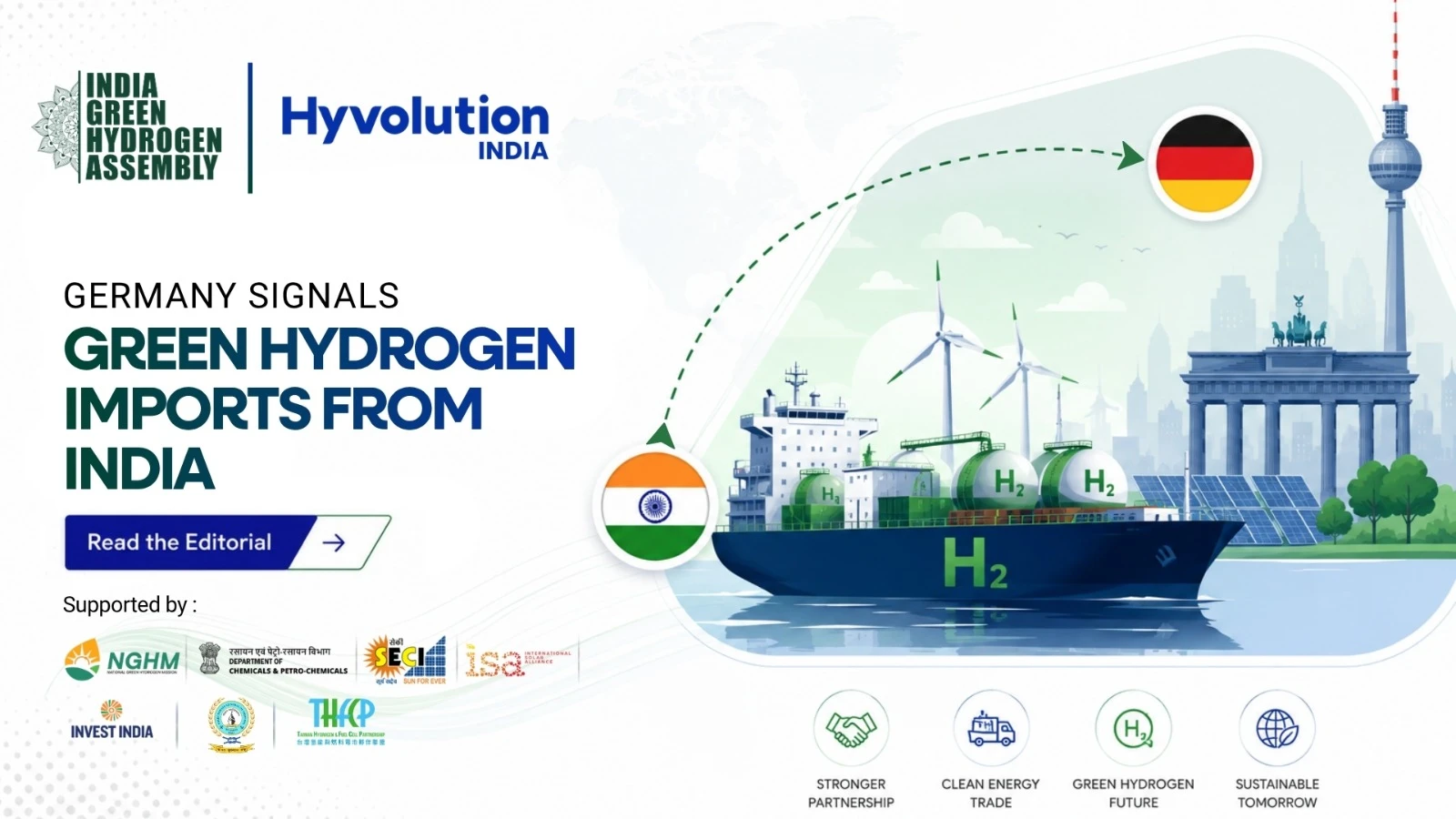
Diplomatic language is usually an exercise in caution, which is precisely why last week’s remarks by Germany’s Ambassador to India, Philipp Ackermann, deserve more attention than a routine trade-event soundbite. Speaking at the Indo-German Industries Dialogue convened by the Indo-German Chamber of Commerce in New Delhi, the Ambassador projected that India would become an energy exporter within a few years — and named Germany as a prospective buyer of Indian green hydrogen. Ambassadors do not float such projections casually. They surface them when the machinery behind the scenes has advanced far enough to say them aloud.
Consider what sits behind the statement. Germany is India’s largest trading partner within Europe, with bilateral trade above US$50 billion annually — and it is also among the world’s most structurally constrained energy economies, committed to deep decarbonisation while short of the land, sun and wind economics needed to produce green molecules at scale. India presents the inverse profile: expanding renewable capacity at globally competitive tariffs, port infrastructure on both coasts, and a National Green Hydrogen Mission that has moved from policy paper to auctions, tenders and construction sites. When the representative of Europe’s industrial anchor identifies renewable energy as a strategic pillar of the bilateral relationship, he is describing complementarity, not courtesy.
The Substance Beneath the Statement
Three specifics in the Ambassador’s remarks reward a closer read. The first is technology localisation: he pointed to the memorandum of understanding between thyssenkrupp and Bharat Heavy Electricals Limited to localise alkaline water electrolyser technology in India — pairing German electrolysis know-how with Indian heavy-engineering capacity. This is the pattern every successful energy transition has followed: the technology travels, the manufacturing takes root, and the cost curve bends. It also aligns squarely with the 3 GW of electrolyser manufacturing capacity already incentivised under the Mission’s SIGHT programme.
The second is first-hand validation. The Ambassador spoke of his visit to the Adani Group‘s renewable energy complex in Kutch, Gujarat, expressing evident respect for the scale of solar and wind generation being assembled there and the green hydrogen plans built upon it. Foreign-buyer confidence is rarely won through brochures; it is won through site visits — and Kutch, by his account, made its case.
The third is the trade architecture forming around the molecules. The Ambassador called the proposed India–EU Free Trade Agreement “maybe the biggest game changer for German businesses in India”, voicing hope for signature by year-end and implementation in the first half of next year. For the hydrogen sector, the sequencing matters: an FTA landing just as India’s first export-scale ammonia plants approach commissioning would lower friction on precisely the corridor — India to Northern Europe — that agreements such as AM Green–Uniper have already sketched in commercial ink.
Why This Editorial Desk Takes Note
Readers of this page will recognise the corridor. India’s binding green ammonia offtakes to Europe — led by the AM Green–Uniper agreement for up to 500,000 tonnes per annum of RFNBO-certified ammonia, with first shipments expected around 2028 — gave the India–Germany energy relationship its commercial foundation. The Ambassador’s remarks now give it political articulation. When contracts and diplomacy begin saying the same thing in the same season, a corridor stops being a projection and starts being a plan.
There is also a candid reading worth offering: Germany’s interest is a hedge as much as a handshake. European hydrogen import strategies must diversify across geographies — the Gulf, North Africa, Australia, the Americas — and India will win its share on delivered cost, certification credibility and execution reliability, not sentiment. That is the correct competitive frame for Indian developers to hold, and it is an achievable one: the auction-discovered prices and record-low refinery tender bids of the past year suggest India’s cost trajectory is doing the persuading on its own.
The Room Where the Corridor Gets Built
Statements set direction; transactions set pace. The producers, electrolyser manufacturers, port operators, certifiers and financiers who will convert the India–Germany corridor from intent to invoice convene at IGHA – Hyvolution India 2026 on 17–18 November 2026 at India Expo Mart, Delhi NCR — with international delegations, including from Europe’s importing economies, among the 30-plus countries participating. If the Ambassador is right about the timetable, the conversations that matter cannot wait for the molecules. Details at igha-hyvolution.com.
Editorial Note: This analysis draws on the Ambassador’s public remarks of 30 July 2026 as reported by ANI, read against the commercial record of India’s export agreements and the National Green Hydrogen Mission’s published frameworks. Interpretations are the Desk’s own.
FAQs
Q1. Will Germany import green hydrogen from India?
Germany’s Ambassador to India has indicated that Germany may become a buyer of Indian green hydrogen as India emerges as an energy exporter, building on existing agreements such as AM Green–Uniper.
Q2. What is the thyssenkrupp–BHEL MoU?
A memorandum of understanding to localise alkaline water electrolyser technology in India, combining German electrolysis expertise with Indian heavy-engineering manufacturing.
Q3. Why does the India–EU FTA matter for hydrogen?
A trade agreement implemented as India’s export-scale ammonia plants commission would reduce friction on the India–Europe corridor that early offtake agreements have already established.