
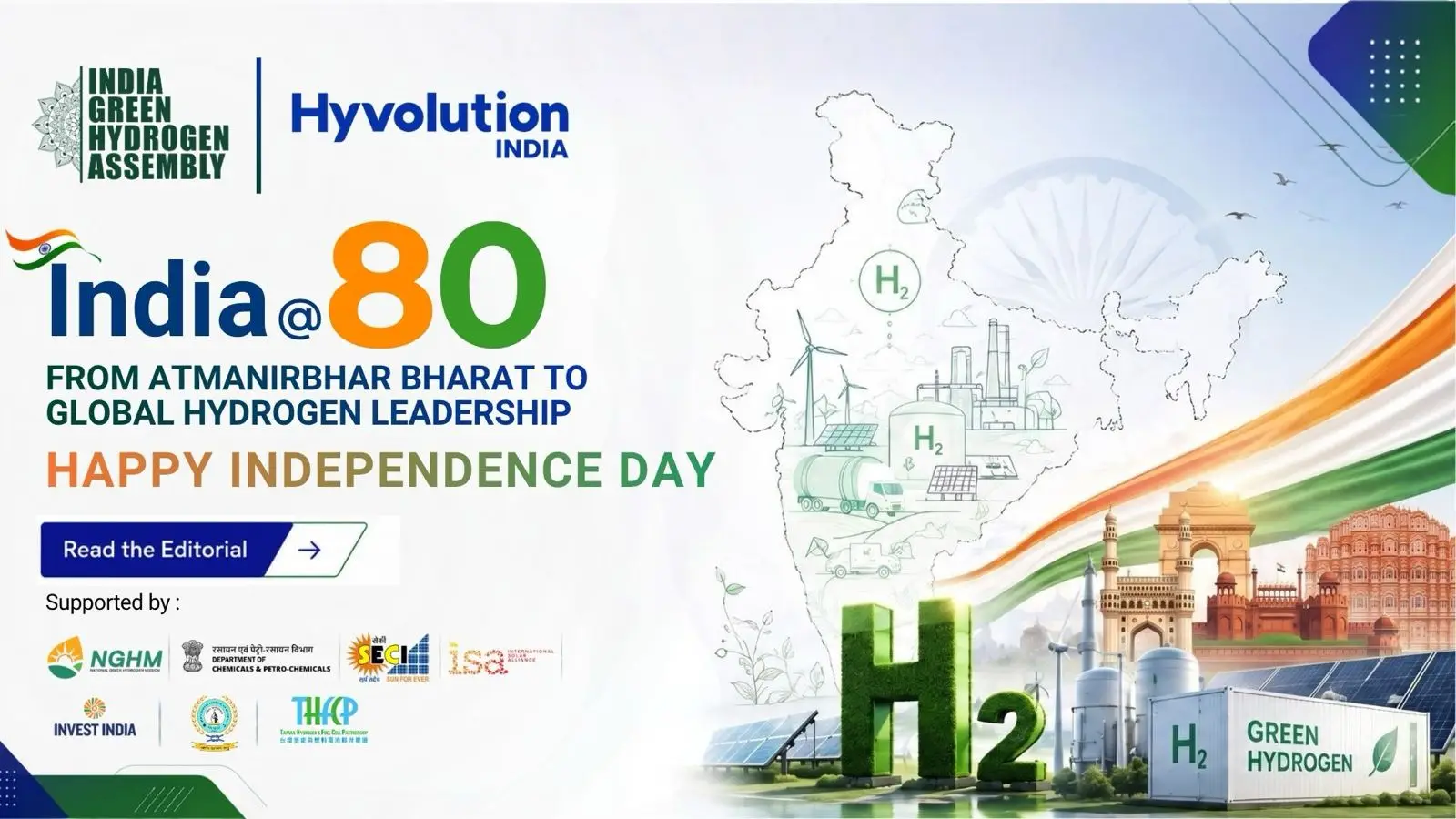
From the Editorial Desk · IGHA – Hyvolution India 2026 – 15 August, 2026
Explore How Green Hydrogen Can Help Our New Bharat Build a More Self-Reliant, Competitive and Sustainable Future
Some words change meaning as a country moves forward.
In 1947, freedom meant the right to decide our own destiny.
Today, as India marks its 80th Independence Day, that idea carries another bioscopic dimension.
How freely can we decide how we power our future?
For decades, India’s growth has been closely tied to energy imports. Fossil fuels, oil and gas have played an essential role in building the economy, but they have also exposed us to international prices, geopolitics and supply disruptions.
The next chapter can be different
And this is where green hydrogen deserves a much bigger place in India’s national conversation.
Not simply because it is clean.
Not simply because it can reduce emissions.
But because it can become an important part of India’s journey towards energy security, industrial self-reliance and technological leadership.
Green Hydrogen in India: From Mission to Market
When India launched the National Green Hydrogen Mission in January 2023, the ambition was clear: build India into a global hub for the production, use and export of green hydrogen and its derivatives.
The Mission targets at least 5 million metric tonnes of green hydrogen production annually by 2030, with an initial government outlay of ₹19,744 crore.
But targets are only the starting point.
What is interesting today is what is happening around that target.
Electrolyser manufacturing is being developed in India. Green hydrogen projects are moving towards commercial deployment. Green ammonia is beginning to find industrial offtakers. Procurement mechanisms are being established.
The conversation is slowly moving from:
“How big can India’s hydrogen ambition be?”
to:
“Can we build it, operate it and compete with it?”
That is a much more meaningful question.
Energy Independence Is the Bigger Story
The connection between green hydrogen and Independence Day is not difficult to see.
India has abundant sunlight. We have significant wind resources. We have a large engineering and manufacturing base. And we have industries that already consume hydrogen and hydrogen derivatives.
Put these together and something interesting becomes possible.
Indian renewable energy → Indian electrolysers → Indian green hydrogen → Indian green ammonia and other derivatives → Indian industry → Indian jobs and manufacturing.
That is more than an energy transition.
It is an opportunity to build a domestic value chain.
The Ministry of New and Renewable Energy itself describes green hydrogen as having the potential to reduce dependence on fossil-fuel imports and contribute to energy independence.
And this is not a distant policy concept.
At the 79th Independence Day address in 2025, the Prime Minister’s official summary specifically highlighted energy independence, Mission Green Hydrogen and the expansion of solar, nuclear, hydro and hydrogen energy as part of India’s progress towards energy self-reliance.
That makes the green hydrogen story particularly relevant this Independence Day.
The Fertiliser Industry Shows What a Real Market Can Look Like
One of the most encouraging developments is coming from an industry that is already here.
Fertiliser.
India does not need to convince the fertiliser industry that ammonia has value. It already does.
The opportunity is to progressively replace conventional ammonia with green ammonia produced using renewable energy.
This is where SECI’s procurement programmes become important.
Instead of waiting for demand to appear, India is creating mechanisms that connect green ammonia producers with established fertiliser consumers.
That is a very different stage of market development.
It means developers can plan production around identified demand. Technology companies have a clearer market to serve. Financial institutions have more information to assess projects. And industrial users can begin gaining experience with green alternatives.
This is how an ecosystem starts to develop—not overnight, but one commercial project at a time.
Energy Independence Also Requires Technology Independence
There is another part of this story that deserves equal attention.
We cannot build energy independence by creating a new dependence on imported technology.
If India is going to become a serious hydrogen economy, domestic capabilities across the value chain will matter.
- Electrolysers
- Renewable power systems
- Power electronics
- Compression
- Storage
- Ammonia synthesis
- Water treatment
- Engineering and EPC
- Ports and logistics
- Digital systems
- Testing and certification
The National Green Hydrogen Mission (NGHM) explicitly includes the development of domestic electrolyser manufacturing and other enabling technologies.
This is where Atmanirbhar Bharat establishes itself more than a slogan.
Self-reliance does not mean India should build everything in isolation.
It means India should have enough capability, talent, technology and manufacturing strength to participate in the global market from a position of confidence.
From Atmanirbhar Bharat to Global Hydrogen Leadership
There is an important distinction here.
Energy independence does not mean closing the doors to the world.
Quite the opposite.
The strongest form of self-reliance is being able to compete globally.
India’s National Green Hydrogen Mission has set an objective of making the country a global hub for the production, use and export of green hydrogen and its derivatives. It also envisages applications across sectors including fertilisers, refining, steel, mobility, shipping and aviation.
So the ambition can be much larger than replacing imported fossil fuels.
India could eventually export:
- Green hydrogen
- Green ammonia
- Green methanol
- Green fuels
- Electrolysers
- Engineering expertise
- Project-development capabilities
That is where the economic opportunity becomes much bigger.
The Road from India@80 to India@100
There is something powerful about looking at the hydrogen journey through the lens of 2047.
In 1947, India became politically independent.
In 2047, the ambition is to see India as a developed, confident and globally competitive nation.
Between those two points lies a question that does not get enough attention:
What will power India@100?
The answer will certainly not be one technology.
- Solar will matter
- Wind will matter
- Nuclear will matter
- Storage will matter
- Electrification will matter
And for sectors that cannot be easily electrified, green hydrogen and its derivatives can become an important part of the mix.
That is why today’s investments matter.
The electrolyser factory being built today.
The green ammonia plant being commissioned today.
The renewable-energy project supporting a hydrogen facility today.
The young engineer learning hydrogen technologies today.
The Indian company developing a component that previously had to be imported.
These are not isolated developments.
They are pieces of a much larger national transition.
What Should India Measure Now?
As we celebrate the 80th Independence Day, perhaps the hydrogen conversation should move beyond announcements and targets.
We should ask harder questions.
How many projects are actually operating?
How much equipment are we manufacturing in India?
How competitive are our hydrogen molecules?
How much fossil-fuel dependence can we replace?
How many Indian companies can compete globally?
How many young Indians will build careers around this industry?
And eventually:
Can India become a country that not only produces its own clean energy, but also supplies clean energy solutions to the rest of the world?
Those are the measures of a successful hydrogen economy.
The Next Freedom
Perhaps this is the most important way to look at India’s green hydrogen journey.
Independence is not something that happened once in 1947.
A nation keeps strengthening its independence by building the capabilities that allow it to make its own choices.
For the next generation, energy will be one of those choices.
India can reduce vulnerabilities while creating an entirely new industrial opportunity with its renewable resources, engineering talent, entrepreneurs, manufacturing capability and industrial demand to build a competitive green hydrogen ecosystem
That is why green hydrogen is not just another clean-energy story.
It is potentially an Indian industrial story!
An energy-security story!
A manufacturing story!
A jobs story!
An export story!
And, ultimately, an independence story!
As India stands at 80, perhaps the question we should ask is not only:
“What have we achieved since 1947?”
But also:
“What capabilities are we building today that will give India greater freedom in 2047?”
Green hydrogen could be one of them.
A Conversation India Should Have
This is precisely the conversation that the hydrogen industry needs to have now—not only about targets, but about projects, manufacturing, investment, infrastructure, skills, technology and global competitiveness.
IGHA – Hyvolution India 2026, taking place on 17–18 November 2026 at India Expo Mart, Greater Noida, will bring together the stakeholders building this emerging ecosystem.
As India celebrates its 80th Independence Day, the country’s hydrogen journey offers a powerful reminder:
The future of energy independence will not be built by policy alone. It will be built by Indian ideas, Indian enterprise, Indian talent and the willingness to execute at scale.
Jai Hind. 🇮🇳
Source:
PM Narendra Modi: https://www.pmindia.gov.in/en/news_updates/pms-address-from-the-ramparts-of-red-fort-on-the-occasion-of-79th-independence-day
NGHM: https://nghm.mnre.gov.in
#IndiaAt80 #IndependenceDay2026 #GreenHydrogen #HydrogenIndia #EnergyIndependence #AtmanirbharBharat #EnergySecurity #MakeInIndia #CleanEnergy #HydrogenEconomy #GreenAmmonia #ViksitBharat2047 #IGHAHYVOLUTIONINDIA2026
FAQs
1. Why is green hydrogen important for India’s energy independence?
Green hydrogen can help India reduce its dependence on imported fossil fuels, particularly in industries where direct electrification is difficult. It also gives India an opportunity to use its own renewable energy resources to produce an important industrial fuel.
2. What is India’s green hydrogen target for 2030?
Under the National Green Hydrogen Mission, India aims to produce at least 5 million metric tonnes of green hydrogen annually by 2030. The mission is also intended to build domestic capabilities across the wider hydrogen value chain.
3. How does green hydrogen connect with India’s Independence Day vision?
Independence is not only about political freedom. For a growing economy, the ability to secure critical resources and make strategic choices also matters. Green hydrogen can contribute to that broader idea of energy self-reliance.
4. Why is the fertiliser industry important to India’s hydrogen journey?
Fertiliser is one of the most practical early markets because India already has substantial ammonia demand. Green ammonia can gradually replace conventionally produced ammonia without requiring an entirely new industrial use case.
5. What role does green ammonia play in India’s hydrogen economy?
Green ammonia can act as an important hydrogen derivative for industries such as fertilisers. It can also potentially support future applications in shipping, energy storage and international hydrogen trade.
6. Is India manufacturing its own hydrogen technology?
Yes. Developing domestic electrolyser manufacturing is an important part of the National Green Hydrogen Mission. The larger objective is to build capabilities across the value chain rather than depend entirely on imported technology.
7. Can green hydrogen create jobs in India?
Yes, but the opportunity goes well beyond hydrogen production plants. Jobs and new businesses can emerge across renewable energy, electrolysers, engineering, EPC, storage, transportation, manufacturing, testing, certification and project development.
8. Can India become a global exporter of green hydrogen?
India’s National Green Hydrogen Mission explicitly aims to establish the country as a global hub for the production, use and export of green hydrogen and its derivatives. India’s renewable-energy resources, industrial base and manufacturing capabilities provide a strong starting point.
9. What will determine whether India achieves its green hydrogen ambitions?
Targets alone will not be enough. The real indicators will be whether projects are commissioned on time, technology performs reliably, costs remain competitive, domestic manufacturing scales up and industries are willing to sign long-term offtake agreements.
10. What could green hydrogen mean for India by 2047?
By 2047, green hydrogen could be one part of a much broader energy system that is more diversified, domestically capable and globally competitive. The bigger opportunity is not simply producing hydrogen—it is building Indian technology, businesses, skills and infrastructure around it.