
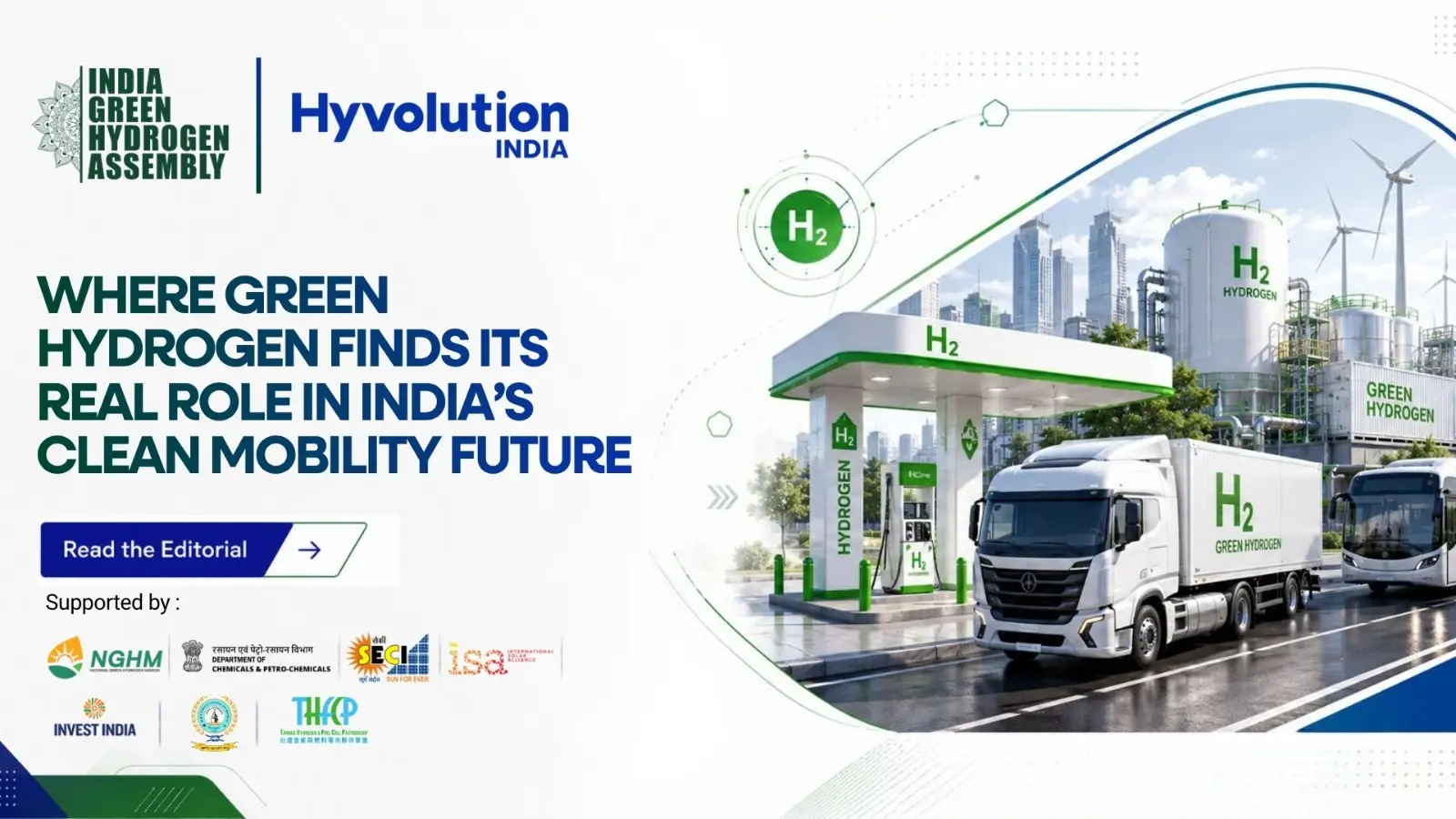
From the Editorial Desk IGHA – Hyvolution India 2026 – 21 August, 2026
There is a question I keep coming back to whenever we talk about green hydrogen and mobility.
Do we really need hydrogen everywhere?
I don’t think we do.
India’s mobility market is simply too diverse for one technology to become the answer to everything. What works beautifully for a two-wheeler in Bengaluru may make little sense for a truck carrying 35 tonnes between Delhi and Mumbai.
EVs already have a strong case in several categories. CBG and other cleaner fuels will find their own applications. Hydrogen, too, needs to find the places where it solves a real problem—not merely where it can technically be used.
And this is where heavy-duty and long-haul transport becomes interesting.
The truck is a very different customer
A truck operator doesn’t buy a technology because it is green.
He buys an asset that has to work.
How far will it go? How long will refuelling take? How much payload will I lose? Where will I refuel? What happens if it breaks down? And, eventually, what does every kilometre cost me?
Those questions change the hydrogen discussion completely.
A battery-electric solution can work extremely well when vehicles have predictable daily ranges and enough downtime to charge. But the equation becomes more complicated when a heavy truck has to travel several hundred kilometres, carry maximum payload and get back on the road quickly.
That is one reason the Government itself has singled out long-haul heavy-duty mobility as an area for green hydrogen pilots under the National Green Hydrogen Mission.
And I think “pilot” is the important word here.
India shouldn’t rush to declare hydrogen the winner. We should test it properly.
Put the trucks on the road. Then look at the numbers.
This is already happening.
Under the National Green Hydrogen Mission, hydrogen-fuelled buses and trucks are being tested using both fuel-cell and hydrogen internal-combustion technologies. The first set of projects sanctioned by MNRE included 37 vehicles and nine hydrogen refuelling stations across multiple routes.
This matters more than another technology presentation or ambitious projection.
Because Indian roads will tell us what a spreadsheet cannot.
How does a hydrogen truck perform in our heat? What happens to efficiency with a full load? What is the actual hydrogen consumption per kilometre? How reliable is the vehicle after thousands of kilometres? What does maintenance look like? And, most importantly, can a fleet operator eventually make money running it?
Those are the numbers I want to see.
I would watch corridors, not the whole country
This, for me, is where India’s hydrogen mobility strategy could become much more practical.
We don’t need thousands of hydrogen stations scattered across India on day one.
Start with corridors.
Take a route connecting a port, steel plant, refinery, logistics park or large industrial cluster. You already have concentrated freight movement. If hydrogen is also being produced or consumed within that industrial ecosystem, the economics become far more interesting.
A relatively small number of strategically located refuelling stations could then serve vehicles travelling repeatedly along the same route.
Interestingly, the National Green Hydrogen Mission itself envisages Green Hydrogen mobility corridors, with hydrogen supply and refuelling infrastructure developed along routes connecting hydrogen hubs.
That, to me, makes considerably more commercial sense than trying to replicate the petrol-pump network immediately.
Build demand first. Build infrastructure around that demand. Then expand.
Hydrogen doesn’t have to beat the EV
We sometimes turn this discussion into an unnecessary competition: battery versus hydrogen.
I don’t see it that way.
If batteries are more economical for a particular vehicle category, use batteries.
If CBG works better somewhere else, use CBG.
But when we come to long-distance, heavily loaded vehicles operating for long hours, hydrogen deserves to be tested seriously.
The Government’s own Green Hydrogen Mission describes hydrogen-fuelled long-haul vehicles as one pathway for decarbonising mobility. At the same time, the Mission is concentrating its efforts on hard-to-abate applications rather than suggesting that hydrogen should replace every transport fuel.
That distinction matters.
Green hydrogen doesn’t need the entire mobility market to become commercially important.
It needs the right part of it.
But there is still an elephant in the room: cost
We can talk about range and refuelling all day, but eventually somebody has to pay for the hydrogen.
And today, that remains one of the biggest questions.
The economics will depend not only on the truck but on renewable electricity, electrolyser costs, hydrogen production, storage, transportation and dispensing.
This is why I believe mobility should not be looked at as an isolated hydrogen market.
Suppose a large industrial cluster is already producing green hydrogen for a refinery, fertiliser unit or steel plant. A logistics corridor operating around the same cluster could potentially draw from that ecosystem.
Now the hydrogen station isn’t sitting alone waiting for a handful of trucks.
It becomes part of a larger hydrogen economy.
That is a much more interesting proposition.
The National Green Hydrogen Mission is actually being built around this broader ecosystem approach—production, electrolyser manufacturing, hydrogen hubs, infrastructure and pilot applications. MNRE has earmarked ₹496 crore for mobility pilots alone.
And this is where the industry conversation should now move
We have spent enough time asking whether a vehicle can run on hydrogen.
Of course it can.
The harder questions are now commercial.
What will hydrogen cost at the pump?
Which freight routes can support the first viable hydrogen corridors?
Fuel cell or hydrogen ICE—which works better under Indian operating conditions?
Who invests in the refuelling infrastructure before vehicle volumes arrive?
Can industrial hydrogen hubs and mobility share infrastructure?
And the biggest one:
At what point does a fleet owner choose a hydrogen truck without needing to be persuaded by a subsidy?
These are exactly the conversations I would like to see gaining prominence at IGHA – Hyvolution India 2026.
Because bringing hydrogen producers, vehicle manufacturers, fleet operators, technology companies, infrastructure developers, investors and policymakers into the same room can help move the discussion from possibility to practicality.
India does not need to prove that hydrogen can move a truck.
We need to find out whether we can build an ecosystem where thousands of those trucks can move goods every day—and do so competitively.
That is the real test.
And perhaps that is where green hydrogen will find one of its strongest places in India’s mobility transition.
Government sources referenced
Ministry of New and Renewable Energy — National Green Hydrogen Mission and transport pilot guidelines
National Green Hydrogen Mission – MNRE
Green Hydrogen Transport Pilot Guidelines – MNRE
Government of India — 70 hydrogen vehicles and 16 refuelling stations across 21 routes
PIB: Hydrogen Mobility Pilot Projects, July 2026
Ministry of Road Transport & Highways — Hydrogen-powered heavy-duty truck trials
PIB: Hydrogen Heavy-DutyTruck Trials
NITI Aayog — Heavy-duty freight and green hydrogen analysis
Transforming Trucking in India – NITI Aayog
Harnessing Green HydrogenOpportunities for Deep Decarbonisation in India – NITI Aayog
Frequently Asked Questions
1. Where does green hydrogen make the most sense in India’s mobility sector?
Green hydrogen appears particularly relevant for applications such as heavy-duty and long-haul transport, where vehicle utilisation, range, payload and refuelling time become important considerations. The National Green Hydrogen Mission specifically identifies long-range heavy-duty mobility for pilot deployment.
2. Can green hydrogen replace EVs in India?
It does not necessarily have to. India is likely to need multiple clean-mobility technologies. Battery-electric vehicles can serve many passenger and shorter-range applications, while hydrogen could find a stronger role in selected heavy-duty, high-utilisation and long-distance operations.
3. Why is green hydrogen being considered for heavy-duty trucks?
Long-haul trucks operate very differently from passenger vehicles. Range, payload, vehicle downtime and fast refuelling all affect commercial viability. India’s Green Hydrogen Mission therefore proposes phased deployment of hydrogen-powered buses and trucks to understand these factors under actual operating conditions.
4. Are hydrogen trucks already being tested in India?
Yes. Under the National Green Hydrogen Mission, five pilot projects involving 37 hydrogen-powered buses and trucks and nine hydrogen refuelling stations have been sanctioned. Trials cover ten routes across India and include both fuel-cell and hydrogen internal-combustion vehicles.
5. What are Green Hydrogen Mobility Corridors?
The Mission envisages corridors connecting hydrogen hubs, supported by hydrogen supply arrangements and sufficient refuelling infrastructure. This corridor approach could allow hydrogen mobility to develop around concentrated demand rather than requiring a nationwide refuelling network immediately.
6. What will determine whether hydrogen trucks become commercially viable in India?
The real test will be total operating economics: hydrogen price, vehicle cost, fuel efficiency, utilisation, maintenance, payload, infrastructure availability and reliability. India’s current pilots are intended partly to generate the technical and economic evidence needed for future commercial deployment.
7. What is the difference between hydrogen fuel-cell trucks and hydrogen ICE trucks?
Fuel-cell vehicles convert hydrogen electrochemically into electricity to power an electric drivetrain. Hydrogen internal-combustion-engine vehicles burn hydrogen in an adapted combustion engine. Interestingly, India’s current pilots include both technologies—15 fuel-cell vehicles and 22 hydrogen-ICE vehicles.
8. How much is the Government investing in green hydrogen mobility pilots?
Under the National Green Hydrogen Mission, ₹496 crore was allocated for mobility pilot projects up to 2025–26.
9. Could industrial hydrogen hubs support hydrogen mobility?
Potentially, yes. This is one of the more commercially interesting possibilities. The Mission itself envisages mobility pilots within Green Hydrogen Hubs and corridors connecting these hubs, allowing production, industrial demand and mobility infrastructure to develop within a more integrated ecosystem.
10. What is the biggest challenge for green hydrogen mobility in India?
The challenge is no longer simply proving that hydrogen can power a vehicle. The bigger question is whether India can make the entire operating ecosystem commercially competitive—from affordable green hydrogen and dependable vehicles to storage, distribution and refuelling infrastructure.