From the Editorial Desk IGHA – Hyvolution India 2026 – 31 August, 2026
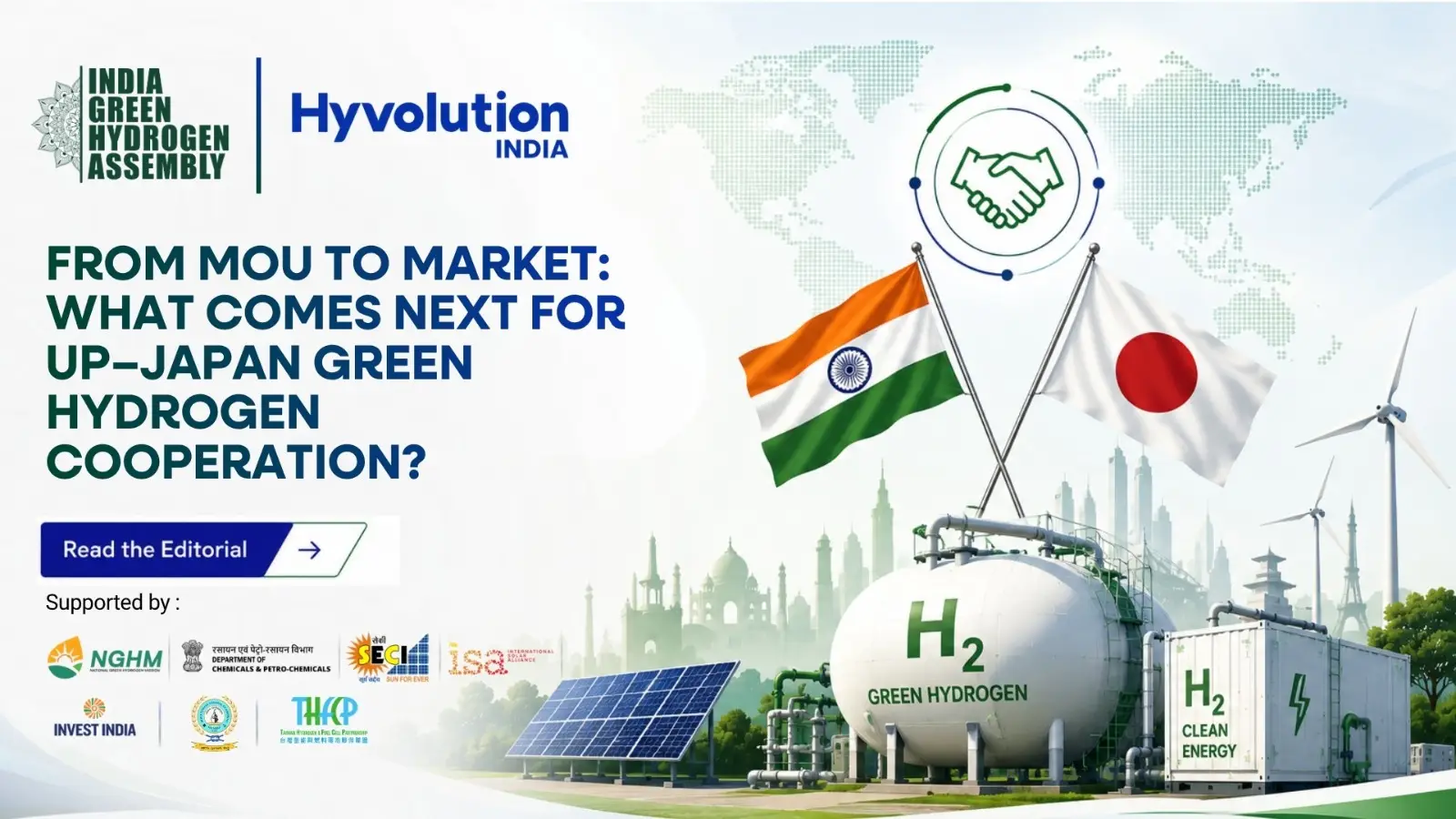
What does the UP–Japan green hydrogen MoU mean for India?
The partnership could help connect Japanese hydrogen technology and operating experience with India’s growing project, manufacturing and research ecosystem. Its longer-term value will depend on whether cooperation results in technology transfer, skilled manpower, local capability and commercially viable green hydrogen projects.
There has been no shortage of green hydrogen announcements in India over the past few years. Targets have been announced, projects proposed, partnerships signed and investment numbers discussed.
So another MoU, by itself, would hardly be remarkable.
But the latest green hydrogen agreement between Uttar Pradesh and Japan’s Yamanashi Prefecture is worth watching for a different reason. There is some continuity behind it.
The Uttar Pradesh New and Renewable Energy Development Agency (UPNEDA) and Yamanashi have agreed to expand cooperation in green hydrogen, renewable energy and clean technologies. The discussions cover technology, research, training, capacity building and investment.
What makes this interesting is that the two sides have already spent time building the relationship.
Back in December 2024, Uttar Pradesh and Yamanashi had entered into an MoU on green hydrogen cooperation. By February 2025, discussions had moved into fairly practical areas—production, storage, transportation and the possibility of developing a Centre of Excellence.
That engagement gathered pace this year.
A Yamanashi delegation visited Uttar Pradesh in January and discussed technology transfer, technical support and collaboration around proposed Green Hydrogen Centres of Excellence. IIT Kanpur and IIT (BHU) Varanasi were among the institutions brought into these discussions.
Then, during Chief Minister Yogi Adityanath’s Japan visit in February, the delegation visited Yamanashi’s Power-to-Gas green hydrogen facility. Further cooperation around research, innovation and skill development followed.
That sequence is more important than the ceremony surrounding any one agreement.
Why Yamanashi is an interesting partner
There is a practical fit here.
Yamanashi has experience with Power-to-Gas and hydrogen technologies. Uttar Pradesh, on the other hand, has a large industrial base, significant hydrogen demand and a state policy that is actively trying to attract green hydrogen and green ammonia projects.
According to the Uttar Pradesh Green Hydrogen Policy 2024, existing hydrogen demand in the state is around 0.9 million tonnes a year, largely from fertiliser and refinery operations. The state has set an objective of building green hydrogen/green ammonia production capacity of up to 1 million tonnes annually by 2028.
That gives the partnership a potentially useful starting point: there are industries that already understand hydrogen and consume it.
The issue is how much of that conventional hydrogen demand can eventually be replaced by commercially viable green hydrogen.
And this is where the discussion becomes more serious.
Technology transfer will matter more than technology demonstration
India does not need green hydrogen technology merely to be demonstrated here.
It needs to learn how to manufacture it, operate it, maintain it and bring its cost down.
That is why the emphasis on training and Centres of Excellence deserves attention.
The state has been discussing research, technology transfer and technical support with the Japanese side, rather than treating the relationship purely as an investment pitch.
If that leads to Indian engineers working alongside Japanese technology teams, students receiving practical exposure, universities undertaking industry-led research and eventually components or systems being manufactured locally, the partnership begins to have much greater value.
Otherwise, it risks remaining another technology cooperation announcement.
Uttar Pradesh has also put a policy framework behind the ambition
The state is not approaching hydrogen without a policy base.
Its Green Hydrogen Policy provides a range of incentives and also calls for Centres of Excellence, a dedicated single-window system and supporting land, water and transmission infrastructure.
The policy architecture is there.
What the market will now want to see is conversion.
Which projects reach financial closure? Where will the first meaningful production come up? Who will buy the hydrogen? At what delivered price? And how much of the equipment and engineering can ultimately come from within India?
Those questions matter far more now than another capacity announcement.
The next stage should be measured in projects, not MoUs
There is a broader lesson here for India’s green hydrogen journey.
International partnerships are going to be important. India cannot—and need not—develop every technology independently. Japan, Europe and several other markets have accumulated valuable experience in electrolysers, storage, hydrogen handling, fuel cells and industrial applications.
But the strongest international partnerships will be those that leave something tangible behind in India.
A trained workforce.
A technology that has been tested under Indian operating conditions.
Local manufacturing capability.
A commercially operating project.
Perhaps eventually, intellectual property developed jointly here.
For the Uttar Pradesh–Yamanashi relationship, those should now be the benchmarks.
The groundwork has been underway for some time. The policy exists. Academic institutions are being brought in. Japanese technology partners are showing interest, and the latest MoU adds another layer to that engagement.
The announcement, therefore, is not really the story.
What gets built next is.
And as India’s hydrogen market moves from policy ambition towards actual deployment, these are precisely the conversations that will matter at IGHA – Hyvolution India 2026: who has the technology, who can manufacture it, where the demand will come from, who will finance the projects—and which partnerships can actually survive the journey from an MoU to a working plant
FAQs
1. What is the Uttar Pradesh–Japan green hydrogen partnership?
Uttar Pradesh and Japan’s Yamanashi Prefecture are strengthening cooperation in green hydrogen, renewable energy and clean technologies. The engagement covers areas such as technology development, research, training, capacity building and investment.
2. Why is Yamanashi important to the green hydrogen sector?
Yamanashi has experience in Power-to-Gas and hydrogen technologies, including the production, storage and use of hydrogen. This makes its technical experience relevant as India moves towards larger-scale green hydrogen deployment.
3. Is this the first green hydrogen agreement between Uttar Pradesh and Yamanashi?
No. The relationship has been developing over time. Uttar Pradesh and Yamanashi had already established green hydrogen cooperation, with subsequent discussions covering technology transfer, research, training and Centres of Excellence.
4. What are the proposed Green Hydrogen Centres of Excellence?
The proposed Centres of Excellence are intended to support areas such as green hydrogen research, innovation, skill development and technical collaboration. Academic institutions have also been part of discussions around building this ecosystem.
5. What is Uttar Pradesh’s green hydrogen target?
Under the Uttar Pradesh Green Hydrogen Policy 2024, the state aims to develop green hydrogen and green ammonia production capacity of up to 1 million tonnes per year by 2028.
6. Why does technology transfer matter for India’s hydrogen industry?
India will need more than access to international hydrogen technologies. Developing domestic engineering knowledge, skilled manpower, manufacturing capability and experience operating hydrogen projects under Indian conditions will be important for long-term competitiveness.
7. What will determine whether the UP–Japan partnership is successful?
The real measure will be what follows the agreements: joint research, operational Centres of Excellence, technology deployment, investment, local manufacturing, skilled workforce development and, ultimately, commercially operating hydrogen projects.