
From the Editorial Desk IGHA – Hyvolution India 2026 – 9 September, 2026
At a Glance
- India has created strong momentum around green hydrogen production, electrolyser manufacturing and large-scale projects.
- But manufacturing capacity and project announcements alone will not create a functioning hydrogen economy.
- L&T’s decision to wait before expanding its electrolyser capacity from 400 MW to 1 GW brings the demand question into focus.
- At the same time, emerging applications in refining, fertilisers, steel and shipping show where demand could begin to take shape.
- The next phase will be about offtake, price, finance and connecting producers with real customers.
For the past few years, India’s green hydrogen conversation has largely started with supply.
How much hydrogen can we produce? How much electrolyser capacity can we manufacture? Can India become a major exporter of green ammonia?
All valid questions.
But the industry is reaching a stage where another question matters just as much:
Who is going to buy it?
L&T’s recent decision to hold its electrolyser manufacturing capacity at 400 MW rather than immediately expanding to 1 GW is a useful signal. The company has not walked away from expansion. It has said it can scale when market demand justifies doing so.
That difference matters.
It suggests that the challenge ahead may be less about whether India can build hydrogen technology and more about whether the market can create enough dependable demand for it.
Supply can be built. Demand takes more work.
India’s National Green Hydrogen Mission has created a strong foundation. The country is targeting at least 5 million metric tonnes of annual green hydrogen production capacity by 2030, while the SIGHT programme has supported domestic electrolyser manufacturing.
But the commercial chain has to work from both ends.
An electrolyser manufacturer needs orders.
A hydrogen project needs customers.
A customer needs reliable supply at a price that makes commercial sense.
And an investor needs confidence that someone will keep buying the hydrogen long enough for the project to generate a return.
That is where the next phase of the market becomes more complicated.
There probably won’t be one hydrogen market
Green hydrogen demand is unlikely to appear everywhere at once.
It will probably develop sector by sector.
Refineries already consume conventional hydrogen, so replacing some of that with green hydrogen provides an obvious starting point.
Fertiliser plants already use ammonia, giving green ammonia an identifiable market.
Steel could become one of the biggest opportunities, although the economics and technology pathways are more complex.
Shipping offers another route, particularly around ports and defined green corridors. Heavy mobility could similarly develop around specific freight routes rather than requiring a nationwide hydrogen-refuelling network from the beginning.
This is why industrial clusters and hydrogen hubs are so important.
Instead of producing hydrogen and then searching for a customer hundreds of kilometres away, production can develop closer to industries that already have a reason to use it.
Shipping shows how demand can become real
The two hydrogen-powered cargo vessels being built by Chowgule Shipbuilding in Goa for Norway’s Green Maritime Infrastructure provide an interesting example.
The significance is not simply that the ships will use hydrogen.
There is a defined application behind them.
The vessels are intended for commercial coastal operations. Freight customers have been identified, while hydrogen supply infrastructure is being developed around Norway’s maritime ecosystem.
In other words, the pieces are beginning to connect.
A vessel creates fuel demand. Fuel demand supports hydrogen production. Infrastructure connects the two. And a paying customer gives the entire chain a commercial purpose.
India will need similar models — around ports, refineries, fertiliser clusters, steel-producing regions and potentially heavy-transport corridors.
The sectors may differ, but the principle is the same:
connect hydrogen supply with a credible buyer.
Then comes the difficult question: price
There is no getting around hydrogen economics.
Companies want to decarbonise, but they also have businesses to run.
If green hydrogen significantly increases the cost of steel, fertiliser, chemicals or transport, somebody has to absorb that difference.
That is why early price discovery matters.
L&T’s FY2025-26 reporting points to early commercial green hydrogen prices of around ₹279–336/kg and a green ammonia benchmark of around ₹49.75/kg through SECI auctions.
Those prices will change as renewable power costs, electrolyser utilisation, technology, financing and project scale improve.
But price discovery does something important: it moves the discussion from “What might green hydrogen cost?” to “Can we build a business case around this price?”
That is when a market starts becoming real.
Why IGHA – Hyvolution India 2026 matters now
This shift from ambition to commercialisation is precisely why platforms such as IGHA – Hyvolution India 2026 have become important.
The next set of hydrogen challenges cannot be solved by producers alone.
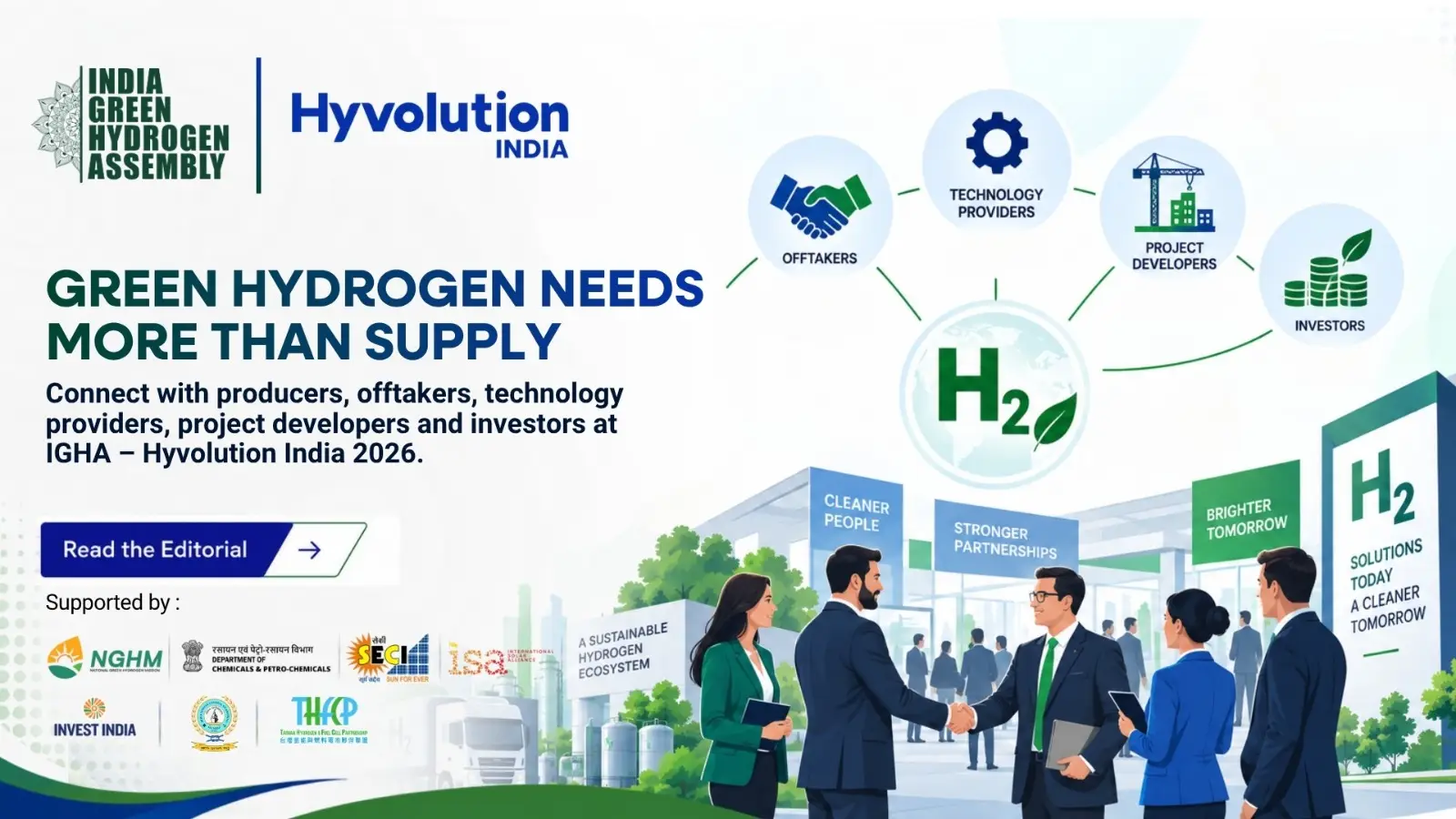
Producers need offtakers. Offtakers need competitive prices. Developers need finance. Investors need bankable projects. Technology providers need orders. And everyone needs infrastructure and policy clarity.
Bringing these stakeholders into the same room creates an opportunity to move beyond broad targets and discuss what will actually get projects built.
For companies participating in the hydrogen economy, the value is not simply visibility. It is the possibility of finding the technology partner, buyer, investor, project developer or market connection that turns an opportunity into something commercially tangible.
India has already done considerable work to create hydrogen ambition.
Now comes the harder — and arguably more important — phase.
Can projects find customers? Can producers reach competitive prices? Can manufacturers build against real orders? Can investors see dependable revenue?
India has spent years asking:
How much green hydrogen can we produce?
The question that could define the next few years is much simpler:
How much can we actually sell — and who will buy it?
FAQs
1. What is the biggest challenge facing India’s green hydrogen market today?
The challenge is increasingly shifting from creating production capacity to building reliable demand. Projects need long-term buyers, commercially workable prices and credible offtake arrangements to move from announcement to execution.
2. Which industries could become the largest buyers of green hydrogen in India?
Early demand is expected from refineries, fertilisers, steel and chemicals, where hydrogen or its derivatives already have clear industrial applications. Shipping and heavy mobility could create additional demand as infrastructure develops.
3. Why are long-term offtake agreements important for green hydrogen projects?
Offtake agreements provide greater certainty that the hydrogen produced will have a buyer. This can improve project bankability, financing prospects and investment confidence, while also giving manufacturers better visibility of future equipment demand.
4. Why will green hydrogen pricing be critical to market growth?
Industrial customers must remain competitive while decarbonising. The closer green hydrogen and its derivatives move towards commercially viable prices, the easier it becomes for businesses to commit to long-term procurement and for projects to attract investment.
5. How can IGHA – Hyvolution India 2026 help accelerate hydrogen demand?
IGHA – Hyvolution India 2026 brings producers, industrial offtakers, project developers, technology providers, investors, policymakers and infrastructure players together. The platform can help move conversations from production targets to real partnerships, offtake opportunities, financing and project execution.
Source:
https://investors.larsentoubro.com/upload/AnnualRep/FY2026AnnualRepLNTIARFY2026.pdf
https://www.hydrogen.no/aktuelt/nyheter/gmi-bestiller-to-nye-hydrogenskip