From the Editorial Desk IGHA – Hyvolution India 2026 – 17 September, 2026
The hydrogen industry has a habit of measuring progress in tonnes and gigawatts. Useful numbers, certainly. But sometimes a much smaller project tells you more about where the market is actually going.
Two cargo vessels being built in Goa are a good example.
In September 2026, Chowgule and Company’s Shipbuilding Division signed a contract with Green Maritime Infrastructure for two hydrogen-powered cargo vessels. Each vessel is around 3,000 DWT and will use hydrogen fuel-cell propulsion. A related contract with eCap Marine covers the integrated hydrogen systems, including compressed-hydrogen storage, PEM fuel cells rated at 1.2 MW per vessel, power management, controls and safety systems. The vessels are expected to enter service in 2029, primarily in Norwegian coastal waters.
Two ships will not transform the global hydrogen market. But look at the commercial chain behind them.
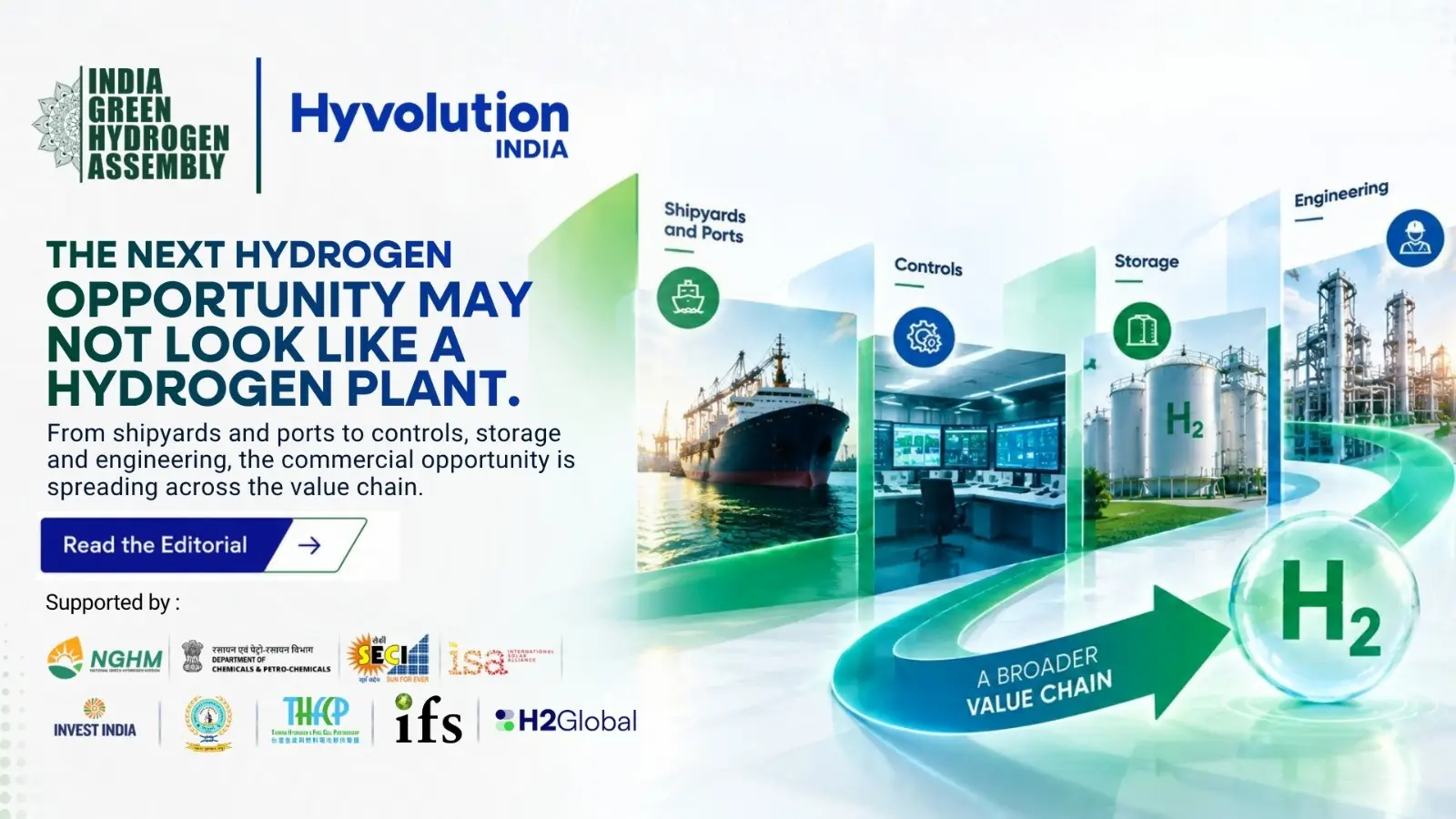
There is a shipyard in India. A vessel owner. A hydrogen-system supplier. Fuel-cell technology. Storage. Power electronics. Controls. Safety engineering. Classification and approvals. Future fuel supply. Port and bunkering requirements. And customers that ultimately need the vessels to move cargo.
That is what a hydrogen economy looks like when it begins leaving the strategy document.
It is also a useful reminder for companies deciding whether the hydrogen market is relevant to them. The opportunity is much wider than producing the molecule.
India will need companies that manufacture equipment, integrate systems, design plants, certify components, manage water, provide renewable electricity, compress and store hydrogen, handle ammonia and methanol, build ports, develop software, monitor safety, finance projects and move molecules from production centres to users.
The infrastructure story is already becoming visible. Earlier this year, the government approved a dedicated jetty at Paradip Port for green hydrogen, ammonia and other liquid cargo, with planned handling capacity of 4 million tonnes per annum. India has also notified green-ammonia and green-methanol standards, while the National Green Hydrogen Mission is supporting pilot applications across steel, shipping and mobility.
For exhibitors, this widening value chain changes how the market should be approached.
A company does not need to sell an electrolyser to have a hydrogen proposition. It may supply a compressor, sensor, membrane, rectifier, valve, coating, analytical instrument, safety system, software platform or engineering service that becomes essential when a project moves from concept to operation. The challenge is making the right buyers and integrators aware of that capability.
That is why exhibition presence matters. It lets a specialist company explain where it fits in the system rather than hoping a procurement team finds it through a search result. It also allows larger companies to discover smaller suppliers, Indian partners and technologies that may solve very specific project problems.
For visitors, the same value chain creates a different opportunity: comparison.
A shipowner exploring alternative fuels needs more than a fuel supplier. A port needs to think about handling, storage and safety. An industrial buyer needs to understand the difference between plant-gate price and delivered cost. A developer needs technology that can be financed and serviced. An investor needs to know whether the supply chain around a project is mature enough to support execution.
Those questions rarely sit neatly inside one conference session or one company presentation. They cut across the market.
IGHA – Hyvolution India 2026 is particularly relevant in that context because its exhibition and programme are designed around an ecosystem: production, demand, technology, infrastructure, finance and international market connections. With 150+ exhibitors targeted, 7,000+ trade visitors and participation expected from 30+ countries, the floor can become a place where one project requirement connects with another company’s capability.
The international dimension matters as well. The Goa vessel contract is a reminder that India’s hydrogen opportunity is not confined to domestic consumption. Indian engineering and manufacturing can participate in global decarbonisation projects even when the hydrogen is ultimately used thousands of kilometres away.
That creates a more interesting question for companies attending IGHA – Hyvolution India.
Not simply: “How large will India’s hydrogen market become?”
But: “Which part of this value chain can we own?”
For an exhibitor, the answer may be a technology, component, engineering capability or partnership that needs market visibility. For a visitor, it may be a supplier, investment opportunity or technical solution worth bringing into a future project. For an international company, it may be an Indian manufacturing or delivery partner. For an Indian company, it may be an export relationship that did not exist before the meeting.
That is why the most useful hydrogen events now need to do more than celebrate ambition. They need to make the value chain visible.
A pair of ships in Goa shows what happens when technology, manufacturing, a customer and an application finally connect.
The next hydrogen opportunity may arrive in the form of a refinery contract, a fertiliser offtake, a port terminal, a fleet, a ship — or a component nobody notices until the project cannot run without it.
The companies that understand those connections early will have a much better chance of finding where they belong in the market. IGHA – Hyvolution India 2026 is where many of those connections can begin.
FAQs
1. Why is the Goa hydrogen-vessel project significant?
It demonstrates how Indian shipbuilding can participate in an international zero-emission project and shows that hydrogen demand creates opportunities across systems, storage, controls, safety and engineering.
2. Is the hydrogen opportunity limited to producers and electrolyser manufacturers?
No. The value chain includes renewable power, engineering, storage, compression, instrumentation, testing, safety, software, ports, logistics, finance and many specialist components and services.
3. Why are ports important to the hydrogen economy?
Hydrogen derivatives such as green ammonia and methanol may require dedicated storage, handling and bunkering infrastructure, particularly as domestic and export markets develop.
4. How is this relevant to exhibitors at IGHA – Hyvolution India?
Exhibitors can show where their capability fits in real projects and meet developers, buyers, integrators and international partners who may need that capability.
5. How is it relevant to visitors?
Visitors can compare technologies and suppliers across multiple layers of the value chain rather than evaluating hydrogen as a single product or isolated technology.
Current News & Reference Sources
India Shipping News — Chowgule Shipbuilding signs contract with GMI for two hydrogen-powered cargo vessels — https://indiashippingnews.com/ship-building/chowgule-shipbuilding-signs-contract-with-gmi-for-two-hydrogen-powered-cargo-vessels-at-smm-hamburg-2026/
India Shipping News — GMI awards eCap Marine contract for two additional hydrogen-powered bulk carriers — https://indiashippingnews.com/international-shipping/gmi-awards-ecap-marine-contract-for-two-additional-hydrogen-powered-bulk-carriers/
PIB — Centre Approves ₹797 Crore Green Hydrogen Jetty at Paradip Port — https://www.pib.gov.in/PressReleasePage.aspx?PRID=2233235&lang=1®=3