From the Editorial Desk IGHA – Hyvolution India 2026 – 29 September, 2026
An exhibitor perspective, ahead of IGHA – Hyvolution India 2026, 17–18 November, India Expo Mart, Delhi NCR.
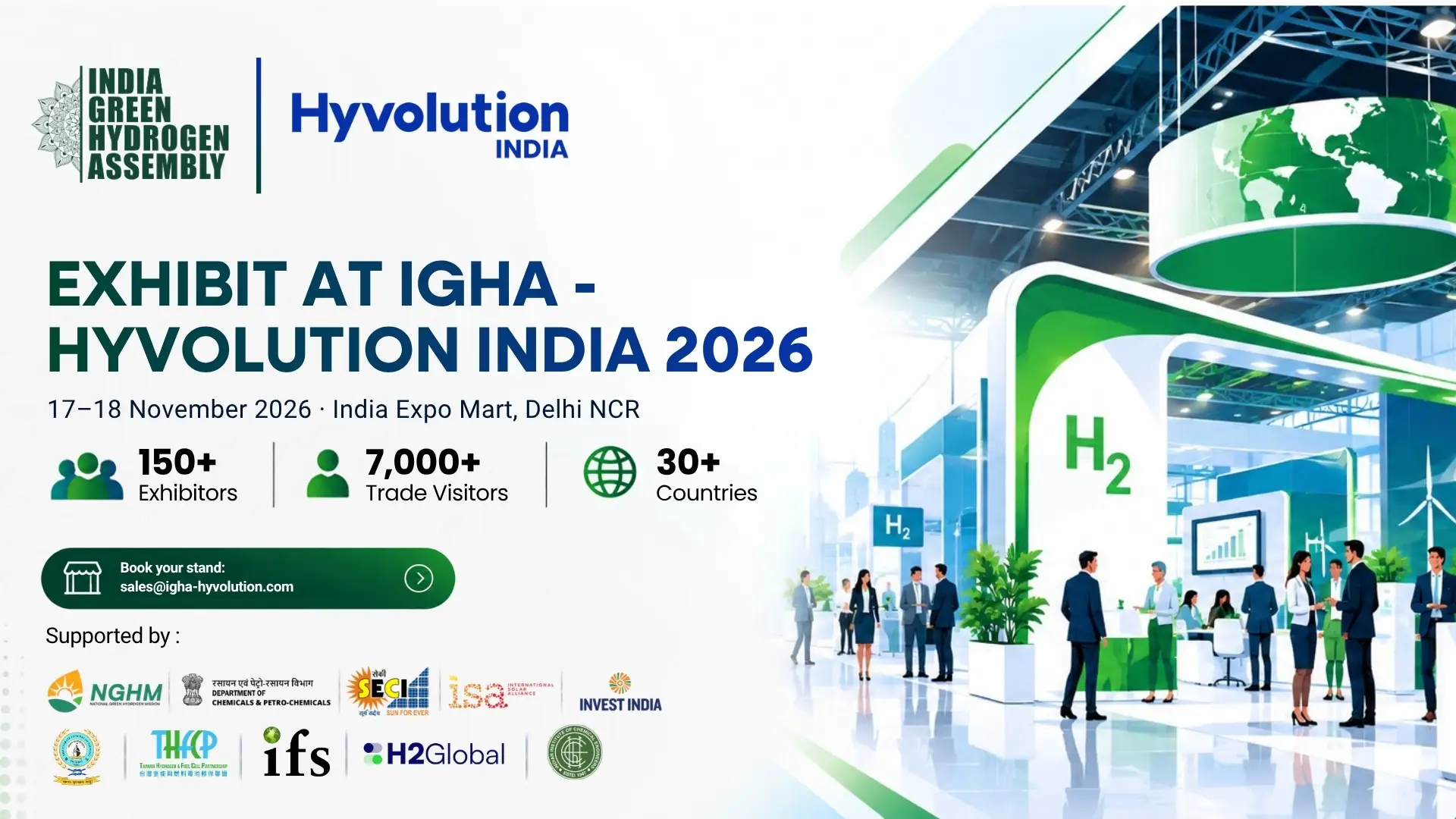
EXHIBIT AT IGHA – HYVOLUTION INDIA 2026 · 17–18 November 2026 · India Expo Mart, Delhi NCR · 150+ exhibitors, 7,000+ trade visitors, 30+ countries · Book your stand: sales@igha-hyvolution.com
On 17 July, a ten-coach passenger train pulled out of Jind station in Haryana running on hydrogen. The coverage that followed went where you would expect it to go. No diesel. No overhead wire. Water vapour at the tailpipe. Room for roughly 2,600 passengers, which makes it the largest-capacity hydrogen train anywhere in service. All of it true, and all of it worth the applause it received.
If you sell into the energy sector, though, that is not the story worth reading twice. The story is the list of names behind the machine.
Indian Railways ran the programme. RDSO wrote the technical specification. The Integral Coach Factory in Chennai designed and built the trainset. Medha Servo Drives, out of Hyderabad, carried the system integration, which is the unglamorous discipline on which fuel cell programmes quietly succeed or fail. At Jind, a hydrogen plant holding around 3,000 kg of storage makes the fuel by electrolysis, fed by a dedicated 11 kV supply.
Four organisations. All Indian. That is not an accident, and it is not a one-off. It is a template, and it tells you something useful about how this market intends to buy.
Look past the train and you find a procurement list
Take the engineering apart and what you are actually looking at is a bill of materials. A proton exchange membrane stack. Onboard cylinders rated for the pressures involved. Compression and dispensing equipment at the refuelling point. Multi-layer detection for hydrogen leaks, heat, flame and smoke. Traction electronics. Thermal management. Water treatment sitting upstream of the electrolyser. Testing and certification at every stage, because a passenger train carries a safety burden no demonstration plant ever has to.
Every one of those lines is somebody’s product. Most of them are somebody’s product that has not yet been specified into the next project.
Now scale it. Indian Railways has already told Parliament what follows Jind: 35 hydrogen trains under the Hydrogen for Heritage programme, estimated at roughly ₹80 crore per train, with a further ₹70 crore of ground infrastructure for each route. The Kalka–Shimla line is under study on the strength of what the Jind project taught them. On trainsets alone that is in the region of ₹2,800 crore, before a rupee of refuelling infrastructure is counted. The pilot that got the country here, a fuel cell retrofit on a DEMU rake, was sanctioned at ₹111.83 crore.
And rail, let us be honest, is the smallest of India’s hydrogen demand sectors.
Rail is the rehearsal. The main performance is industrial.
The five sectors that will actually consume Indian hydrogen at scale are fertilisers, refining, steel, shipping and mobility. Each one is already past the discussion stage.
India’s refiners have moved from evaluation to procurement: 30,000 tonnes a year of green hydrogen has been tendered, with Numaligarh Refinery clearing at ₹279 per kilogram through NeuEn Green Energy, HPCL Visakh and BPCL Bina at ₹328 through OCIOR Energy, and Indian Oil Panipat at ₹397 through L&T Energy GreenTech. On the ammonia side, IFFCO, Coromandel International, Paradeep Phosphates, Krishna Phoschem, Madhya Bharat Agro, Indorama and Mangalore Chemicals have all signed as offtakers under the SIGHT auctions, with discovered prices starting at ₹49.75 per kilogram.
Those are not memoranda of understanding. They are contracts with delivery obligations attached, and delivery obligations are what build supply chains. Somebody has to supply the electrolysers, the compressors, the storage, the piping, the instrumentation, the balance of plant, the EPC capability and the certification that turns all of it into an operating asset.
India has over 7 million tonnes of standing hydrogen demand today. It is the world’s third-largest hydrogen market, and it is on course to be the second largest by 2035. The greening of that demand is the industrial procurement event of the decade in this country, and it is being sourced right now.
Why a floor beats a pitch deck
Here is the practical problem every supplier in this space runs into. The buyer you need is not one person. It is a project developer, a consultant who wrote the specification, an EPC contractor who will issue the purchase order, a lender who has to be comfortable with your technology, and a plant engineer who will have to live with it for twenty years. Reaching all five by email takes a quarter. Reaching all five in a hall takes an afternoon.
That is the entire argument for IGHA – Hyvolution India 2026. On 17 and 18 November at India Expo Mart in Delhi NCR, the event is built to convene over 150 exhibitors, more than 7,000 trade visitors, 500-plus organisations, over 1,000 delegates and participation from more than 30 countries. Jointly organised by GH2 India and GL events, it carries the support of the Government of India’s National Green Hydrogen Mission, with the International Solar Alliance, SECI, the Department of Chemicals and Petro-Chemicals, the Directorate General of Shipping and Invest India among the supporting agencies.
The agenda itself is shaped by a Strategic Advisory Committee drawn from the people who sign things: a former Secretary at MNRE, a former Chairman of Indian Oil, the chairmen of the V.O. Chidambaranar and Deendayal Port Authorities, the former Director for Hydrogen and Fuel Cells at the US Department of Energy, and senior technology leadership from AM Green, ACME, Avaada, Hero Future Energies, thyssenkrupp nucera and John Cockerill Greenko, among others.
What exhibiting actually gets you
A stand at this event is a 3 metre by 3 metre shell scheme, 9 square metres, available in premium and standard configurations. The premium build comes with a customised fascia, a wooden reception counter with storage and front branding, back wall branding, carpet flooring, seven spotlights, a glass round table with two chairs, a bar stool, a 5 amp socket, 1 KVA of power and three exhibitor passes. The standard build covers the same footprint with a vinyl letter-cut fascia, an octonorm table, two director chairs, five spotlights, the same power provision and the same three passes. Side wall branding and customisation run through empanelled booth builders.
Locations are allocated in the order confirmations come in, which is the only genuine scarcity in an exhibition and the one most companies discover too late.
The train at Jind proved that India can specify, build, integrate and operate hydrogen technology on home soil. The next question the market is asking is who supplies the second one, and the thirty-fifth, and the refinery electrolyser after that. If your company has an answer to that question, November is where you say it out loud, to the people who are writing the specifications.
To discuss exhibition space, write to sales@igha-hyvolution.com or visit igha-hyvolution.com.
Frequently Asked Questions
When and where is IGHA – Hyvolution India 2026 taking place?
IGHA – Hyvolution India 2026 will be held on 17 and 18 November 2026 at India Expo Mart, Delhi NCR. It is jointly organised by GH2 India and GL events, and is supported by the Government of India’s National Green Hydrogen Mission, with the International Solar Alliance, SECI, the Department of Chemicals and Petro-Chemicals, the Directorate General of Shipping and Invest India among the supporting agencies. Full details are available at igha-hyvolution.com.
Which companies should exhibit at IGHA – Hyvolution India 2026?
The exhibition is built for organisations that supply the green hydrogen value chain: electrolyser manufacturers, fuel cell and stack suppliers, compression, storage and dispensing specialists, safety and instrumentation providers, EPC and engineering firms, renewable energy developers, water treatment and balance-of-plant suppliers, port and logistics operators, certification and testing bodies, and technology providers serving fertilisers, refining, steel, shipping and mobility. If your product appears anywhere on the bill of materials for a hydrogen project, the floor is relevant to your order book.
Who will exhibitors actually meet at the event?
The event is set to convene over 150 exhibitors, more than 7,000 trade visitors, over 500 organisations, more than 1,000 delegates and participation from over 30 countries. That audience includes policymakers, project developers, offtakers from the fertiliser and refining sectors, electrolyser manufacturers, EPC contractors, financiers, port authorities, certification bodies and international delegations from India’s principal export markets in Europe, Japan, Korea and Singapore.
What is included in an exhibition booth at IGHA – Hyvolution India 2026?
Stands are 3 metres by 3 metres, 9 square metres, offered in premium and standard shell scheme configurations. The premium build includes a customised fascia with vinyl print, a wooden reception counter with storage and front branding, back wall branding, carpet flooring, seven spotlights, a glass round table with two chairs, a bar stool, a 5 amp power socket, 1 KVA power supply and three exhibitor passes. The standard build includes a 9 square metre shell scheme booth, carpet flooring, a vinyl letter-cut company name on the fascia, an octonorm table, two foldable director chairs, five spotlights, a 5 amp socket, 1 KVA power supply and three exhibitor passes. Additional branding and customisation are arranged through empanelled booth builders.
Why is November 2026 the right time for suppliers to be present in India?
Because the procurement decisions are being taken now. India’s refiners have already tendered 30,000 tonnes a year of green hydrogen, and fertiliser majors including IFFCO, Coromandel International and Paradeep Phosphates have contracted green ammonia under the SIGHT scheme. Roughly 770 KTPA of capacity and 5.4 GW of electrolysers are under construction, with a further 8,393 KTPA and 57.44 GW in pre-construction. Projects with commercial dates in 2027 and 2028 are selecting equipment and shortlisting vendors during 2026 and 2027.
How do I book exhibition space or request the floor plan?
Write to sales@igha-hyvolution.com or visit igha-hyvolution.com to request the exhibitor kit and current floor plan. Stand positions are allocated in order of confirmation, so preferred locations are best secured early. For conference, speaking and delegate enquiries, contact conference@igha-hyvolution.com.
Sources and references
Ministry of Railways statements on the Jind–Sonipat hydrogen trainset, including the PEM fuel cell architecture and the RDSO, ICF and Medha Servo Drives roles, July 2026.
Press coverage of the flag-off at Jind railway station, 17 July 2026 (Business Today; Swarajya).
Railway Minister’s replies in Parliament on the DEMU retrofit pilot (₹111.83 crore) and the Hydrogen for Heritage programme, as reported by The Tribune and Deccan Herald.
Jind hydrogen plant commissioning details, Deccan Herald, January 2026.
IGHA – Hyvolution India 2026 event presentation: overview, demand sectors, SIGHT auction outcomes and refinery tender results.