
From the Editorial Desk IGHA – Hyvolution India 2026 – 1 October, 2026
Large hydrogen announcements naturally attract attention. But industrial transitions are rarely decided by the biggest number on a press release. They are decided on operating sites, where engineers have to make a new system work alongside an existing one, safely and economically, without disrupting production.
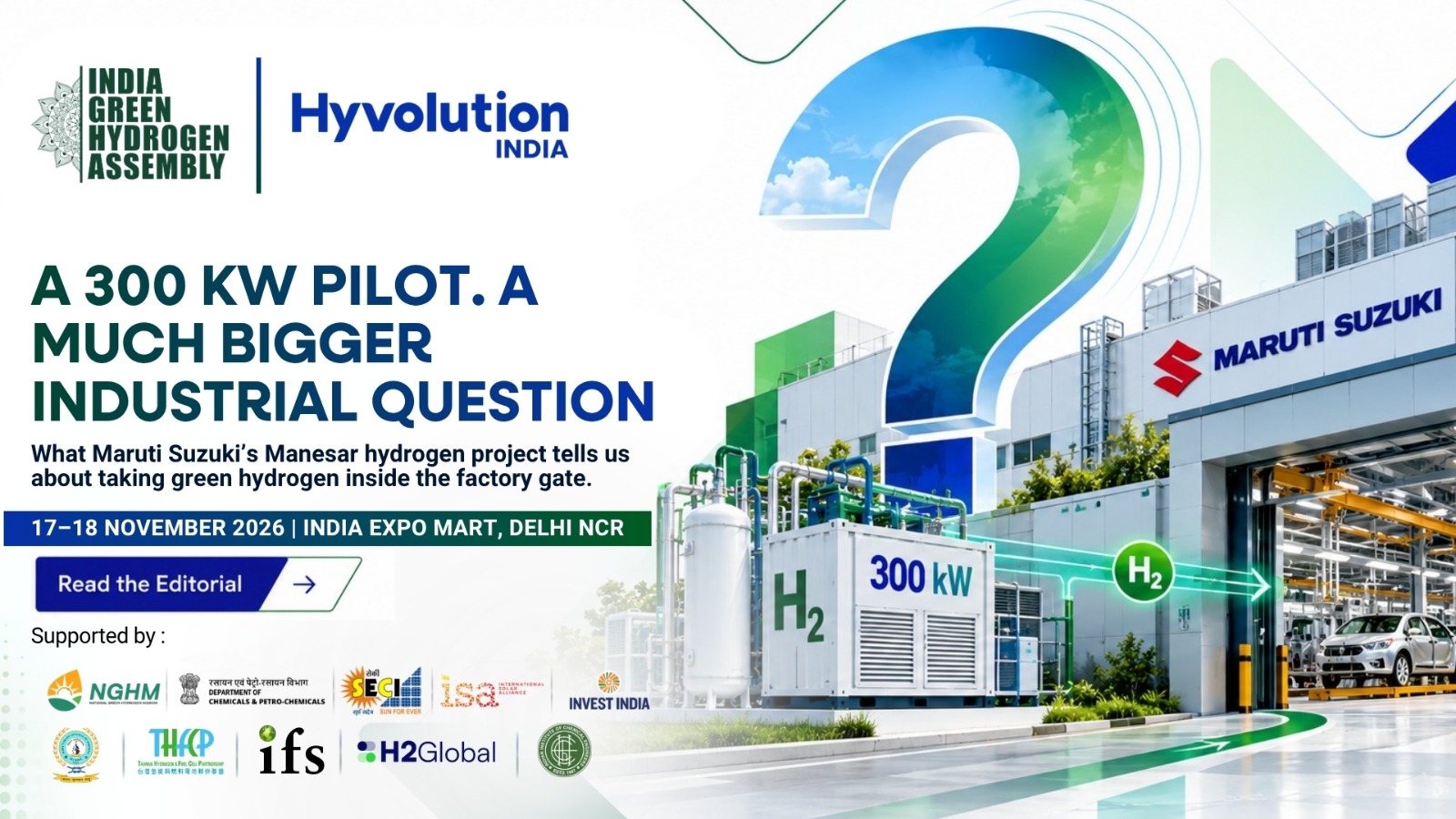
That is what makes Maruti Suzuki’s new green hydrogen installation at Manesar worth watching. The company has commissioned a 300 kW pilot plant at its Haryana manufacturing facility, using surplus solar electricity to produce hydrogen. At first glance, 300 kW looks modest beside the multi-megawatt and gigawatt-scale projects now discussed across India. In practice, its importance lies elsewhere: it moves hydrogen from a strategy presentation into an industrial environment.
The distinction matters. Manufacturing sites do not buy decarbonisation in the abstract. They buy equipment, power, reliability, maintenance support and measurable operating outcomes. A pilot allows a company to understand how hydrogen production behaves under real conditions: when renewable electricity is available, how the system responds to changing loads, what storage is required, how hydrogen is handled on site and where it can sensibly displace a conventional fuel.
For India’s hydrogen market, this is precisely the kind of learning that is needed now. The National Green Hydrogen Mission has created policy direction and a large project pipeline. The next challenge is adoption. Refineries and fertiliser plants are obvious early users because hydrogen is already part of their process. Manufacturing is more varied. Each factory has a different heat profile, power requirement, safety environment and economics. That means the route to adoption will not be identical from one plant to another.
Maruti Suzuki’s pilot also highlights a point that is sometimes lost in the discussion around electrolyser capacity: green hydrogen begins with electricity. If surplus renewable power can be converted into hydrogen instead of being curtailed or left under-used, the molecule becomes part of a broader energy-management strategy. The economics, however, depend on utilisation. An electrolyser that operates only occasionally has a very different cost profile from one supplied with predictable renewable power.
This is where the market becomes interesting for technology companies. The industrial hydrogen opportunity is not limited to electrolyser manufacturers. It includes power electronics, rectifiers, transformers, water treatment, purification, compression, storage, valves, sensors, controls, fire and gas detection, engineering, certification, maintenance and digital energy management. Once hydrogen enters an operating factory, integration becomes as important as production.
That should also change the way suppliers approach customers. A buyer is unlikely to be persuaded by a generic claim that hydrogen is clean. The useful conversation is much more specific: What process are you trying to decarbonise? What renewable-power profile do you have? What purity is required? How much space is available? What safety architecture is needed? What is the expected utilisation? Who will service the equipment five years from now?
These are exactly the conversations that become easier when industrial users, project developers and technology providers meet in the same place. IGHA–Hyvolution India 2026, scheduled for 17–18 November at India Expo Mart, Greater Noida, arrives at a useful moment. The Indian market has moved beyond simply explaining green hydrogen. It now needs to compare approaches, understand operating experience and decide which solutions can survive commercial scrutiny.
For exhibitors, the Manesar story is a reminder not to present a booth as a catalogue. Industrial visitors want to understand where a solution fits. A company selling storage should be able to discuss duty cycles and safety. A controls company should show how it manages variable renewable input. An engineering business should be ready to explain integration with an existing plant. The strongest exhibition conversations are likely to begin with the customer’s operating problem, not the supplier’s product list.
For trade visitors, a live exhibition compresses the learning curve. A procurement or engineering team can compare technologies, ask competing suppliers the same technical questions and see how different parts of the system connect. That is difficult to achieve through individual sales calls. It is even harder when a market is developing quickly and specifications are still evolving.
Delegates have a different reason to pay attention. Small industrial pilots can reveal what policy and finance need to solve at scale. If renewable electricity is the constraint, the discussion moves toward open access, transmission and storage. If equipment utilisation is the problem, project design changes. If safety approvals or standards slow deployment, industry and government need a common framework. If the economics only work for a narrow set of applications, the market needs to be honest about where hydrogen should—and should not—be used.
That last point is important. Green hydrogen does not need to be presented as the answer to every industrial energy requirement. Its credibility will grow faster if companies identify the applications where it solves a genuine decarbonisation problem and prove performance there.
The Manesar plant is therefore interesting not because 300 kW transforms India’s hydrogen market. It does not. It is interesting because it represents the work that comes before transformation: testing, integrating, measuring and learning. India will need large production projects, but it will also need hundreds of practical decisions inside factories about where hydrogen makes operational and commercial sense.
By November, those decisions will be increasingly relevant to the people walking the IGHA–Hyvolution India exhibition floor. For a market moving from ambition to use, that is where the conversation should be.
FAQs
1. Why is a 300 kW hydrogen pilot relevant to a large market?
Because industrial adoption is built through operating experience. A pilot can test integration, utilisation, safety, renewable-power matching and the economics of a specific use case before larger capital is committed.
2. Does the Manesar project mean hydrogen will replace all industrial fuels?
No. Hydrogen is likely to be more suitable for some processes than others. Commercial use will depend on cost, process requirements, renewable-power availability and competing decarbonisation options.
3. What opportunities does industrial hydrogen create for exhibitors?
Beyond electrolysers, projects require electrical systems, water treatment, compression, storage, controls, instrumentation, safety, engineering, certification and maintenance.
4. Why should industrial buyers visit IGHA–Hyvolution India 2026?
It gives engineering, procurement and sustainability teams a place to compare technologies and discuss integration questions with multiple suppliers in person.
5. Why should technology suppliers exhibit?
Industrial users increasingly want application-specific answers. Exhibiting creates an opportunity to demonstrate how a solution performs within a real project rather than relying on broad product claims.
6. When and where is IGHA–Hyvolution India 2026?
17–18 November 2026 at India Expo Mart, Greater Noida, Delhi NCR, India.