
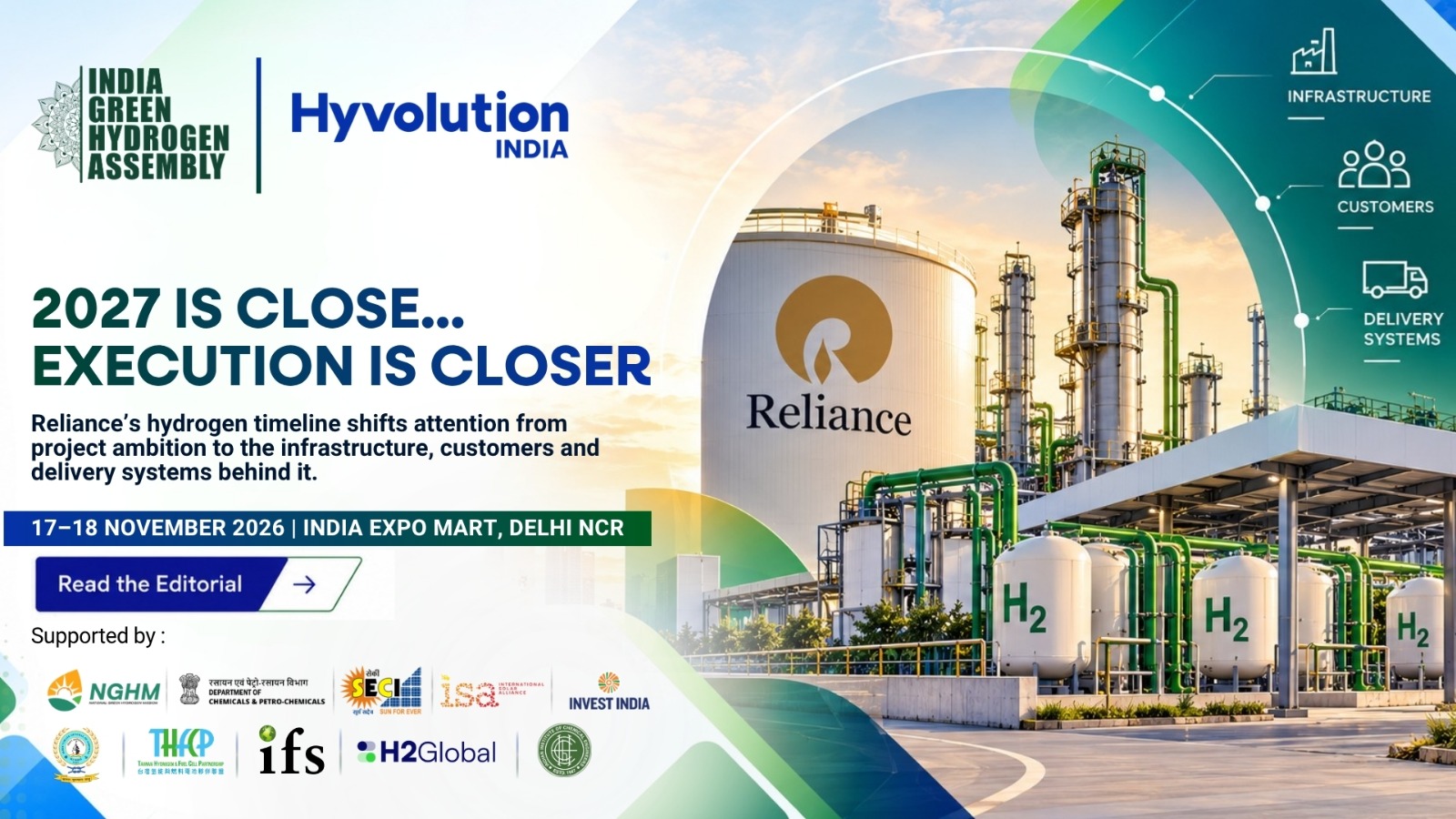
From the Editorial Desk IGHA – Hyvolution India 2026 – 2 October, 2026
Hydrogen has spent several years being discussed in future tense. Capacity will be built. Costs will fall. Export corridors will emerge. Industrial demand will scale. Reliance Industries has now attached a more immediate clock to that conversation.
In an interview published by S&P Global Energy on 28 September 2026, Rahul T.R., vice president for strategy and planning in Reliance’s new energy business, said the company expects renewable hydrogen production to begin in 2027, with a ramp-up toward commercial offtake in 2028. Renewable generation is planned in Kutch, while hydrogen and ammonia facilities are envisaged at Jamnagar, Kandla and other coastal locations.
The headline is the production date. The more revealing part is what sits behind it. Reliance identified transmission infrastructure as an important execution risk. That sounds prosaic beside the scale of a hydrogen project, but it goes to the heart of the economics. Electrolysers need electricity; green hydrogen needs renewable electricity; and renewable generation is often located far from the industrial site where the molecule will be produced or consumed.
A project can therefore be ready on paper and still wait for the physical system that connects generation to production. Lines, substations, transformers, grid connectivity and approvals are not peripheral issues. They are part of the hydrogen plant.
Reliance is pursuing an integrated model. S&P Global reported that the company has licensed alkaline electrolyser technology from Norway’s Nel and is establishing electrolyser manufacturing in Gujarat. Hydrogen is expected to support domestic use at the Jamnagar refinery, renewable ammonia production and potentially mobility applications, while export markets remain part of the longer-term picture.
The company has also secured 138,000 tonnes per annum of renewable hydrogen production capacity under government support schemes, according to the S&P Global report. At the same time, the distance between today’s market economics and long-term cost ambitions remains substantial. S&P Global noted a Platts India renewable-hydrogen term assessment of $3.19/kg on 24 September 2026, while Reliance continues to reference its longer-term ambition of $1/kg.
That gap should not be treated as a footnote. It is the work programme for the industry. Electricity cost, equipment utilisation, financing, transmission, water, storage, compression, project scale, efficiency and dependable offtake all influence the final number. There is no single technology intervention that makes those variables disappear.
This is why the Indian market feels different in late 2026. Policy has already created scale. Government material shows substantial green-hydrogen production and electrolyser-manufacturing capacity awarded under the National Green Hydrogen Mission. The question now is what reaches financial close, construction and operation—and how quickly.
For suppliers, that changes the sales conversation. A developer moving toward construction is no longer looking only for an impressive specification. It is asking about delivery schedules, warranties, local service, integration, operating flexibility and bankability. The opportunity expands beyond the electrolyser to electrical equipment, balance of plant, water systems, compression, storage, controls, safety, certification, ports and logistics. But the standard of proof rises as well.
For industrial buyers, the Reliance timeline is equally useful. It shows that domestic demand and export ambition can develop together. Refineries, fertilisers, steel, shipping and mobility will not all adopt hydrogen at the same pace, nor will they accept the same price. A credible market will have to match different forms of supply with different customer economics.
That makes IGHA–Hyvolution India 2026 particularly relevant. On 17–18 November, the event brings the policy, project, technology, investment and demand sides of the market into the same venue at India Expo Mart, Greater Noida. At this stage of the market, that combination matters more than another round of isolated announcements.
A delegate listening to a project developer should be able to ask what is actually holding up final investment. A financier should be able to challenge assumptions on utilisation and offtake. An industrial buyer should be able to compare supply models. A technology company should be able to explain not only efficiency but delivery, service and integration. A port or logistics provider should be part of the conversation before export infrastructure becomes a late-stage bottleneck.
Trade visitors can use the exhibition differently. Large projects become easier to understand when the component systems are visible. Electrolysers may attract the headline, but a functioning plant depends on rectifiers, transformers, cooling, purification, compression, storage, instrumentation, automation, fire and gas systems and a long list of engineering decisions. Seeing competing approaches in one place makes the project pipeline more tangible.
Exhibitors should take the same lesson from Reliance’s timeline: show where you fit in execution. “Hydrogen solution” is too broad. A useful booth answers a narrower question—what risk, cost or delivery problem does this technology remove for a project that is trying to operate in 2027, 2028 or 2029?
India does not lack hydrogen ambition. What it needs now is coordination between the organisations responsible for turning that ambition into assets. Reliance’s timetable makes the deadline feel less theoretical. The next two years will expose which parts of the ecosystem are ready and which still need work.
That is the discussion worth having in November: not whether green hydrogen has potential, but what has to happen next for projects to run, customers to buy and suppliers to deliver.
FAQs
1. When does Reliance expect renewable hydrogen production to begin?
S&P Global reported that Reliance expects production to start in 2027 and ramp toward commercial offtake in 2028.
2. Why is transmission important to hydrogen economics?
Renewable electricity often has to travel from generation sites to electrolysers. Delays or high costs in transmission can affect both project schedules and hydrogen cost.
3. What does the Reliance timeline mean for suppliers?
Projects moving closer to construction create demand for equipment and services across electrical systems, water, compression, storage, controls, safety, engineering and logistics.
4. Why is offtake central to project execution?
Long-term demand gives developers and financiers greater confidence in utilisation and revenue, which can improve project bankability.
5. What should delegates look for at IGHA–Hyvolution India?
Practical discussion around project finance, transmission, industrial demand, technology performance, certification, infrastructure and contracting—not only headline capacity targets.
6. When is IGHA–Hyvolution India 2026?
17–18 November 2026 at India Expo Mart, Greater Noida, Delhi NCR.