
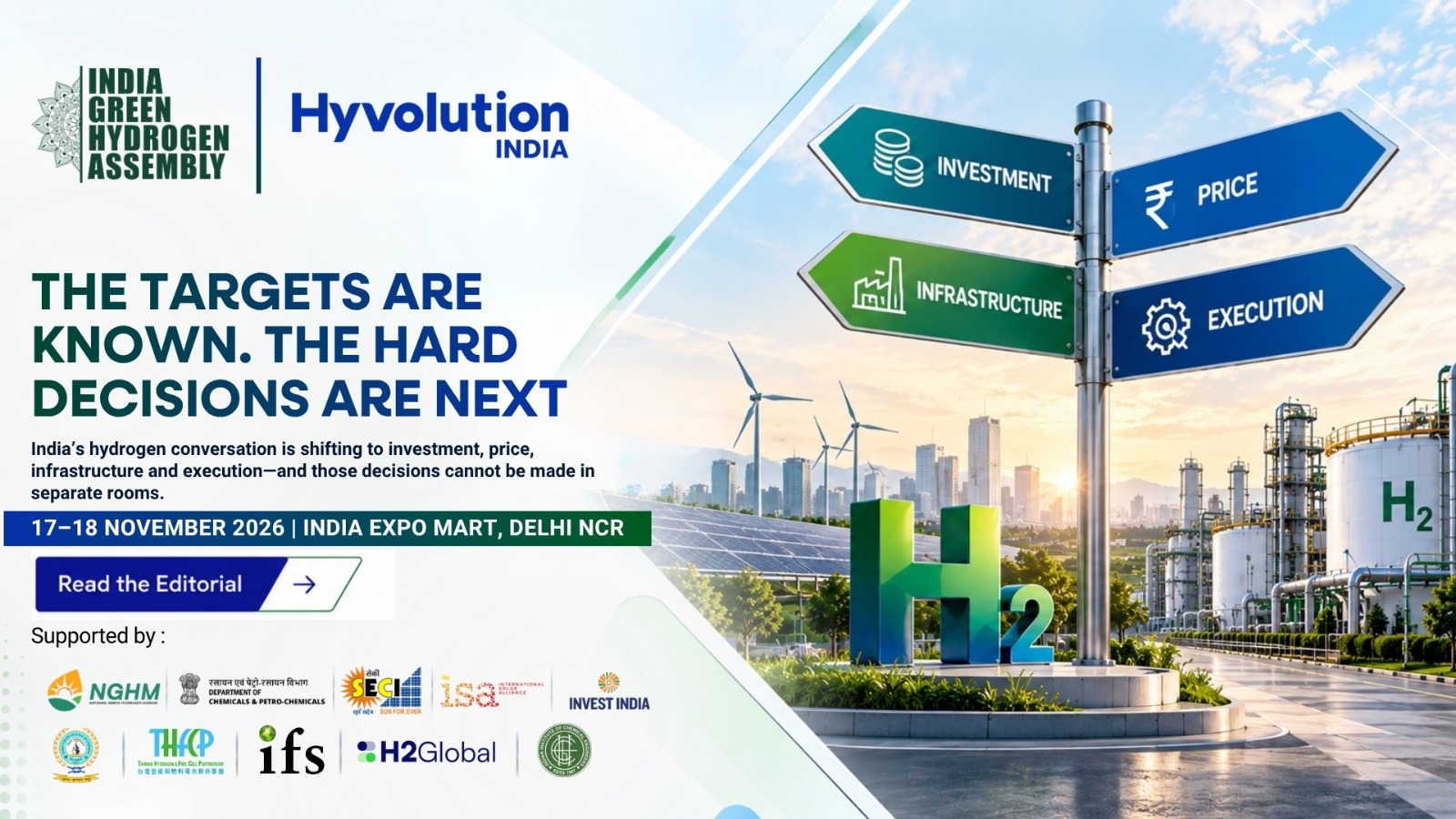
From the Editorial Desk IGHA – Hyvolution India 2026 – 5 October, 2026
For several years, a hydrogen conference could begin with the same slide: the size of the opportunity, the 2030 target and a map of proposed projects. In 2026, the useful conversation starts one step later.
Which projects can actually reach final investment decision? Who will buy the hydrogen, at what price and for how long? Can renewable power and transmission be delivered on schedule? Which infrastructure should be shared? How much technology risk will lenders accept? And where does hydrogen make economic sense before permanent subsidy becomes part of the business model?
Those are more difficult questions. They are also a sign of progress.
S&P Global Energy’s reporting from Horizons Clean Energy Expansion India in September described a sector increasingly focused on final investment and construction. Many projects remain early-stage, but the discussion has moved toward the conditions required for commercial delivery: affordable renewable electricity, infrastructure, credible demand, financing and policy certainty.
India already has a substantial policy base. The National Green Hydrogen Mission carries an initial outlay of ₹19,744 crore. Government programmes have awarded green-hydrogen production capacity and electrolyser-manufacturing capacity, while auctions and tenders have begun to create price signals in fertilisers and refining. Certification has also advanced, including the launch of India’s Green Hydrogen Certification Portal in 2026.
These are important building blocks. They do not make the economics automatic.
Hydrogen projects are unusually dependent on what happens outside the electrolyser. Electricity can dominate operating cost. Transmission can determine whether renewable generation reaches the plant when needed. Storage and compression affect both capex and efficiency. An export project may depend on a port, derivative conversion, certification and an overseas buyer. A refinery project has a different integration problem. A mobility project depends on vehicle utilisation and refuelling infrastructure.
The industry therefore has to resist the temptation to discuss “the hydrogen market” as if it were one market. Fertilisers, refining, steel, shipping and heavy mobility have different willingness to pay, different technical requirements and different alternatives. A project that is viable for one sector may be uneconomic for another.
This is why senior-level dialogue matters now. The remaining barriers do not sit neatly inside individual organisations. A developer cannot build a national transmission system. An electrolyser manufacturer cannot create industrial demand. A port cannot justify large infrastructure without expected throughput. A buyer cannot sign a long-term contract without confidence in supply and price. A bank cannot finance a project simply because the technology is strategically important.
The next phase is about interfaces: developer and buyer, producer and grid, project and port, technology and finance, policy and commercial reality.
IGHA–Hyvolution India 2026, taking place on 17–18 November at India Expo Mart, Greater Noida, has an opportunity to make those interfaces useful. The value of the event should not be measured only by the number of people in the room. It should be measured by whether delegates leave with a clearer view of what can move a project forward.
For policymakers, that means hearing where regulation or infrastructure is creating avoidable friction without assuming every commercial problem requires a subsidy. For developers, it means being candid about what is blocking FID. For offtakers, it means discussing the price, reliability and contract terms they can genuinely support. For financiers, it means separating technology risk from market risk. For technology companies, it means understanding which performance improvements buyers will actually pay for.
A good delegate agenda should therefore be uncomfortable in places. What is the realistic delivered cost of hydrogen for different Indian users? Which projects have a credible route to low-cost renewable power? What should happen when announced export demand does not convert on schedule? How should long-term contracts allocate price risk? Where is common infrastructure essential, and who should finance it? Which parts of the value chain are sufficiently localised today? What evidence will lenders require before backing newer technologies at scale?
The exhibition floor gives those strategic questions a physical counterpart. Delegates discussing storage can meet storage providers. A conversation about electrolyser flexibility can continue with manufacturers and power-electronics companies. Infrastructure discussions can include ports, engineering firms, valves, compression and logistics. Certification stops being a policy abstraction when exporters and standards specialists are in the same ecosystem.
For trade visitors, this is one of the strongest reasons to register. The market is moving quickly enough that desktop research can become fragmented. An exhibition allows engineering, procurement and business-development teams to see multiple parts of the chain at once, compare approaches and identify suppliers or partners that may not appear in a narrow online search.
Exhibitors, meanwhile, gain something beyond footfall: context. A supplier listening carefully to the conference can understand where project economics are tightening and adapt its commercial proposition accordingly. Is the customer worried about capex, efficiency, delivery time, local service, safety or integration? The answer determines what should be discussed at the booth.
India’s hydrogen opportunity remains significant, but significance alone will not finance a project or create a customer. The market is entering the period in which assumptions are tested against contracts, construction schedules and operating performance. Some projects will advance. Others will change shape or take longer than expected. That is normal for a new industrial market.
What matters is whether the ecosystem learns quickly enough to direct capital and effort toward the projects that can work.
By November, the most valuable conversations at IGHA–Hyvolution India will not be the ones that repeat the ambition. They will be the ones that clarify the next decision.
FAQs
1. What has changed in India’s hydrogen discussion in 2026?
Attention is increasingly moving from targets and announcements toward FID, construction, offtake, delivered cost, infrastructure and operating performance.
2. Why are different demand sectors likely to develop at different speeds?
Fertilisers, refineries, steel, shipping and mobility have different technical needs, incumbent fuels, willingness to pay and infrastructure requirements.
3. What should senior delegates expect from a useful hydrogen conference?
Evidence-led discussion of project economics, contracting, infrastructure, finance, technology risk, policy and real barriers to execution.
4. Why should trade visitors attend as well as delegates?
The exhibition allows technical and procurement teams to compare technologies and suppliers while understanding how individual solutions fit the wider project chain.
5. How can exhibitors benefit from the conference programme?
It provides market context: suppliers can hear what buyers, developers, financiers and policymakers consider the real constraints and adjust their proposition accordingly.
6. When and where will IGHA–Hyvolution India 2026 take place?
17–18 November 2026 at India Expo Mart, Greater Noida, Delhi NCR, India.