
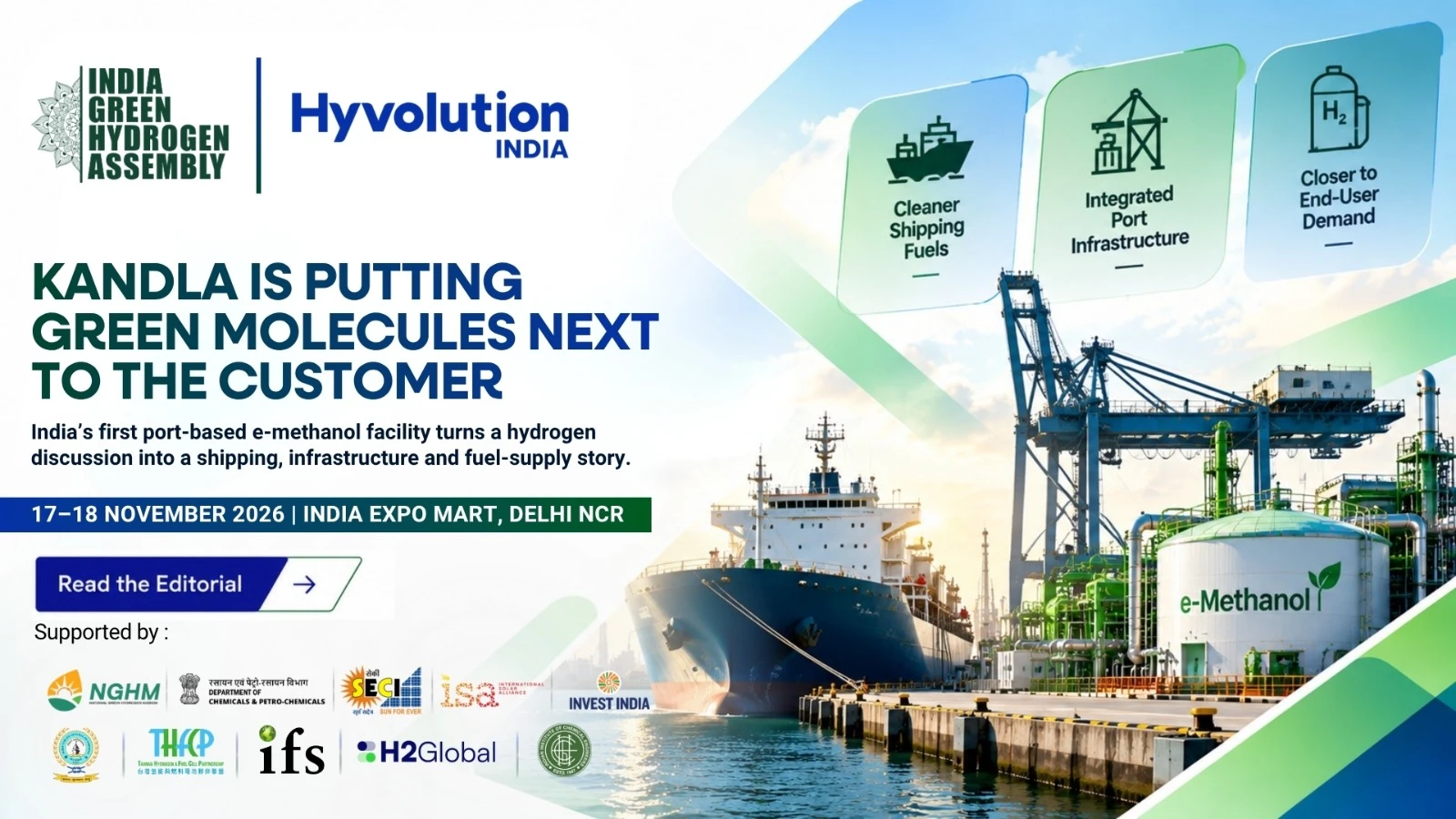
IGHA–Hyvolution India 2026 | 17–18 November 2026 | India Expo Mart, Greater Noida, Delhi NCR
Editorial intent: Hydrogen derivatives and maritime demand | Best suited to delegates, visitors, ports, shipping and infrastructure exhibitors
There is something useful about seeing a green-fuel project turn up at a port. It immediately answers one question that hangs over many hydrogen announcements: who might actually use the product?
At Deendayal Port Authority in Kandla, Gujarat, India is developing what has been described as its first port-based e-methanol production facility. The Maritime Executive reports a planned capacity of 150 tonnes a day once both phases are complete, with the first 50-tonne-per-day phase targeted ahead of a further 100 tonnes per day. The plant is being developed by Deendayal Port Authority and Assam Petro-Chemicals Ltd.
The location is the real story. E-methanol can take renewable hydrogen and convert it, with a suitable carbon source, into a liquid molecule that is far easier to handle than hydrogen gas. Put that production inside a port ecosystem and the link to shipping becomes immediate: storage, bunkering, marine customers and export logistics are all nearby.
Kandla has already been building towards that role. The port has green-hydrogen activity under way and has carried out a methanol bunkering demonstration. The new facility therefore does not arrive as an isolated experiment. It sits inside a broader attempt to make the port a green-fuel node on the Asia–Europe shipping corridor.
This is also a useful reminder that the hydrogen economy will not be built only by companies selling electrolysers. An e-methanol plant needs hydrogen production, of course, but it also needs water systems, carbon handling, synthesis equipment, tanks, pumps, valves, instrumentation, loading systems, safety equipment, fire protection, digital controls and marine logistics. Then come certification, fuel quality, lifecycle-emissions accounting and the commercial arrangements with shipowners or fuel buyers.
That is a much wider industrial opportunity than the phrase “green hydrogen” sometimes suggests.
The project also exposes the questions the market still has to answer. The Maritime Executive cites an ambition to produce methanol at a cost well below prevailing global levels. Whether that can be achieved consistently at commercial scale will depend on renewable electricity, utilisation, feedstock, financing and plant performance. The shipping customer will care about the delivered fuel price, not the attractiveness of the production story.
And shipping is not a forgiving market. Vessels trade across jurisdictions. Fuel specifications, safety rules and emissions accounting have to travel with them. A bunkering hub in India is therefore connected to decisions being made in Europe, Asia and at international maritime bodies. That makes standards and certification every bit as important as plant capacity.
This is where the Kandla development becomes highly relevant to IGHA–Hyvolution India 2026. A visitor looking at hydrogen technology can see the end-use chain more clearly: renewable power becomes hydrogen; hydrogen becomes methanol; methanol is stored, handled and potentially bunkered into ships. Each step has its own suppliers and its own economics.
For exhibitors, that creates several routes into the market. A storage company, process-equipment manufacturer, automation provider or safety specialist may have as much reason to be on the exhibition floor as an electrolyser OEM. The buyer may not be asking for “hydrogen technology” at all. It may be asking for a reliable loading system, a certified valve, a control package or an engineering solution for a methanol terminal.
For delegates, the questions are larger. Can Indian ports become competitive production and export centres for green molecules? Which fuel will shipping adopt at meaningful scale? How much infrastructure should ports build before long-term demand is contracted? And how should India balance export opportunity with domestic demand for green hydrogen and its derivatives?
Those questions do not have to be settled before investment starts, but they do have to be discussed by the people making the investments. That is why the mix of ports, producers, shipowners, technology firms, investors and policymakers matters at an event such as IGHA–Hyvolution India.
Kandla is valuable because it makes an abstract market visible. There is a site. There is a port. There is a product. There is a plausible customer base. There are still commercial risks, but the value chain can be drawn from one end to the other.
Green hydrogen will eventually be judged less by how many projects announce production capacity and more by how many customers can use the resulting molecule at a price that works. Kandla’s e-methanol project is not the final answer to that problem. It is, however, a much more concrete question to take into Greater Noida this November: if the customer is already at the port, what will it take to make the fuel competitive?
Questions readers may have
What is being built at Kandla?
A port-based e-methanol production facility at Deendayal Port Authority, being developed with Assam Petro-Chemicals Ltd.
Why is e-methanol part of the hydrogen economy?
Renewable hydrogen can be combined with an appropriate carbon source to produce e-methanol, turning hydrogen into a liquid fuel and chemical feedstock.
Why does a port location matter?
It places production close to storage, bunkering, shipping routes and potential export infrastructure, reducing some of the logistical complexity around green fuels.
Is the project already at full 150-tonne-per-day capacity?
No. The reported plan is phased: 50 tonnes per day first, followed by an additional 100 tonnes per day.
What is the opportunity for IGHA–Hyvolution India exhibitors?
The opportunity spans process equipment, tanks, pumps, controls, safety, engineering, certification, bunkering and logistics as well as hydrogen production technology.
What should delegates watch next?
Project commissioning, actual production economics, marine offtake, certification requirements and the development of methanol bunkering demand.
Sources
• The Maritime Executive – India to get its first port-based e-methanol production facility