From the Editorial Desk · IGHA – Hyvolution India 2026 – 18 August, 2026
The Vizag transmission project is not a line on a map. It is the physical proof that India’s hydrogen economy is moving from ambition to construction.
On 14 August 2026 — with quiet efficiency and without the fanfare the moment deserves — the handover of the Vizag Power Transmission Special Purpose Vehicle from RECPDCL to Adani Energy Solutions marked something the Indian energy sector has been waiting years to see: dedicated, large-scale transmission infrastructure specifically commissioned to serve green hydrogen and green ammonia production.
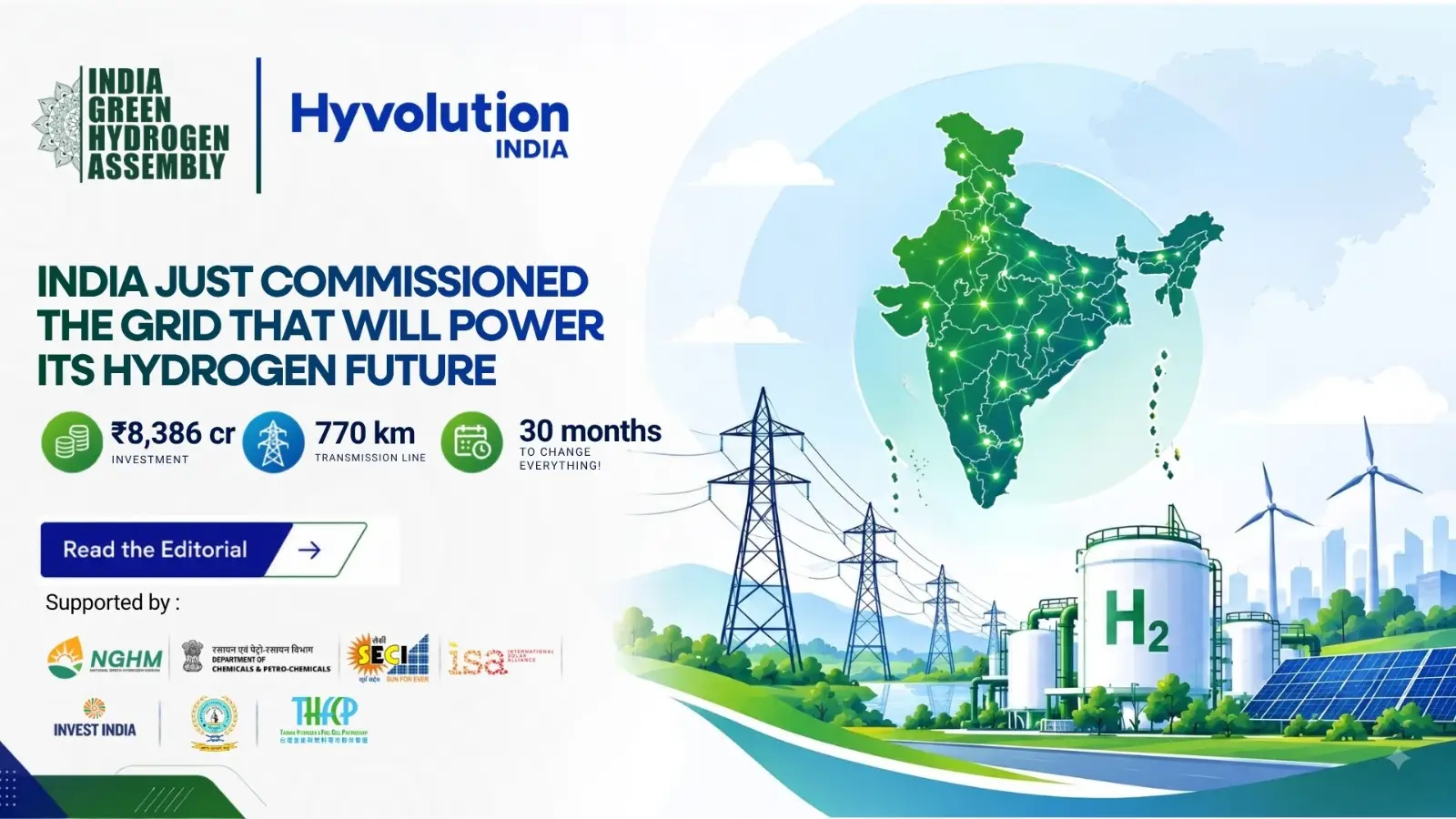
This is not a retrofit. It is not an adaptation of existing grid capacity. The ₹8,386 crore project — awarded through tariff-based competitive bidding and structured on a Build, Own, Operate and Transfer (BOOT) basis — exists for one reason: to move enormous quantities of power to and from the green hydrogen clusters that are being planned across Vizag and the surrounding areas of Andhra Pradesh.
If you have been following India’s National Green Hydrogen Mission and wondering when the physical infrastructure would start materialising, this is your answer.
What Exactly Was Handed Over
The Vizag Power Transmission SPV — a project-specific entity created for this purpose — was transferred by Rajkumar Sonkar of RECPDCL to Shashank Sharma, Chief Business Development Officer of Adani Energy Solutions, in the presence of senior officials from RECPDCL, Adani Energy Solutions, and the Central Transmission Utility of India.
The scope of what Adani Energy Solutions is now obligated to build within 30 months is substantial:
- 4 × 1,500 MVA, 765/400 kV Pendurthi GIS Substation — a gas-insulated switchgear substation at this capacity rating is utility-scale infrastructure of the highest order
- 3 × 1,500 MVA, 765/400 kV Khammam-II Substation
- 765 kV Double Circuit line from Pendurthi to Srikakulam — 226 km
- 765 kV Double Circuit line from Khammam-II to Warangal New — 153 km
- 765 kV Double Circuit line from Khammam-II to Pendurthi — 338 km
- 400 kV Double Circuit line from Khammam-II to Khammam (existing) — 60 km
Total transmission corridor length: over 770 route kilometres of high-voltage infrastructure across Andhra Pradesh, Telangana, and connecting nodes. Designed to carry the electricity loads that commercial-scale green hydrogen electrolysis will demand — and to evacuate power generated from the renewable energy projects that will feed those electrolysers.
The Larger Story: Why This Project Exists
Andhra Pradesh has moved faster and more decisively on green hydrogen than almost any other Indian state. The state’s hydrogen policy, its designation as an emerging green hydrogen manufacturing hub, and its geographic advantages — long coastline, port infrastructure at Vizag, Kakinada, and Gangavaram, and abundant solar and offshore wind potential — have made it a natural anchor for India’s emerging green hydrogen export industry.
The Vizag transmission project exists because the hydrogen projects that need it are real. SECI’s green ammonia supply tenders — which contracted 7,24,000 tonnes per year of green ammonia supply to 13 fertiliser units across India in March 2026 — require production capacity to be built. Several of the contracted projects are anchored in Andhra Pradesh. Without the transmission infrastructure to supply them with renewable power at scale, they cannot operate.
This is the critical sequencing problem of the energy transition, and it is the one that tends to get the least public attention. Power purchase agreements get signed. Production targets get announced. But unless someone builds the substations and the lines that move the electricity from where it is generated to where it is needed, the economics stay on paper.
Adani Energy Solutions, operating through the BOOT structure, is now on the hook to have this infrastructure operational within 30 months. That deadline matters — it is a contractual commitment, not a target.
What 765 kV Actually Means
A word on the voltage level, because it matters more than most coverage of this project acknowledges. India’s existing inter-state transmission network operates primarily at 400 kV. The move to 765 kV represents a step-change in transmission capacity — a single 765 kV circuit can carry roughly four times the power of a 400 kV circuit over the same corridor. For green hydrogen at scale, where a single large electrolyser facility might require 500 MW to 1 GW of dedicated electricity supply, 765 kV infrastructure is not overengineering. It is the minimum viable grid architecture.
The choice of gas-insulated switchgear (GIS) for both the Pendurthi and Khammam-II substations also reflects the design intent. GIS substations are compact, more reliable in high-humidity coastal environments, and suitable for the kind of dense, high-capacity electrical switching that hydrogen production hub integration requires. This is infrastructure designed to last decades and to handle future capacity additions, not just the initial phase.
My Read: The Transmission Announcement Is the Proof of Concept
Three years into India’s green hydrogen policy journey, the most persistent sceptic argument has been that the targets are aspirational but the infrastructure is not real. The land is not acquired, the power lines are not built, the substations do not exist. Policy documents are not hydrogen plants.
The Vizag Power Transmission SPV handover, at ₹8,386 crore and with a 30-month completion commitment from a company with Adani Energy Solutions’ execution track record, is a direct answer to that argument. The infrastructure is now contracted, funded, and under development. The developer has skin in the game.
What happens next — at the hydrogen production facilities that this grid is being built to serve — will determine whether India’s green hydrogen industry achieves the proof of scale that SECI’s managing director called for earlier this month. But the grid is coming. And without it, nothing else could.
Connection to IGHA – Hyvolution India 2026
The Vizag transmission project is exactly the type of infrastructure-market nexus story that will be front and centre at IGHA – Hyvolution India 2026 — scheduled for 17–18 November 2026 at India Expo Mart, Greater Noida, Delhi NCR. The event, listed on the National Green Hydrogen Mission official events calendar, will bring together the developers, infrastructure companies, project finance specialists, policymakers, and technology providers who are turning India’s hydrogen ambitions into executable projects.
If you are working on transmission infrastructure, green ammonia project development, renewable energy integration, or hydrogen project finance — the people you need to know are registering for November. The conversation about who builds the backbone of India’s green hydrogen economy is happening at #IGHAHYVOLUTIONINDIA2026.
Frequently Asked Questions
1. What is the Vizag Power Transmission project and who won the contract?
The Vizag Power Transmission project is a dedicated inter-state transmission system designed to support green hydrogen and green ammonia production in the Vizag area of Andhra Pradesh. Adani Energy Solutions won the contract through RECPDCL’s Tariff-Based Competitive Bidding (TBCB) process and received the SPV handover on 14 August 2026.
2. What is the total project value and construction timeline?
The project is estimated at ₹8,386 crore (approximately $870 million at current exchange rates) with a construction completion schedule of 30 months from SPV handover, structured on a Build, Own, Operate and Transfer (BOOT) basis.
3. What infrastructure does this project include?
The project includes two 765/400 kV GIS substations (4×1,500 MVA at Pendurthi and 3×1,500 MVA at Khammam-II), over 770 route kilometres of 765 kV and 400 kV double circuit transmission lines connecting Pendurthi, Srikakulam, Khammam-II, Warangal New, and existing Khammam substation.
4. Why is this project specifically designed for green hydrogen?
The project is titled ‘Transmission System for Proposed Green Hydrogen / Green Ammonia Projects in Vizag Area, Andhra Pradesh (Phase-I)’ — it was designed from the outset to provide the power transmission backbone for hydrogen production clusters planned in Andhra Pradesh, not retrofitted from general utility grid capacity.
5. What is RECPDCL and what is its role in this project?
REC Power Development and Consultancy (RECPDCL) is a wholly owned subsidiary of REC, a Maharatna Central Public Sector Undertaking under India’s Ministry of Power. RECPDCL served as the Bid Process Coordinator for the TBCB process and was responsible for creating and handing over the project-specific SPV to the successful bidder.
6. Why is 765 kV voltage level significant for green hydrogen applications?
A 765 kV transmission circuit can carry approximately four times the power of a 400 kV circuit over the same corridor. For commercial-scale green hydrogen production, where a single large facility may require 500 MW to 1 GW of electricity supply, 765 kV infrastructure is the appropriate grid architecture — not overengineering.
7. What green ammonia projects is this transmission infrastructure intended to serve?
The infrastructure is designed to serve the broader cluster of green hydrogen and green ammonia projects planned in the Vizag region of Andhra Pradesh. Several developers who won SECI’s green ammonia supply contracts — covering 7,24,000 TPA to 13 fertiliser units announced in March 2026 — have production facilities anchored in Andhra Pradesh.
8. How does this project connect to India’s National Green Hydrogen Mission?
The NGHM has set a target of 5 MMT of green hydrogen production per year by 2030 and ₹8 lakh crore+ in projected investments. Dedicated transmission infrastructure for hydrogen production clusters is a prerequisite for achieving those targets. The Vizag project is the first large-scale, TBCB-awarded transmission project specifically designed for green hydrogen — a direct implementation of the NGHM infrastructure mandate.
9. What is Adani Energy Solutions’ role in India’s energy transition beyond this project?
Adani Energy Solutions is one of India’s largest power transmission companies, with a portfolio spanning thousands of kilometres of transmission lines and multiple substations across the country. The Vizag hydrogen transmission win marks the company’s formal entry into purpose-built hydrogen infrastructure, alongside its existing clean energy transmission portfolio.
10. Where can hydrogen infrastructure professionals discuss these developments with peers and policymakers?
IGHA – Hyvolution India 2026 on 17–18 November at India Expo Mart, Greater Noida, Delhi NCR, brings together transmission infrastructure developers, green hydrogen project developers, policymakers from MNRE and state governments, and project finance specialists — all working on exactly these questions. Register at igha-hyvolution.com. #IGHAHYVOLUTIONINDIA2026.