
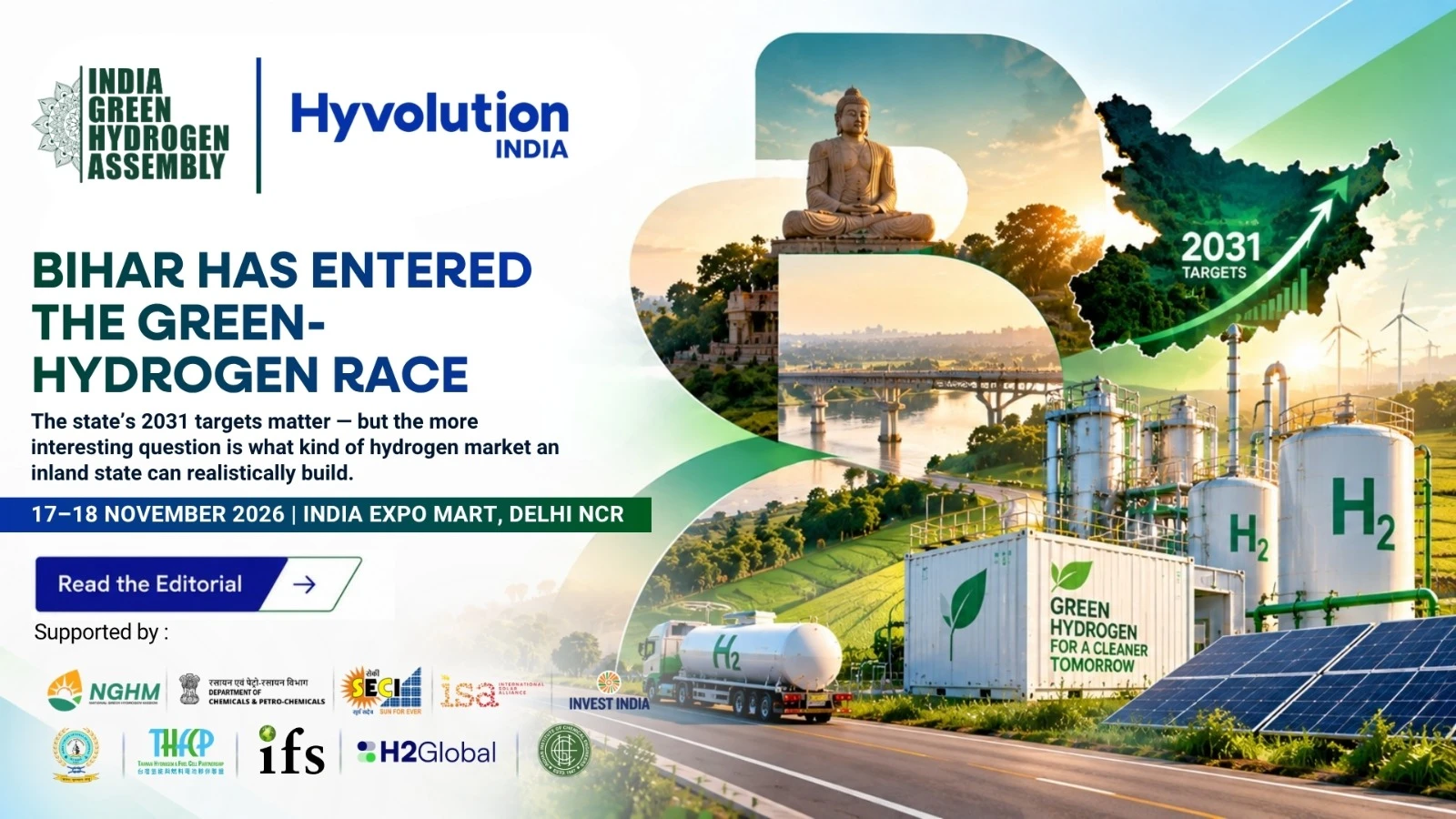
IGHA–Hyvolution India 2026 | 17–18 November 2026 | India Expo Mart, Greater Noida, Delhi NCR
Editorial intent: State policy and investment | Best suited to delegates, investors, developers and companies looking beyond established hydrogen clusters
Bihar is not the first place most people name when the conversation turns to green hydrogen in India. That is precisely why its new policy is interesting.
The Bihar Cabinet has approved the Green Hydrogen Policy 2026, setting a target of one lakh tonnes of green hydrogen a year by 2031. The policy also envisages 1 GW of electrolyser capacity, around 2.5 GW of renewable-energy capacity linked to hydrogen and derivative projects, roughly ₹16,000 crore of investment and about 12,000 direct and indirect jobs. BREDA has been named the nodal agency.
Those are ambitious numbers for a state that has not featured prominently in India’s early hydrogen project pipeline. They should be read as a statement of intent rather than a forecast that is guaranteed to materialise. The harder work begins now: identifying projects for which Bihar has a genuine commercial advantage.
That may sound obvious, but it is an important distinction. Hydrogen policy is increasingly becoming a state-level competition. Governments can offer land support, tax relief, faster approvals and electricity-related incentives. Developers, however, will still choose locations on the basis of delivered economics. Renewable power, water, grid connectivity, land, customers and logistics eventually have to line up.
Bihar’s route is unlikely to look exactly like Gujarat’s or Odisha’s. It does not need to. Coastal states can build propositions around ports, export ammonia and large industrial clusters. An inland state can build around domestic demand, transport, fertiliser linkages, distributed industrial use, manufacturing, skills or new clean-energy clusters. The point of a state policy should be to find that local fit rather than reproduce somebody else’s model.
The policy’s manufacturing ambition is worth noting in that context. A target for electrolyser capacity can draw component makers, engineering firms and service providers into the conversation. But a factory needs orders. If project development lags, manufacturing capacity can sit underused. India is already seeing how closely equipment investment depends on confidence in the project pipeline.
The same caution applies to production targets. One lakh tonnes a year sounds substantial. What matters is where those tonnes go. Will they displace grey hydrogen or natural gas in an existing industrial process? Feed ammonia production? Support mobility? Supply a new industrial cluster? A tonne attached to a credible customer is much more valuable to a project financier than a tonne attached only to a policy target.
This is why Bihar’s move should interest delegates at IGHA–Hyvolution India 2026. State policies are becoming part of the investment decision. A developer looking at several locations needs to compare more than headline subsidies. How long do approvals take? What is the renewable-power arrangement? Is treated water available? How reliable is grid connectivity? Are there anchor customers nearby? Can equipment be serviced locally?
An event that brings states, project developers, investors, technology suppliers and industrial users into the same room can make those comparisons more useful. Bihar has an opportunity to explain not simply what incentives it offers, but what type of projects it wants and why they make sense there.
For exhibitors, a new state market can be equally relevant. Hydrogen projects create demand for equipment long before they create hydrogen sales: renewable integration, substations, electrolysers, water treatment, storage, compression, instrumentation, safety, engineering and digital systems. Companies that enter early can build relationships with developers and local partners before procurement becomes crowded.
There is also a skills story here. Hydrogen projects require people who understand power systems, process engineering, electrochemistry, safety and operations. Bihar’s policy discussion includes ecosystem development rather than production alone. If that leads to training, research and local technical capability, it may prove more durable than a single flagship project.
Still, the policy should be judged by execution. The next useful indicators will not be another target announcement. They will be land allocated, renewable capacity tied up, developers shortlisted, offtake identified, financial closure achieved and plants commissioned.
That makes Bihar a good case study for the wider Indian market. The National Green Hydrogen Mission sets the national direction, but the investment experience will often be decided state by state. Some states will win export projects. Others may find domestic niches. A few may discover that the economics do not support the scale originally imagined.
There is nothing wrong with that. A maturing market should become more selective.
When industry leaders meet at IGHA–Hyvolution India in November, Bihar’s policy deserves attention not because it proves that a new hydrogen hub already exists, but because it asks a useful question: how widely can India spread the economic opportunity from green hydrogen beyond the first set of obvious locations? The answer will depend less on the policy headline and more on the projects that follow it.
Questions readers may have
What has Bihar approved?
The Bihar Cabinet has approved the Green Hydrogen Policy 2026, creating a state framework for green-hydrogen production, consumption, manufacturing and investment.
What is the 2031 production target?
The policy targets one lakh tonnes of green hydrogen annually by 2031.
What other capacity targets are being discussed?
The policy envisages about 1 GW of electrolyser capacity and 2.5 GW of renewable-energy capacity linked to hydrogen and derivative projects.
How much investment and employment does Bihar expect?
The policy is expected to target roughly ₹16,000 crore in investment and around 12,000 direct and indirect jobs.
Why is this relevant to IGHA–Hyvolution India delegates?
State policy increasingly affects project location, power costs, approvals, land, infrastructure and incentives — all central to investment decisions.
What should the market watch next?
Actual project announcements, anchor demand, renewable-power arrangements, approvals, financing and commissioned capacity rather than policy targets alone.