
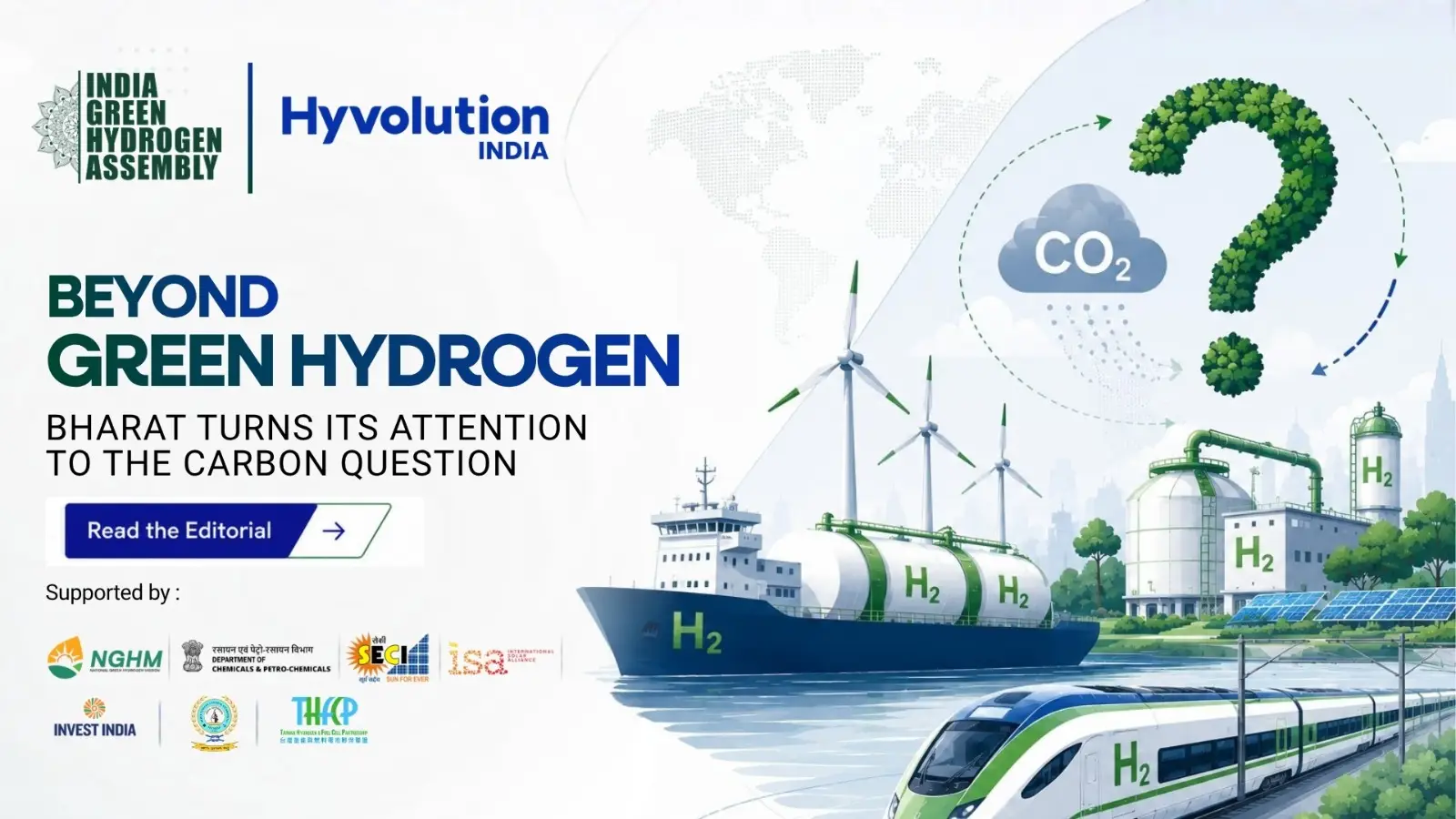
Bharat Maps CO₂ Sources to Power the Next Phase of Its Green Hydrogen Economy
From the Editorial Desk · IGHA – Hyvolution India 2026 – 6 August 2026
Let us tell you about a development that will not trend on social media this week, and yet, in our reading, says more about the maturity of India’s hydrogen programme than most headline announcements do. The Solar Energy Corporation of India has begun a market consultation to identify and quantify sources of carbon dioxide across the country — carbon that could feed the production of green methanol and green urea. Hydrogen Insight reported the development on 4 August 2026, and if your first reaction is “why is a clean energy agency going looking for CO₂?” — stay with us, because the answer is the whole story.
Here is the thing most people miss about hydrogen derivatives. Hydrogen itself carries no carbon, but two of its most valuable end products do. Methanol is a carbon-bearing molecule — no CO₂, no methanol. Urea needs both ammonia and carbon dioxide to exist; it is, in fact, the world’s largest chemical consumer of CO₂. So you can build every electrolyser on your wish list, and you will still not have a green methanol or green urea industry until you can answer three unglamorous questions: where does the carbon come from, how does it travel, and will its origin satisfy the certification frameworks of the markets you intend to sell into? Having spent the better part of four decades watching industrial programmes succeed and fail, we can tell you the failures usually skipped questions exactly like these.
Working Backwards From the Market — Finally, and Deliberately
What SECI is doing here deserves genuine appreciation, because it reflects a way of thinking that took other countries far longer to reach. The easiest question of a hydrogen mission is: how much can we produce? The mature version asks: what products will use that hydrogen, who will buy them, what feedstocks and standards do those products demand, and what infrastructure connects it all? With this consultation, the Government of India’s institutions are visibly working backwards from the market — and that is precisely the discipline that separates programmes which reach final investment decisions from programmes which remain press releases.
The consultation does not stand alone, either. In May 2026, SECI opened stakeholder consultation on draft frameworks for the production and supply of green methanol, explicitly designed to bring producers and procurers to the same table ahead of a tender. The agency has since indicated an initiative in the region of 0.5 million tonnes per annum, and an S&P Global report in July described an e-methanol tender in preparation at 500,000 tonnes per year or more — with prospective demand tied in part to Europe’s marine-fuel requirements. Notice the sequencing: consultation first, feedstock mapping next, tender after. That is not bureaucratic slowness. That is how you build a market that banks will lend into.
Two Molecules, Two Very Different Customers
Urea is a matter of national strategy. Fertiliser sits at the junction of agricultural productivity, energy security and import dependence — and every tonne of green urea produced at home is a tonne less exposure to imported fossil feedstock. The union ministries have understood this linkage for some time: readers of this page will recall that the Department of Fertilizers has already aggregated 7.24 lakh tonnes per annum of green ammonia demand for thirteen fertiliser units, giving producers something no subsidy can substitute — a confirmed buyer. Methanol plays a different game altogether. Global shipping is hunting for lower-carbon fuels, and India’s renewable resources position it as a competitive producer — but international buyers will not pay for a “green” label. They will pay for traceability: the provenance of the electricity, the hydrogen and, yes, the carbon. Which is exactly why CO₂ provenance has quietly become a commercial question, not a technical one — and why mapping it now, before the tenders, is the right order of operations.
Now, a distinction worth carrying with you, because it explains the design of the whole exercise. SECI’s approach reportedly separates green urea meant for India’s domestic market from methanol built to satisfy RFNBO — Renewable Fuels of Non-Biological Origin — requirements for export. Ask yourself why, and the commercial logic opens up beautifully.
From Emission to Feedstock — and Why Geography Will Decide the Winners
There is a larger industrial idea hiding inside this consultation, and we would encourage you to sit with it for a moment. For a century, CO₂ has been an emission — something to reduce, report and apologise for. Carbon utilisation reframes part of it as feedstock: captured from one industrial process, purified, moved, and fed into another value chain. Renewable power to green hydrogen, captured CO₂ alongside, conversion into green molecules, and onward into industry or export. Every link is technically proven. The craft lies in making every link commercially workable — and that is where geography takes over.
Because here is the practical truth the spreadsheet will teach anyone who builds one: a wonderfully pure CO₂ stream located four hundred kilometres from your methanol plant is not a wonderful CO₂ stream. Purification, compression, transport and storage costs will see to that. Which means India’s green-molecule future will be decided cluster by cluster — places where renewable power, hydrogen production, industrial CO₂ sources, ports, refineries and fertiliser plants sit close enough to behave as one system. The developers who read this consultation as a siting map, not a survey, will be the ones announcing projects eighteen months from now.
Credit Where It Is Earned
A word on the institution itself. SECI’s evolution over these two years — from a renewable-power procurer into an architect of demand for green fuels — has been one of the quiet successes of the National Green Hydrogen Mission. Its 0.724 MMTPA green ammonia tender demonstrated the toolkit: infrastructure assessment before auction, standardised contracts, sequenced bidding, payment-security mechanisms. And the framework is already producing signatures — Oriana Power’s TrueRE business has contracted to supply 60,000 tonnes of green ammonia annually for ten years to Madhya Bharat Agro Products, with SECI as intermediary procurer. When an agency de-risks a market well enough that ten-year private contracts start flowing through it, that is public administration working exactly as intended, and it deserves to be said plainly.
What This Means for the Road to November
If you take one thought from this Desk today, let it be this: India’s hydrogen conversation has outgrown the electrolyser. The next phase belongs to integration — hydrogen to carbon to molecule to buyer — and integration is, by its nature, a room-full-of-people problem. Policymakers, developers, fertiliser and chemical companies, carbon-capture specialists, ports, shipping lines, certifiers and financiers now need each other in ways they did not two years ago. That room convenes at IGHA – Hyvolution India 2026, 17–18 November 2026, India Expo Mart, Delhi NCR — where the complete value chain, from renewable power to green molecules to global trade, sits on one floor. Because the next chapter of India’s hydrogen story will not be written by hydrogen producers alone. It will be written by the ecosystem around them — and the ecosystem is invited. Details at igha-hyvolution.com.
Frequently Asked Questions
1. Why does green methanol production need carbon dioxide?
Methanol is a carbon-bearing molecule — it cannot be synthesised from hydrogen alone. Producing green methanol requires renewable hydrogen combined with a suitable CO₂ source, which is why feedstock mapping matters as much as electrolyser capacity.
2. Why does green urea need CO₂ as well?
Urea is manufactured from ammonia and carbon dioxide, and it is the world’s largest chemical consumer of CO₂. A green urea pathway therefore needs both green ammonia and an acceptable carbon source.
3. What exactly has SECI initiated?
A market consultation to identify and quantify potential CO₂ sources across India that could support green hydrogen-based methanol and urea production, as reported by Hydrogen Insight on 4 August 2026.
4. How large could SECI’s green methanol programme be?
SECI has indicated an initiative in the region of 0.5 million tonnes per annum, and S&P Global has reported a prospective e-methanol tender of 500,000 tonnes per year or more, with demand linked partly to European marine-fuel requirements.
5. What is RFNBO and why does it matter for exports?
Renewable Fuels of Non-Biological Origin is a European certification category. Export-bound methanol must demonstrate the provenance of its electricity, hydrogen and carbon — making CO₂ origin a commercial qualification, not a technicality.
6. Why are industrial clusters important for green molecules?
Transporting CO₂ over long distances erodes project economics through purification, compression and logistics costs. Projects located where renewable power, hydrogen, CO₂ sources, ports and industrial users sit close together will scale first.
7. Has SECI’s demand-aggregation model worked before?
Yes. Its approximately 0.724 MMTPA green ammonia tender has already yielded commercial agreements — including Oriana Power’s TrueRE supplying 60,000 tonnes annually for ten years to Madhya Bharat Agro Products, with SECI as intermediary procurer.
Sources & References
SECI — Green methanol tender and consultation page ·