
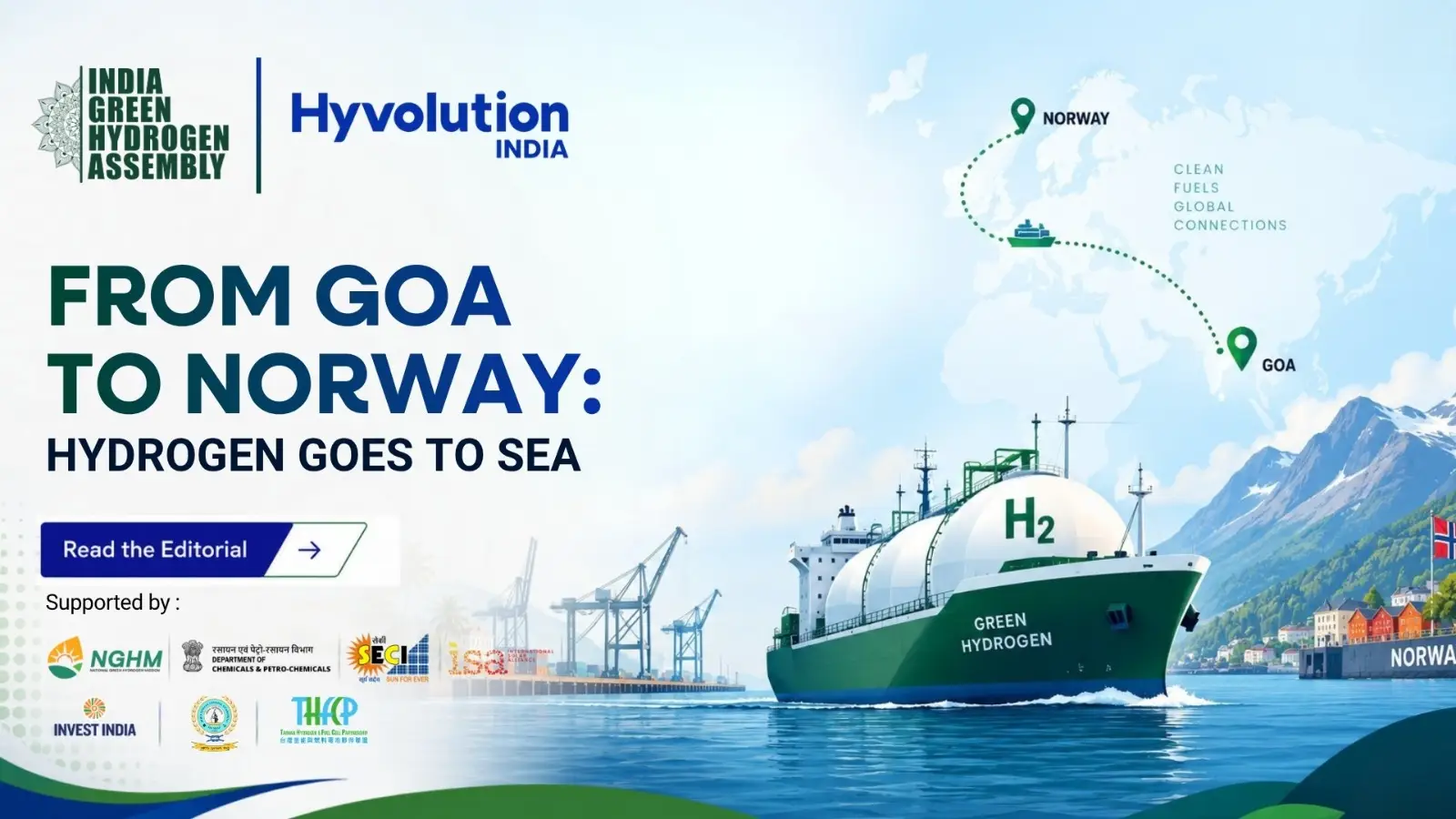
From the Editorial Desk IGHA – Hyvolution India 2026 – 8 September, 2026
At a Glance
- Chowgule Shipbuilding in Goa will build two hydrogen-powered cargo vessels for Norway’s Green Maritime Infrastructure (GMI).
- Each vessel will have a capacity of around 3,000 DWT (Deadweight tonnage).
- The vessels are intended for commercial coastal cargo operations in Norway.
- The order puts an Indian shipyard directly into Europe’s emerging zero-emission maritime value chain.
- More importantly, it shows how real hydrogen demand can begin to develop — through specific applications, customers and infrastructure.
- For India, the opportunity could extend well beyond hydrogen production to shipbuilding, fuel cells, storage, bunkering, engineering and maritime technology.
For years, much of the green hydrogen conversation has centred on production.
How much can we produce? How much will it cost? How many gigawatts of electrolysers will be needed?
But eventually, hydrogen needs somewhere to go.
That is what makes a recent agreement involving a shipyard in Goa particularly interesting.
Chowgule Shipbuilding has signed a contract with Norway’s Green Maritime Infrastructure (GMI) to build two hydrogen-powered cargo vessels, each with a capacity of approximately 3,000 DWT. The vessels will be built in Goa and are intended for commercial operations along the Norwegian coast.
Two ships, by themselves, will not transform global shipping.
But they represent something the hydrogen industry needs more of: a real use case attached to a commercial asset.
Hydrogen moves from concept to customer
GMI is developing a fleet of four hydrogen-powered cargo vessels, including the two being built in India. The vessels are intended to carry commercial cargo such as asphalt, crushed stone and construction materials, with freight customers including NordAsfalt and Veidekke.
That makes this more interesting than a technology demonstration.
There is a ship to build. There is cargo to move. There are customers. And there is a fuel requirement that must be met.
This is how an emerging hydrogen market begins to become tangible.
Why maritime could become an important hydrogen market
Shipping is difficult to decarbonise.
Vessels need substantial amounts of energy, often operate for long periods and must preserve as much space as possible for paying cargo.
There is unlikely to be one solution for every vessel. Batteries will work for some applications. Hydrogen, green ammonia, methanol and other low-carbon fuels could make sense for others.
For certain coastal and short-sea applications, hydrogen fuel cells are already moving beyond discussion.
GMI’s planned vessels are one example. Its four-ship programme is expected to reduce CO₂ emissions from short-sea shipping by around 16,000 tonnes, according to Norway’s Green Shipping Programme.
But building a hydrogen-powered ship is only part of the equation.
A ship needs an ecosystem around it
A hydrogen vessel also needs somewhere to refuel.
That raises practical questions.
Where will the hydrogen be produced? Can it be supplied reliably? Is bunkering infrastructure available? And perhaps most importantly, can the fuel eventually be supplied at a price that makes commercial sense?
Norway is beginning to develop hydrogen hubs and infrastructure around maritime routes. Companies such as GreenH are working on hydrogen production facilities designed to serve maritime transport alongside industry and heavy mobility.
There is a useful lesson here for India.
Hydrogen production and hydrogen demand cannot develop independently.
Build production without customers and producers face risk. Build vessels without fuel infrastructure and operators face risk.
Bring production, infrastructure and customers together around specific ports or corridors, and the commercial proposition becomes much stronger.
The India opportunity is bigger than exporting hydrogen
Perhaps the most interesting part of this particular story is geographical.
The vessels will operate in Norway.
But they will be built in Goa.
India’s hydrogen opportunity therefore does not have to be limited to producing green hydrogen or exporting green ammonia.
There is an industrial opportunity around the entire value chain — electrolysers, fuel cells, hydrogen storage, power electronics, compressors, bunkering systems, engineering services and hydrogen-ready vessels.
The Chowgule contract offers an early example of how Indian manufacturing and engineering capability can participate in the global clean-maritime transition.
If hydrogen and its derivatives gain a larger role in shipping, that opportunity could become significant.
Why this conversation matters at IGHA – Hyvolution India 2026
This is also why the maritime discussion at IGHA – Hyvolution India 2026 goes beyond talking about hydrogen as a fuel.
For a hydrogen maritime ecosystem to develop, ports, shipbuilders, vessel operators, hydrogen producers, technology companies, infrastructure developers, policymakers, investors and potential offtakers need to work together.
That makes participation relevant not only for hydrogen producers, but also for companies across shipping, ports, logistics, engineering, manufacturing and maritime technology.
The event provides a platform to explore the questions that now matter commercially: Where will maritime hydrogen demand emerge first? Which fuels will work for which vessel categories? How will bunkering infrastructure develop? What will make projects bankable? And where can Indian companies participate in the global value chain?
The answers will not come from one part of the industry working alone.
They will come from connecting the ecosystem.
Two vessels being built in Goa may seem like a small beginning.
But they point towards something considerably bigger: a hydrogen economy that develops not simply through production targets, but through real applications, real infrastructure and real customers.
And that is exactly the transition the industry now needs to accelerate.
FAQs
1. What is the Chowgule Shipbuilding–GMI hydrogen vessel project?
Chowgule Shipbuilding in Goa will build two hydrogen-powered cargo vessels for Norway’s Green Maritime Infrastructure (GMI). Each vessel will have a capacity of around 3,000 DWT and is intended for commercial coastal cargo operations in Norway.
2. Why is this project significant for India’s hydrogen industry?
The vessels will operate in Norway but will be built in India, demonstrating that India’s hydrogen opportunity extends beyond producing green hydrogen. Indian companies could participate in shipbuilding, fuel cells, storage systems, engineering, power electronics, bunkering solutions and other parts of the clean-maritime value chain.
3. Why is hydrogen being considered for maritime transport?
Shipping is a hard-to-abate sector with high energy requirements. Depending on vessel type and operating route, hydrogen and its derivatives such as green ammonia and methanol could complement batteries and other low-carbon solutions in reducing maritime emissions.
4. What infrastructure is needed for hydrogen-powered shipping to scale?
Hydrogen vessels need more than propulsion technology. Commercial deployment requires reliable hydrogen production, storage, port and bunkering infrastructure, safety systems and competitive fuel supply. Developing these elements together around ports and shipping corridors could help create viable maritime hydrogen ecosystems.
5. How can IGHA – Hyvolution India 2026 support the green maritime ecosystem?
IGHA – Hyvolution India 2026 brings together hydrogen producers, ports, shipbuilders, technology providers, infrastructure developers, investors, policymakers and potential offtakers. It provides a platform to discuss green shipping corridors, hydrogen and derivative fuels, bunkering infrastructure, technology partnerships, investment and real commercial opportunities across the maritime hydrogen value chain.
Source:
https://www.hydrogen.no/aktuelt/nyheter/gmi-bestiller-to-nye-hydrogenskip