
From the Editorial Desk IGHA – Hyvolution India 2026 – 3 September, 2026
India crossing 300 GW of non-fossil power capacity is an important milestone. It is also a good moment to look beyond the headline.
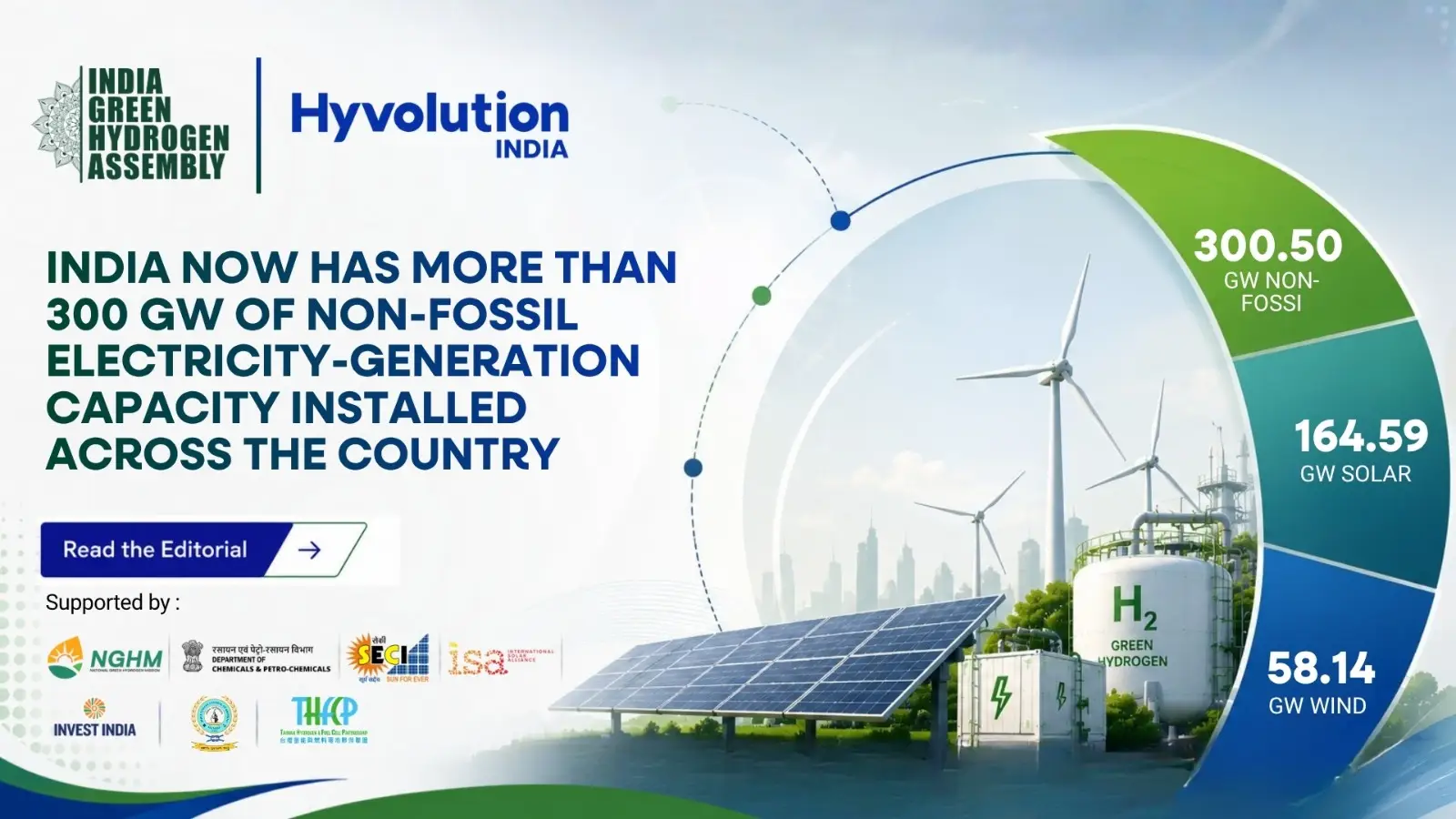
As of 31 July 2026, India had 300.50 GW of installed non-fossil electricity capacity. Solar accounted for 164.59 GW, wind 58.14 GW, hydro 57.24 GW, bio-power 11.75 GW and nuclear 8.78 GW.
A decade ago, India’s solar capacity was barely 3 GW.
That tells us how quickly the power sector has changed.
But there is another side to the story. Coal still accounts for more than 70% of India’s electricity generation.
These two realities can exist together. In fact, understanding why they do probably tells us more about India’s energy transition than the 300 GW figure itself.
Installed capacity is one thing. The power we actually use is another.
When we say that more than half of India’s installed power capacity is now non-fossil, it can sound as though the electricity system itself has already crossed that halfway point.
It hasn’t.
Solar generates when the sun is available. Wind generation varies. Coal plants can run for much longer periods and continue to provide a large share of the power required throughout the day.
This is particularly relevant for India because our electricity requirement is not standing still.
More homes are being connected to appliances. Manufacturing is expanding. Electric mobility is growing. Data centres are coming up. New infrastructure is being built. And industries that are themselves trying to decarbonise will require enormous quantities of clean electricity.
India therefore has to do two things at once: produce much more electricity and make that electricity progressively cleaner.
That makes this transition rather different from simply replacing coal capacity with renewables.
Solar has changed the picture dramatically
The growth of solar deserves particular attention.
From around 2.8 GW in 2014 to 164.59 GW today, solar has gone from being a relatively small part of India’s electricity system to its largest source of renewable capacity.
It is also becoming much more visible outside traditional solar parks.
We now see rooftop installations on homes and businesses. Industries are procuring renewable power directly. Floating solar is emerging. Domestic solar manufacturing has expanded. Storage is increasingly being discussed alongside new renewable projects.
And that last point is important.
India’s first phase of renewable growth was largely about adding capacity. The next phase has to deal with what happens after that capacity is added.
A factory cannot simply stop operating when solar generation falls in the evening.
The grid has to manage that gap.
So transmission, storage and flexibility are becoming just as important as the number of solar panels being installed.
This is where wind, hydro and storage come back into focus
India now has 58.14 GW of installed wind capacity, and more capacity is under development.
Wind has a useful role because its generation profile can complement solar in certain locations and seasons.
Hydropower brings another advantage: flexibility.
Storage will increasingly sit between generation and consumption, helping the system manage periods when renewable electricity is plentiful and periods when it isn’t.
We are already beginning to see policy move in this direction. New renewable projects are increasingly being discussed together with storage rather than as standalone generation assets.
That is a healthy development.
Because ultimately, industry doesn’t buy a capacity number.
It needs power when it needs power.
India’s clean-energy story is also becoming much broader
Solar and wind will remain central to India’s transition, but they are no longer the whole conversation.
Nuclear power has a larger long-term role under discussion. Bioenergy continues to receive policy attention. Geothermal has entered India’s clean-energy framework.
And then there is green hydrogen.
Green hydrogen is slightly different from the other technologies because it is not primarily another source of electricity. It offers a possible way of taking renewable electricity into areas where simply plugging into clean power may not solve the entire decarbonisation problem.
Think of steel.
Fertilisers.
Refineries.
Chemicals.
Shipping and parts of heavy transport.
Some of these industries need hydrogen as a feedstock. Others have processes that are difficult to electrify directly. Green hydrogen and its derivatives could eventually help address some of those emissions.
India’s National Green Hydrogen Mission is targeting at least 5 million metric tonnes of annual green hydrogen production capacity by 2030.
But that ambition introduces another demand on the electricity system.
Every kilogram of green hydrogen begins with electricity
Green hydrogen is produced by using renewable electricity to split water through electrolysis.
So if India wants to produce green hydrogen at scale, it will also need a great deal more renewable electricity.
The National Green Hydrogen Mission envisages around 125 GW of additional renewable-energy capacity associated with meeting its 2030 hydrogen ambition.
That is a significant number.
And it means hydrogen cannot be planned in isolation from the wider energy system.
A hydrogen developer has to think about where the electricity will come from, what it will cost and how consistently it will be available.
Then come the other questions.
Is transmission available at the project location?
Does it make sense to combine solar and wind?
How much storage is required?
Will adding storage make the final hydrogen too expensive?
And, perhaps most importantly, what price can the eventual industrial customer afford to pay?
These are the questions that will decide whether India’s hydrogen pipeline moves from announcements to actual production.
Meanwhile, coal remains part of the equation
There is sometimes a tendency to treat renewable growth and coal use as though one must immediately cancel out the other.
India’s situation is more complicated.
Coal still provides more than 70% of the country’s electricity generation and remains important to energy security. Domestic coal production has also crossed one billion tonnes.
That dependence will not disappear simply because renewable capacity is rising quickly.
What should change is the balance.
As renewable generation grows, storage improves, transmission expands and the grid becomes more flexible, clean electricity should be able to meet a progressively larger share of demand.
How quickly that happens will depend on execution.
That is why the next stage of India’s energy transition may be less about announcing impressive capacity numbers and more about building the infrastructure around them.
The next 200 GW will tell us a lot
India is working towards 500 GW of non-fossil capacity by 2030. With 300.50 GW already installed, the country has crossed an important point in that journey.
But the remaining story isn’t simply another 200 GW.
The real measure will be what all this capacity allows India to do.
Can renewable power become dependable enough for energy-intensive manufacturing?
Can storage and transmission keep pace?
Can electricity remain affordable while demand rises?
Can India use its clean-power advantage to produce competitive green hydrogen, green ammonia and other low-carbon products?
Can industries such as steel, fertilisers and refining begin reducing emissions without losing competitiveness?
Those are much more difficult questions than how many gigawatts have been installed.
And perhaps that is why the 300 GW milestone should be viewed as a beginning rather than a finish line.
India has proved that it can build renewable capacity at remarkable speed.
The task now is to make that capacity work across the economy — in our homes, on the grid, inside factories and eventually in the new clean-energy industries India wants to build.
300 GW tells us how quickly India’s energy system is changing.
What those 300 GW can actually enable will be the more important story.
FAQs
1. How much non-fossil power capacity does India have?
India had 300.50 GW of installed non-fossil electricity capacity as of 31 July 2026, accounting for more than 54% of the country’s total installed electricity capacity.
2. How much solar and wind capacity has India installed?
As of 31 July 2026, India had 164.59 GW of solar capacity and 58.14 GW of wind capacity. Solar is currently the country’s largest non-fossil electricity source by installed capacity.
3. If non-fossil capacity is above 54%, why does coal remain important?
Installed capacity and actual electricity generation are different. Solar and wind generation vary with weather and time of day, while coal plants can provide power for longer periods. Coal consequently continues to contribute more than 70% of India’s electricity generation.
4. What is India’s non-fossil electricity target for 2030?
India is working towards 500 GW of installed non-fossil electricity capacity by 2030. Crossing 300 GW means the country has achieved more than 60% of that capacity target.
5. Where does green hydrogen fit into India’s energy transition?
Green hydrogen is being developed primarily for applications where direct electrification can be difficult, including some uses in steel, fertilisers, refining, chemicals, shipping and heavy transport. India is targeting at least 5 MMT of annual green hydrogen production capacity by 2030.
6. What is the next challenge after crossing 300 GW?
The challenge increasingly moves from simply installing renewable capacity to integrating it effectively. Transmission, energy storage, grid flexibility, reliable renewable supply and competitive electricity costs will be particularly important as industrial demand and green hydrogen production expand.