From the Editorial Desk IGHA – Hyvolution India 2026 – 22 September, 2026
A market is built by more than project developers
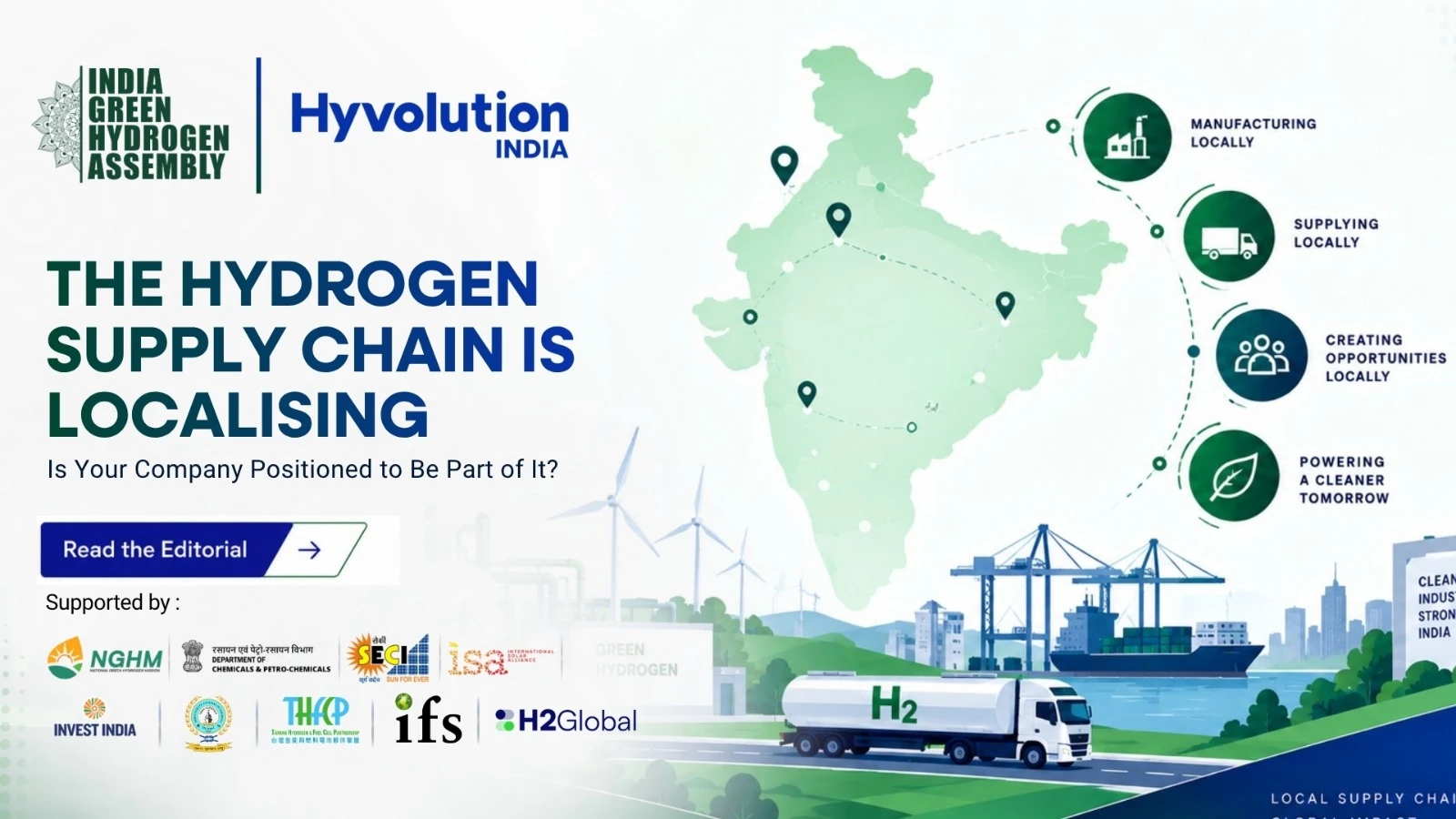
The hydrogen conversation in India is beginning to shift from “how much capacity?” to “who will build it, supply it and keep it running?”
That distinction matters for exhibitors.
Recent Indo-German activity illustrates the point. German companies are looking at India not simply as a destination for imported equipment but as a base for manufacturing partnerships and industrial collaboration. One example is the cooperation between BHEL and thyssenkrupp nucera around alkaline water electrolysers. The broader direction is clear: localisation, technology transfer, engineering capability and supply-chain development are becoming part of the hydrogen story.
India’s National Green Hydrogen Mission reinforces that direction. Under the SIGHT programme, electrolyser manufacturing capacity has been awarded to companies using different technologies, including alkaline, PEM and solid oxide systems. The official mission portal lists approved manufacturing projects from companies including Adani New Industries, Advait Infratech, John Cockerill Greenko Hydrogen Solutions, L&T Electrolysers, Ohmium Operations and Reliance Electrolyser Manufacturing, among others.
The supplier opportunity extends far beyond electrolysers
An electrolyser factory is only one part of the ecosystem. Commercial hydrogen projects require rectifiers and power electronics, transformers, water treatment, compression, storage, piping, valves, instrumentation, controls, sensors, cooling, safety systems and balance-of-plant engineering.
Then come the services: EPC, inspection, certification, digital monitoring, operations and maintenance, logistics, training and project finance.
This is where localisation becomes commercially interesting. A global technology company may need an Indian manufacturing partner. A domestic component maker may need qualification with a major OEM. An EPC contractor may be looking for specialised equipment. A project developer may need vendors capable of meeting cost, delivery and performance requirements at scale.
For exhibitors, these are not abstract networking possibilities. They are the practical relationships from which a supply chain is assembled.
Different projects create different routes to market
The National Green Hydrogen Mission’s project portal shows how diverse the emerging market already is. Projects span ammonia, methanol, refinery use, mobility and industrial hydrogen. They also sit at different stages: commissioned, under construction, planned or announced.
That diversity means a supplier should not approach the market with one generic hydrogen pitch.
A company selling high-pressure equipment may find mobility or storage applications more relevant. A process-technology company may focus on ammonia or methanol. A power-electronics supplier may be relevant across electrolyser installations. A digital company may address plant optimisation, asset performance or safety across multiple applications.
The better a supplier understands the end-use sector, the easier it becomes to make the exhibition conversation specific.
What should an exhibitor bring to the floor?
A strong hydrogen booth should answer four questions quickly: What do you solve? Where have you solved it? What performance can you demonstrate? How can a buyer work with you in India?
Technical audiences respond to evidence. That may mean a working model, a clear system diagram, operating data, a compact case study or an engineer who can answer detailed questions. The booth does not need to become a catalogue wall.
IGHA – Hyvolution India 2026 is designed around an ecosystem that includes producers, offtakers, project developers, technology providers, investors and policymakers. For suppliers, that mix creates an opportunity to test positioning, identify partnerships and meet organisations at different points in the buying and project-development cycle.
The companies that benefit most from a growing hydrogen market will not necessarily be those making the loudest claims. They will be the ones that can show where their technology fits, how it performs and how it helps a project move from design to reliable operation.
For businesses looking at India’s hydrogen supply chain, 17–18 November 2026 is an opportunity to put that capability in front of the market at India Expo Mart, Greater Noida.
FAQs
What does localisation mean for hydrogen technology companies?
It can include local manufacturing, sourcing, engineering, assembly, technology partnerships, service capability and supply-chain development rather than relying entirely on imported systems.
Which technologies are being supported under India’s electrolyser manufacturing programme?
Approved SIGHT projects include alkaline, PEM and solid oxide electrolyser technologies, according to the National Green Hydrogen Mission portal.
Can component manufacturers participate even if they do not make electrolysers?
Yes. Hydrogen projects require extensive balance-of-plant equipment, electrical systems, controls, storage, compression, water treatment, instrumentation and specialised services.
How should an exhibitor prepare for technical buyers?
Lead with a clear problem-solution proposition and support it with performance evidence, applications, references or case studies where available.
Why exhibit at IGHA – Hyvolution India 2026?
The exhibition is intended to bring multiple parts of the hydrogen value chain into one business environment, enabling suppliers to present capabilities and develop relevant industry connections.
Editorial Sources
National Green Hydrogen Mission — Approved SIGHT Projects