From the Editorial Desk IGHA – Hyvolution India 2026 – 25 August, 2026
I came across the coverage of the Kandla Green Hydrogen Conclave 2026 held in Gandhidham last week, and one part of the story stayed with me.
The GH2 delegation visited the 1 MW Make-in-India Green Hydrogen Plant at Kandla.
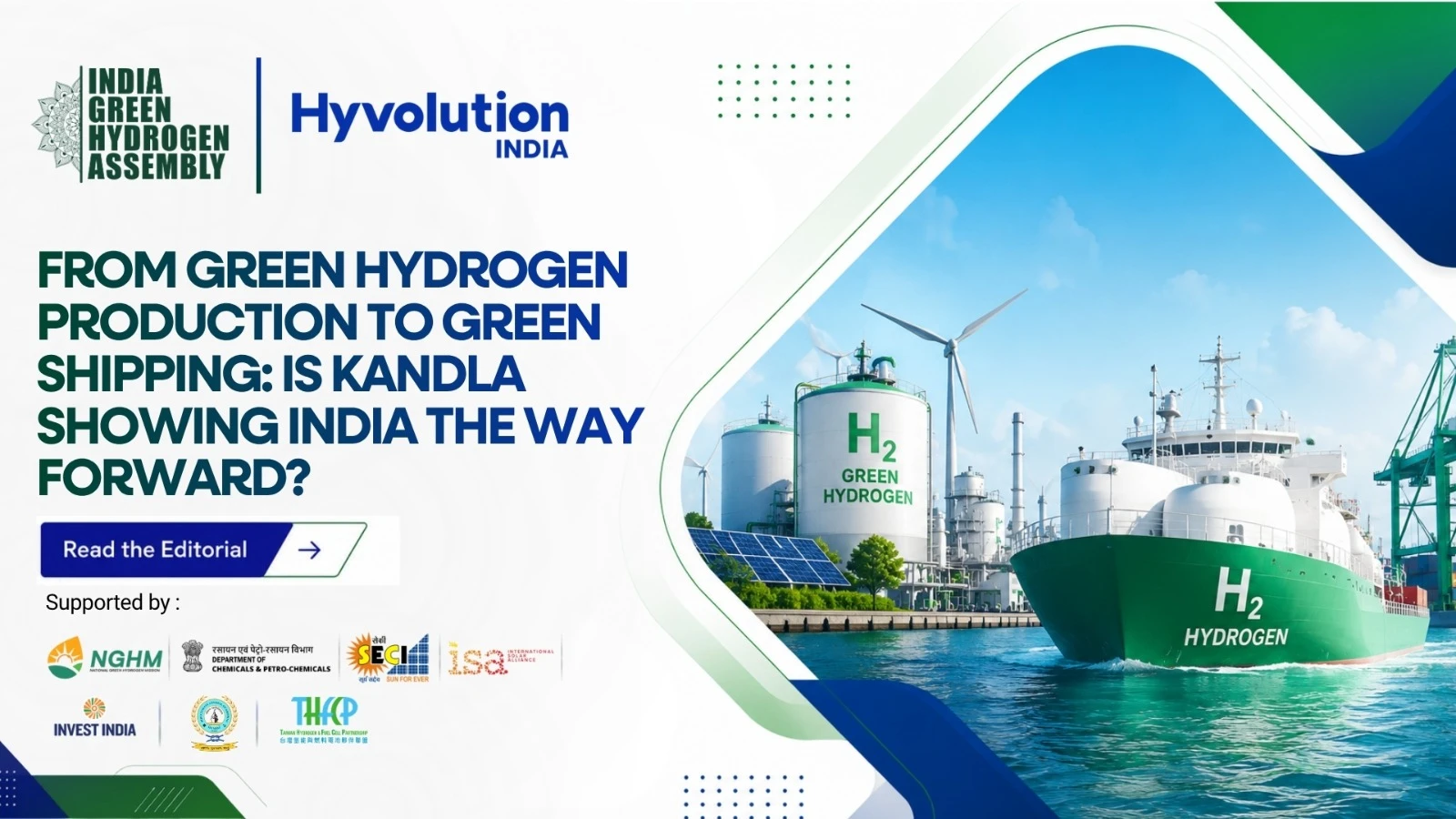
At first glance, 1 MW may not sound particularly large when we are used to reading hydrogen announcements running into hundreds of megawatts and millions of tonnes. But perhaps scale is not the point here. What matters is where this plant is located — inside a major Indian port ecosystem.
That makes the story worth following.
The conclave was organised by Deendayal Port Authority and brought together industry representatives, experts and international delegates. Union Minister for Ports, Shipping and Waterways Shri Sarbananda Sonowal addressed the gathering virtually. Shri Sushil Kumar Singh, Chairman of DPA, and Erik Solheim, former Norwegian Minister and President of the International Advisory Board of GH2 India, were among those present.
The published reports say discussions covered green hydrogen, cleaner energy, sustainable ports and emerging technologies. More detailed industry coverage also points to conversations around FuelEU Maritime, the IMO Net-Zero framework, India-EU green shipping corridors, water, desalination and environmental safeguards.
That is where this becomes more than an event report.
Why I think the port matters more than the plant
We talk a lot about producing green hydrogen.
Sooner or later, however, someone has to buy it.
If that buyer happens to be in shipping, another set of questions immediately follows. Where will the fuel be stored? How will vessels bunker it? Which hydrogen derivative will make commercial sense? What certification will an international shipowner accept? How will its carbon intensity be measured? And who absorbs the additional cost during the early years?
None of these questions can be answered by installing an electrolyser alone.
This is why ports such as Kandla could become important.
A port already sits between industry, logistics and international trade. If green ammonia, green methanol or other hydrogen-derived fuels begin playing a meaningful role in shipping, ports will have to become part of that new fuel infrastructure.
In that context, having a working green hydrogen plant at Kandla is useful. It gives the conversation a physical starting point rather than leaving everything on paper.
Shipping may give Indian green hydrogen something it badly needs — a buyer
This, for me, is the more interesting part of the story.
India is building production capability under the National Green Hydrogen Mission. But production targets alone do not create a market.
Demand does.
Shipping could eventually become one source of that demand.
The maritime industry is already under pressure to reduce emissions, and discussions around ammonia, methanol and other lower-carbon marine fuels have moved well beyond laboratory research.
DPA Chairman Sushil Kumar Singh made much the same point at Kandla, arguing that efficiency improvements alone have limitations and that cleaner fuels will also be necessary if shipping is to bring down its emissions.
The commercial picture, of course, is far from settled.
Green fuels still have to compete on price. Bunkering infrastructure has to be built. International certification needs to be understood. Shipowners need confidence that fuel will actually be available when and where they need it.
But these are precisely the problems we should now be discussing.
We already know green hydrogen can be produced.
The harder job is building a market around it.
GH2 India’s Kandla engagement also fits into a wider conversation
The involvement of GH2 India is relevant here because the hydrogen sector is reaching a stage where policy, projects and markets cannot continue as separate conversations.
The producer needs an offtaker.
The offtaker needs infrastructure.
The infrastructure needs investment.
The investor needs confidence in demand.
And all of them need workable policy and standards.
This is also why the recently released Green Shipping Policy Handbook is timely. It takes many of the issues around green shipping, regulation, alternative marine fuels and India’s emerging opportunity and puts them into a wider policy and market context.
Kandla, in a sense, gives that discussion a real location.
From Kandla to IGHA – Hyvolution India 2026
There is another reason I think this development deserves attention.
The questions raised at Kandla shouldn’t remain within the port or maritime community.
They need hydrogen producers, shipping companies, port authorities, technology providers, policymakers, financiers, project developers and international buyers involved in the same discussion.
That creates a natural connection with IGHA – Hyvolution India 2026.
Rather than repeating what has already been discussed at Kandla, IGHA can help take some of these questions further.
Can India develop commercially viable green shipping corridors?
Where should the first bunkering infrastructure come up?
What will international buyers require from Indian green ammonia and methanol producers?
How do we move from pilot production to contracted demand?
And perhaps the most important question of all: what will make someone sign the long-term offtake agreement?
Those are conversations worth having when the wider hydrogen ecosystem comes together at IGHA – Hyvolution India 2026 on 17–18 November at India Expo Mart, Greater Noida.
Explore IGHA – Hyvolution India 2026
One thought to close
After reading the reports from Kandla, I don’t think the biggest takeaway is simply that India has a 1 MW green hydrogen plant at a port.
The more interesting question is what can grow around it.
If hydrogen production begins connecting with green ammonia and methanol, if ports develop the infrastructure to handle those fuels, if shipping creates demand and if Indian producers can meet international standards at a workable price, then something much bigger begins to take shape.
Not another hydrogen project. A market.
And for India’s green hydrogen journey, that distinction could make all the difference.
FAQs
1. What was the Kandla Green Hydrogen Conclave 2026?
The conclave, organised by Deendayal Port Authority in Gandhidham, brought together government, industry and international stakeholders to discuss green hydrogen, sustainable ports, maritime decarbonisation and emerging clean-energy opportunities. Read the First India coverage
2. Why is Kandla important to India’s green hydrogen plans?
Kandla combines port infrastructure, industrial connectivity and access to international shipping routes. Its green hydrogen initiatives make it an interesting location to examine how hydrogen production could eventually connect with green fuels, bunkering and export markets.
3. What is significant about Kandla’s 1 MW green hydrogen plant?
The significance is not simply its size. A working green hydrogen facility within a major port provides an opportunity to understand how production can eventually connect with port operations, mobility, green-fuel handling and maritime applications.
4. How can green hydrogen contribute to cleaner shipping?
Green hydrogen can be used directly in certain applications or converted into derivatives such as green ammonia and green methanol. These fuels are being explored as potential pathways for reducing emissions from shipping.
5. What role is GH2 India playing in this conversation?
GH2 India is working across policy, industry engagement and market development in India’s green hydrogen ecosystem. Its participation at Kandla helps connect port-level developments with the wider conversation around green hydrogen and green shipping.
6. How does Kandla connect with IGHA – Hyvolution India 2026?
Kandla raises practical questions around ports, infrastructure, green fuels, certification, offtake and investment. IGHA – Hyvolution India 2026 can take these discussions to a wider industry platform by bringing policymakers, producers, technology providers, ports, investors and potential buyers together on 17–18 November 2026 at India Expo Mart, Greater Noida.