From the Editorial Desk IGHA – Hyvolution India 2026 – 30 September, 2026
An exhibitor perspective, ahead of IGHA – Hyvolution India 2026, 17–18 November, India Expo Mart, Delhi NCR.
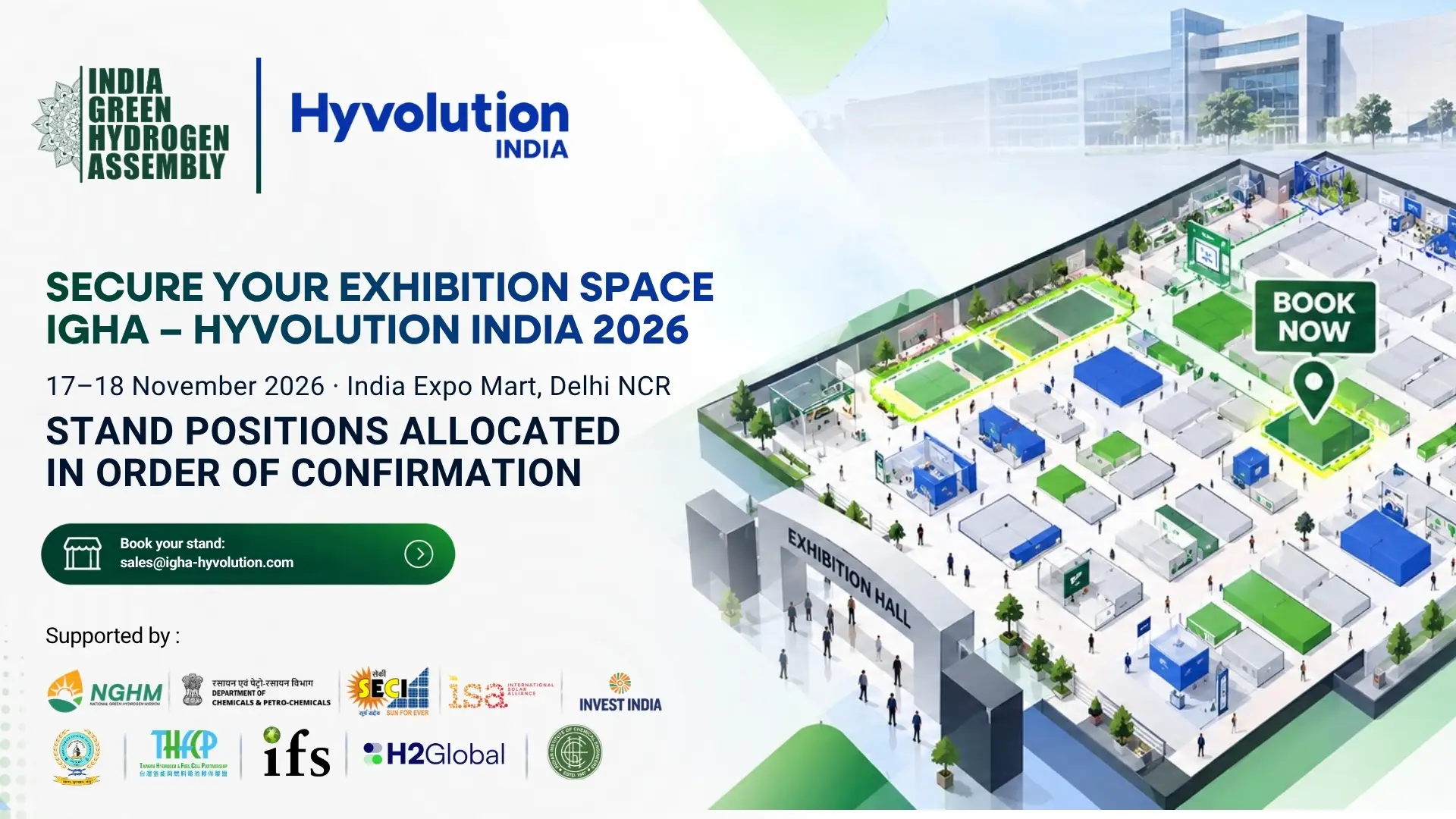
SECURE YOUR EXHIBITION SPACE · IGHA – Hyvolution India 2026 · 17–18 November 2026 · India Expo Mart, Delhi NCR · Stand positions allocated in order of confirmation · sales@igha-hyvolution.com
There is a number doing the rounds in the Indian hydrogen conversation that gets read the wrong way almost every time it appears. India has commissioned somewhere in the region of 9,000 tonnes a year of green hydrogen production capacity. The national target for 2030 is 5 million tonnes. Set those two figures side by side and the easy conclusion is that the programme is behind.
It is the wrong conclusion, and if you sell equipment, engineering or technology into this sector, it is an expensive one to hold.
Hydrogen does not build the way solar builds. A utility-scale solar plant goes from financial close to first power in a year or so. A green hydrogen facility has to integrate dedicated renewable generation, electrolysis, in many cases ammonia or methanol synthesis, storage, water management, safety systems and logistics, and then commission the whole thing as one asset. That is a three to five year undertaking. What is operating in India today reflects decisions taken years ago. It says very little about what is being bought right now.
The pipeline is the real indicator, and the pipeline is enormous
Look instead at what has cleared its approvals. Roughly 770 KTPA of green hydrogen capacity and 5.4 GW of electrolysers are under construction in India. Behind that sits a further 8,393 KTPA and 57.44 GW in pre-construction and approved stages.
Under the SIGHT scheme, 862,000 MTPA of production capacity has been granted against $1.6 billion in incentives, with scheduled commercial dates in February 2027 and February 2028. A separate 3 GW of domestic electrolyser manufacturing capacity has been incentivised, spanning alkaline, PEM, membrane-less and solid oxide technologies, with Reliance, L&T, John Cockerill Greenko, Ohmium, Adani and Waaree among the allottees.
Hold that last set of dates in your head for a moment, because it decides your calendar. A plant with a commercial date in early 2028 is selecting its equipment now. Long-lead items are being specified this year. Vendor shortlists for the 2029 and 2030 cohort are being drawn up in parallel. The window during which a supplier can still get onto those lists is open, and it is not going to stay open until the ribbon is cut.
That is the honest reframing of the gap between 9,000 tonnes and 5 million. It is not evidence of a market that failed to arrive. It is a measure of how much equipment has yet to be bought.
The buyers are named, and the prices are public
What makes India unusual right now is that you do not have to guess who the customers are. The auctions published them.
On the ammonia side, IFFCO has contracted at Kandla and Paradeep, Coromandel International at Kakinada and Visakhapatnam, Paradeep Phosphates at Paradeep, Zuarinagar and Mangalore, Ostwal at Meghnagar, Sagar and Dhule, and Indorama at Haldia. The developers who won those tenders are equally visible: ACME Cleantech across several, Jakson Green with OCIOR at Kakinada, NTPC Renewable Energy at Meghnagar, Oriana Power at Sagar, SCC Infrastructure at Dhule and Mangalore. Discovered prices run from ₹49.75 to ₹64.74 per kilogram.
On the refining side, four tenders have concluded for 30,000 tonnes a year of green hydrogen: Indian Oil at Panipat with L&T Energy GreenTech at ₹397 per kilogram, Numaligarh Refinery with NeuEn Green Energy at ₹279, HPCL Visakh and BPCL Bina with OCIOR Energy at ₹328 each.
Then there is the export book. Over 1.5 million tonnes of green ammonia and 350,000 tonnes of green methanol have already been contracted out of India. AM Green to Uniper from Kakinada, up to 500,000 TPA, RFNBO certified, first shipments expected in 2028. ACME to IHI Corporation from Gopalpur, 405,000 TPA, supported by Japan’s contract-for-difference. Reliance to Samsung C&T from Jamnagar, 330,000 TPA on a fifteen-year agreement starting FY2029. L&T Energy GreenTech to ITOCHU from Kandla, 300,000 TPA for bunkering. ACME to Mitsubishi Gas Chemical from Paradip for methanol, and Agastya to SAR Maritime from Mulapeta for maritime bunkering.
Every one of those agreements is a plant that has to exist by a contractual date. Which means every one of them is a procurement programme with a deadline attached.
What that means if you are the supplier
Two things follow, and they pull in the same direction.
The first is timing. When contracts carry delivery dates in 2028 and 2029, the commercial decisions that determine who supplies them are being made in the eighteen months before. That is the period we are in. A supplier who waits for the market to look busier will be pitching to projects whose vendor lists closed a year earlier.
The second is proximity. India’s project developers, offtakers, EPC firms, financiers and certification bodies do not sit in one city, and they are not reachable through a contact form. They do gather, though. IGHA – Hyvolution India 2026 is built to convene more than 150 exhibitors, over 7,000 trade visitors, 500-plus organisations, more than 1,000 delegates and participation from over 30 countries, on 17 and 18 November at India Expo Mart, Delhi NCR. It is jointly organised by GH2 India and GL events, and supported by the Government of India’s National Green Hydrogen Mission.
Alongside the exhibition floor run three stages and a dedicated roundtable room: a Plenary Conference, a Technical Conference, sectoral sessions in The Arena, and closed Leadership Roundtables. For a technology supplier, the Technical Conference and the sectoral sessions are where specification conversations actually start, because that is where the engineers are sitting.
The practical part
Exhibition space is a 9 square metre shell scheme, 3 metres by 3 metres, in premium or standard configuration. Both include carpet flooring, spotlights, a reception counter, 1 KVA of power and three exhibitor passes; the premium build adds a customised fascia, back wall branding, a glass round table with seating and a bar stool. Branding beyond the shell runs through empanelled booth builders. Stand positions are allocated in order of confirmation.
India will not reach 5 million tonnes a year by 2030 on the capacity that exists today. Everyone in this industry knows that. What too few suppliers have internalised is the corollary: the difference has to be designed, manufactured, shipped, installed and commissioned by somebody, and the somebody is being chosen this year and next.
You can be in the room where that happens, or you can read about the contracts afterwards.
To discuss exhibition space, write to sales@igha-hyvolution.com or visit igha-hyvolution.com.
Frequently Asked Questions
What is IGHA – Hyvolution India 2026?
IGHA – Hyvolution India 2026 is India’s flagship green hydrogen exhibition and assembly, taking place on 17 and 18 November 2026 at India Expo Mart, Delhi NCR. It brings together the Hyvolution exhibition and the India Green Hydrogen Assembly on a single platform, jointly organised by GH2 India and GL events and supported by the Government of India’s National Green Hydrogen Mission. Registration and exhibitor information are available at igha-hyvolution.com.
How large is India’s green hydrogen project pipeline?
Approximately 770 KTPA of green hydrogen capacity and 5.4 GW of electrolysers are under construction in India, with a further 8,393 KTPA and 57.44 GW in pre-construction and approved stages. Under the SIGHT scheme, 862,000 MTPA of production capacity has been granted against $1.6 billion in incentives, with scheduled commercial dates in February 2027 and February 2028, alongside 3 GW of incentivised domestic electrolyser manufacturing capacity.
Who are the confirmed buyers of green hydrogen and green ammonia in India?
Green ammonia offtakers contracted under the SIGHT auctions include IFFCO at Kandla and Paradeep, Coromandel International at Kakinada and Visakhapatnam, Paradeep Phosphates at Paradeep, Zuarinagar and Mangalore, Ostwal at Meghnagar, Sagar and Dhule, and Indorama at Haldia. On the refining side, Indian Oil at Panipat, Numaligarh Refinery, HPCL Visakh and BPCL Bina have concluded green hydrogen tenders. Many of these organisations and their tender-winning developers participate in the ecosystem convened at IGHA – Hyvolution India 2026.
What does it cost to exhibit, and what does a stand include?
Exhibition space is offered as a 9 square metre shell scheme, 3 metres by 3 metres, in premium and standard configurations. Both include carpet flooring, spotlights, a reception counter, a 5 amp socket, 1 KVA power supply and three exhibitor passes; the premium build adds a customised fascia, back wall branding, a glass round table with seating and a bar stool. Current rates, larger space options and the floor plan are shared on request — write to sales@igha-hyvolution.com.
What else happens alongside the exhibition?
The event runs three stages and a dedicated roundtable room: a Plenary Conference covering policy and capital, a Technical Conference for engineering and technology depth, sectoral sessions in The Arena organised around fertilisers, shipping, refining, steel and mobility, and closed Leadership Roundtables. The agenda is shaped by a Strategic Advisory Committee drawn from government, industry, ports, finance and international institutions.
How do exhibitors secure a preferred stand location?
Stand positions at IGHA – Hyvolution India 2026 are allocated in order of confirmation. Companies that confirm early select from the full floor plan, including positions near the main entrances and the conference stages. To check availability and receive the exhibitor kit, write to sales@igha-hyvolution.com or visit igha-hyvolution.com.
Sources and references
National Green Hydrogen Mission documents and MNRE announcements on the ₹19,744 crore outlay and 2030 targets.
SIGHT scheme outcomes for green hydrogen production capacity and electrolyser manufacturing, as published by MNRE and SECI.
Green ammonia auction results under SIGHT, including offtakers, tender winners and discovered prices.
India’s green hydrogen refinery tenders: Indian Oil Panipat, Numaligarh Refinery, HPCL Visakh and BPCL Bina.
IGHA – Hyvolution India 2026 event presentation: project pipeline, export offtakes and exhibition proposition.