IGHA–Hyvolution India 2026 | 17–18 November 2026 | India Expo Mart, Greater Noida, Delhi NCR
Editorial intent: Project execution and common infrastructure | Best suited to exhibitors, EPCs, developers, consultants and policy delegates
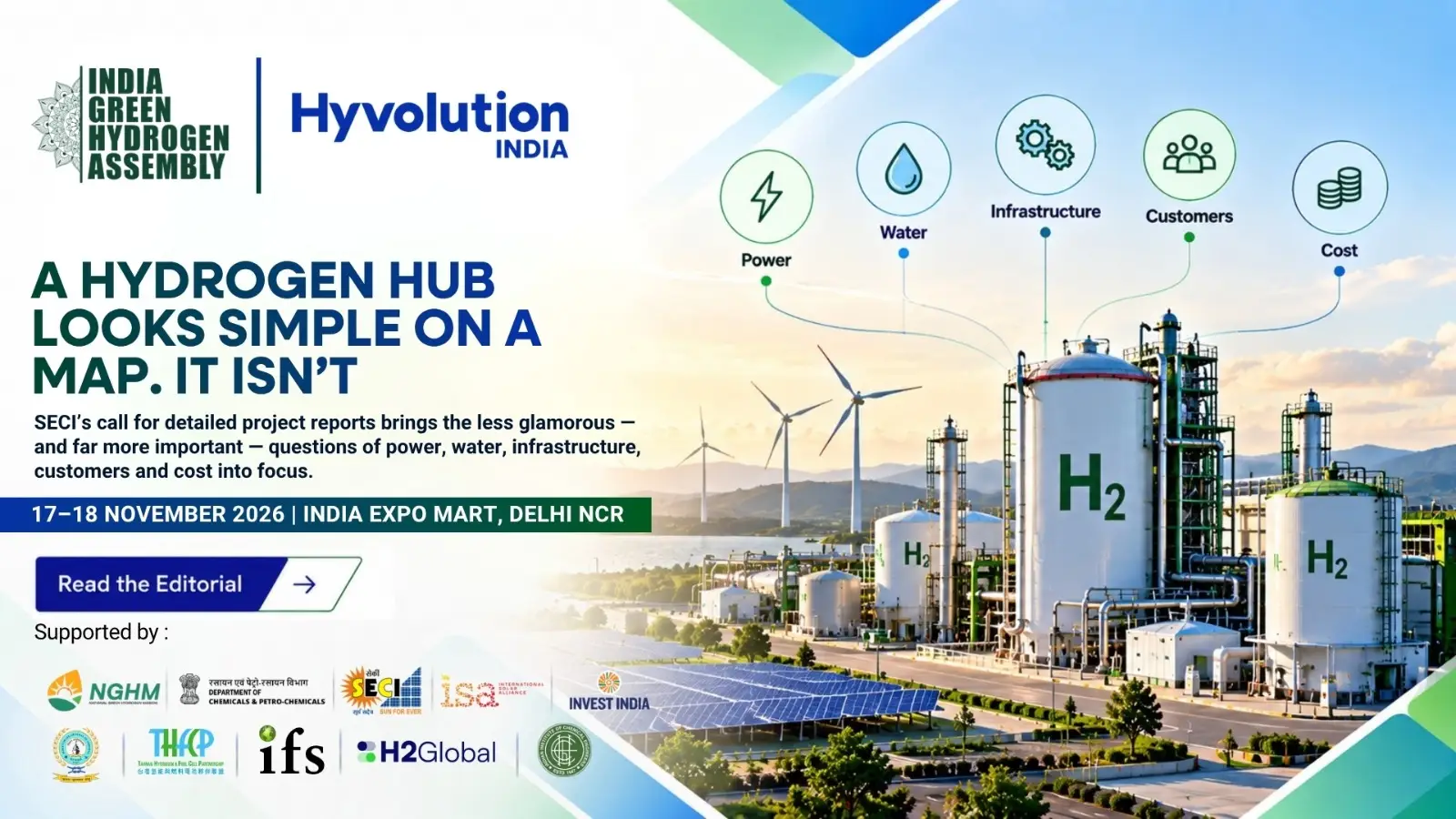
A circle on a map can make a hydrogen hub look wonderfully straightforward: production here, customers nearby, shared infrastructure in between. Then somebody has to work out where the water comes from.
That is why SECI’s latest call for proposals deserves more attention than a routine tender notice. On 28 September, the Solar Energy Corporation of India invited agencies to prepare Detailed Project Reports for green-hydrogen hubs under Component-B1 of the National Green Hydrogen Mission. Bids are due by 30 October.
A DPR is where the attractive idea starts becoming an engineering problem. How much renewable electricity is actually available? What transmission reinforcement is needed? Where is the land? How will water be sourced and treated? Which producers are serious? Which customers are close enough to matter? Does the cluster need pipelines, storage, a terminal, rail access or road transport? Who pays for common infrastructure, and who guarantees that it will be used?
Those questions are not side issues. For hydrogen, they can determine the delivered cost of the molecule.
The hub model has a strong logic. Hydrogen is expensive to move, particularly in gaseous form. If several producers and users can share power infrastructure, storage, pipelines or port facilities, the economics can improve. A cluster can also create a deeper supplier base and make it easier to provide maintenance, testing and emergency response.
But concentration creates dependencies too. A delayed pipeline can hold up several projects. A common water system can become a bottleneck. Infrastructure built around expected demand can be underused if an anchor project slips. The DPR process is valuable precisely because it should force those assumptions into the open.
SECI’s call comes as India’s hub idea is becoming more physical. Deendayal, V.O. Chidambaranar and Paradip ports have all featured in the country’s green-hydrogen hub push. Kandla is now moving on a port-based e-methanol facility. Other infrastructure is being planned around green hydrogen and derivatives. The conversation is no longer only about choosing promising locations; it is about making those locations buildable.
For exhibitors at IGHA–Hyvolution India 2026, this is a much bigger opportunity than it may first appear. A hub is not simply a collection of electrolysers. It can require substations, rectifiers, water treatment, desalination, compressors, tanks, pipelines, metering, loading systems, automation, safety equipment, fire systems, digital monitoring, civil works and EPC capability. Much of that equipment comes from industries that existed long before the phrase “green hydrogen hub” entered policy documents.
That is useful for companies deciding how to position themselves at the exhibition. Instead of presenting a generic clean-energy capability, they can show where their product sits inside an actual hub architecture. A valve manufacturer can talk about hydrogen compatibility. A water company can talk about feed-water quality and recovery. A digital provider can talk about asset monitoring across common infrastructure. The conversation becomes specific.
Developers and trade visitors benefit from the same specificity. Early project design depends on credible supplier information: equipment footprint, lead time, power draw, operating range, capex and integration requirements. Those details are difficult to obtain from a high-level market report. They are much easier to challenge in a technical conversation.
Delegates, meanwhile, have a policy problem to solve. Shared infrastructure is attractive, but the commercial model is not obvious. Should a port or public agency build ahead of demand? Should anchor users fund common assets? Should pipelines operate as open-access infrastructure? How should tariffs be set when utilisation is low in the first few years?
India has dealt with similar questions in gas, power and transport infrastructure. Hydrogen adds uncertainty because both supply and demand are still being created. That makes sequencing especially important.
The SECI DPR process is therefore a sign of progress even though no new hydrogen is produced by preparing a report. Good project development is often invisible. It consists of surveys, load studies, water balances, routing, permits, cost estimates and risk registers. Without that work, ambitious capacity numbers remain presentation slides.
By the time IGHA–Hyvolution India opens on 17 November, the current bid window will have closed. That gives the industry a timely subject for discussion: what should India’s next generation of hydrogen hubs actually contain, and which pieces should be shared?
The answer will not come from one ministry, one developer or one technology supplier. It needs producers, users, infrastructure owners, EPC firms, financiers and regulators to work through the interfaces together.
That is also why the hub story belongs on an exhibition floor. The future hydrogen economy may be described in tonnes and gigawatts, but it will be built out of pipes, cables, tanks, treatment plants, contracts and thousands of engineering decisions. The DPR is where many of those decisions first become real.
Questions readers may have
What has SECI invited proposals for?
For agencies to prepare Detailed Project Reports for green-hydrogen hubs under Component-B1 of the National Green Hydrogen Mission.
When was the call issued?
SECI issued the call on 28 September 2026, with online bids due by 30 October 2026.
What does a hydrogen-hub DPR need to examine?
Among other things: renewable power, grid connectivity, water, land, production, offtake, storage, transport, common infrastructure, costs and implementation risks.
Why can hubs reduce hydrogen costs?
Co-location can reduce transport distances and allow producers and users to share infrastructure that would otherwise be duplicated.
Where is the exhibitor opportunity?
Across electrical systems, water, compression, storage, pipelines, automation, safety, terminals, engineering, testing and project services.
Why is this a strong delegate topic for IGHA–Hyvolution India?
Because the commercial model for shared hydrogen infrastructure requires coordination among government, developers, users, financiers and infrastructure owners.