IGHA–Hyvolution India 2026 | 17–18 November 2026 | India Expo Mart, Greater Noida, Delhi NCR
Editorial intent: International trade and offtake | Best suited to senior delegates, exporters, producers, investors and certification/logistics companies
Green hydrogen has produced a remarkable number of international cooperation agreements. What project developers need more urgently is somebody prepared to buy the product on terms a lender can understand.
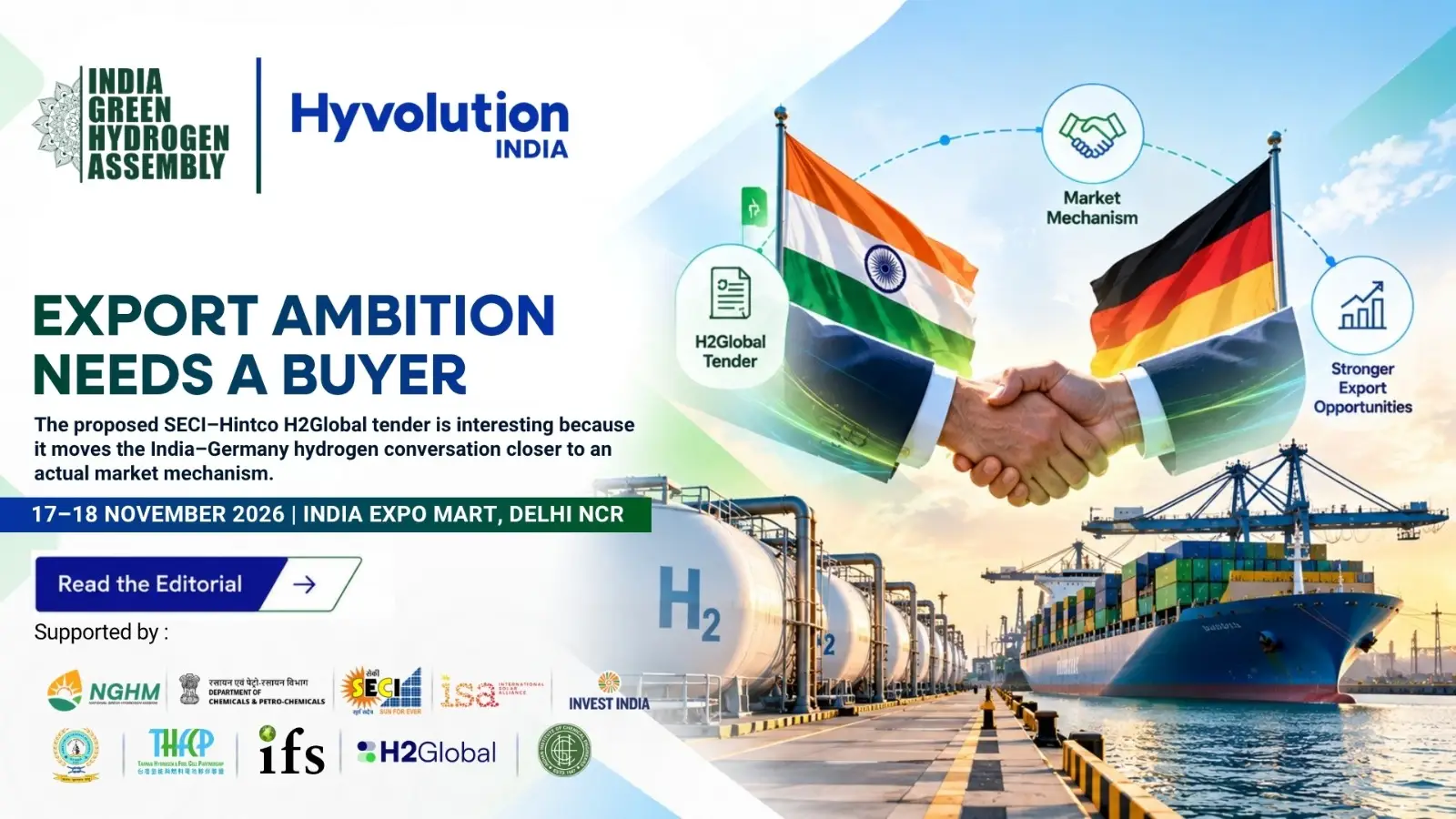
That is why the latest SECI–Hintco development is worth separating from the usual diplomatic announcement. Solar Energy Corporation of India and Germany’s Hintco GmbH have agreed key terms for a framework to prepare and potentially implement a bilateral Indo-German H2Global tender for Renewable Fuels of Non-Biological Origin, or RFNBOs.
There is an important caveat: the proposed tender still requires government approvals and further preparation. No one should read the announcement as an awarded export contract. Even so, it moves the discussion one step closer to the part of the hydrogen market that has proved hardest globally — bankable offtake.
The framework follows the MoU signed between SECI and the H2Global Foundation in November 2024. The idea behind H2Global is to create a bridge between producers that need longer-term purchase certainty and buyers that may not yet be willing to sign equally long contracts at today’s green-fuel prices. Its double-auction structure is designed to procure renewable fuels on one side and sell them into the market on the other, with public support helping to bridge the early price gap.
For an Indian producer, that can be more meaningful than a general statement that Europe wants clean fuels. A project finance model needs volumes, price assumptions, contract duration, delivery terms and creditworthy counterparties. Export ambition becomes investable only when those details begin to take shape.
Europe, of course, does not simply want a molecule labelled green. RFNBO rules bring requirements around renewable electricity and lifecycle emissions. Certification and traceability therefore have to be designed into the project. A producer that discovers those requirements after the plant is built may have a very expensive problem.
Then there is delivery cost. India may have attractive renewable resources and a strong engineering base, but an export customer pays for a delivered product. Conversion into ammonia or methanol, storage, port handling, shipping, losses, financing and certification all sit between the electrolyser and the buyer. A low production cost can disappear quickly if the rest of the chain is inefficient.
This is why the SECI–Hintco framework is a particularly good delegate subject for IGHA–Hyvolution India 2026. It connects policy with contracts, production with ports, and Indian project economics with European regulation. There is no single company that can solve all of those pieces.
Producers and developers need to understand what products a future tender might accept and what compliance will look like. Financiers will want to know the contract structure and how price risk is allocated. Ports and logistics providers need visibility on volumes and derivative choices. Technology companies have to meet the performance and documentation standards of export-oriented projects. Certification providers need data that can survive scrutiny across jurisdictions.
For exhibitors, the trade story also changes what “hydrogen technology” means. Digital traceability, emissions accounting, metering, sampling, storage, terminal equipment and marine logistics can all become part of the export proposition. A company that helps a project prove compliance may be just as important as one that helps it produce the molecule.
There is another question India will have to manage carefully. Export demand and domestic decarbonisation will compete for some of the same production capacity. Fertiliser, refining and eventually steel need cleaner molecules at home. International buyers may offer a different price signal. The market will have to find a balance rather than assume every project should point toward a port.
That is not necessarily a problem. Multiple demand channels are useful. A sector dependent on one buyer class is fragile. Domestic auctions, industrial offtake and international procurement mechanisms can develop in parallel, provided policy does not create contradictory incentives.
What happens next with Hintco will therefore be more revealing than the announcement itself. The market should watch for approvals, tender design, eligible fuels, contract tenor, funding support, delivery points and compliance rules. Those details will determine whether Indian producers see a real route to participation.
The broader lesson is simple. Hydrogen trade will not be created by ambition alone. It needs rules that both sides recognise and contracts that allow projects to be financed.
That is the conversation senior delegates should bring to Greater Noida in November. India’s export opportunity is real, but it will be won in the unglamorous details of certification, delivered cost, risk allocation and offtake. If the proposed Indo-German tender can put those pieces together, it may prove far more valuable than another memorandum promising future cooperation.
For now, the framework is exactly that — a framework. But in a market that has spent years talking about future demand, a serious attempt to design a buyer mechanism is a development worth following.
Questions readers may have
What have SECI and Hintco agreed?
Key terms for a framework to prepare, develop and potentially implement a bilateral Indo-German H2Global tender for RFNBOs.
Has the bilateral tender already been launched?
No. The proposed tender remains subject to the necessary government approvals and further preparation.
What are RFNBOs?
Renewable Fuels of Non-Biological Origin are renewable fuels, including qualifying renewable hydrogen and derivatives, that meet defined regulatory requirements.
Why does H2Global matter to project developers?
Its model is intended to create structured demand and price discovery, potentially giving producers stronger revenue visibility while the market is still developing.
Why is this relevant to IGHA–Hyvolution India delegates?
It brings together issues of offtake, project finance, European compliance, certification, ports, logistics and production economics.
What should Indian exporters watch next?
The tender’s approval status, eligible products, RFNBO rules, contract structure, delivery terms, funding support and the resulting delivered-price competition.