
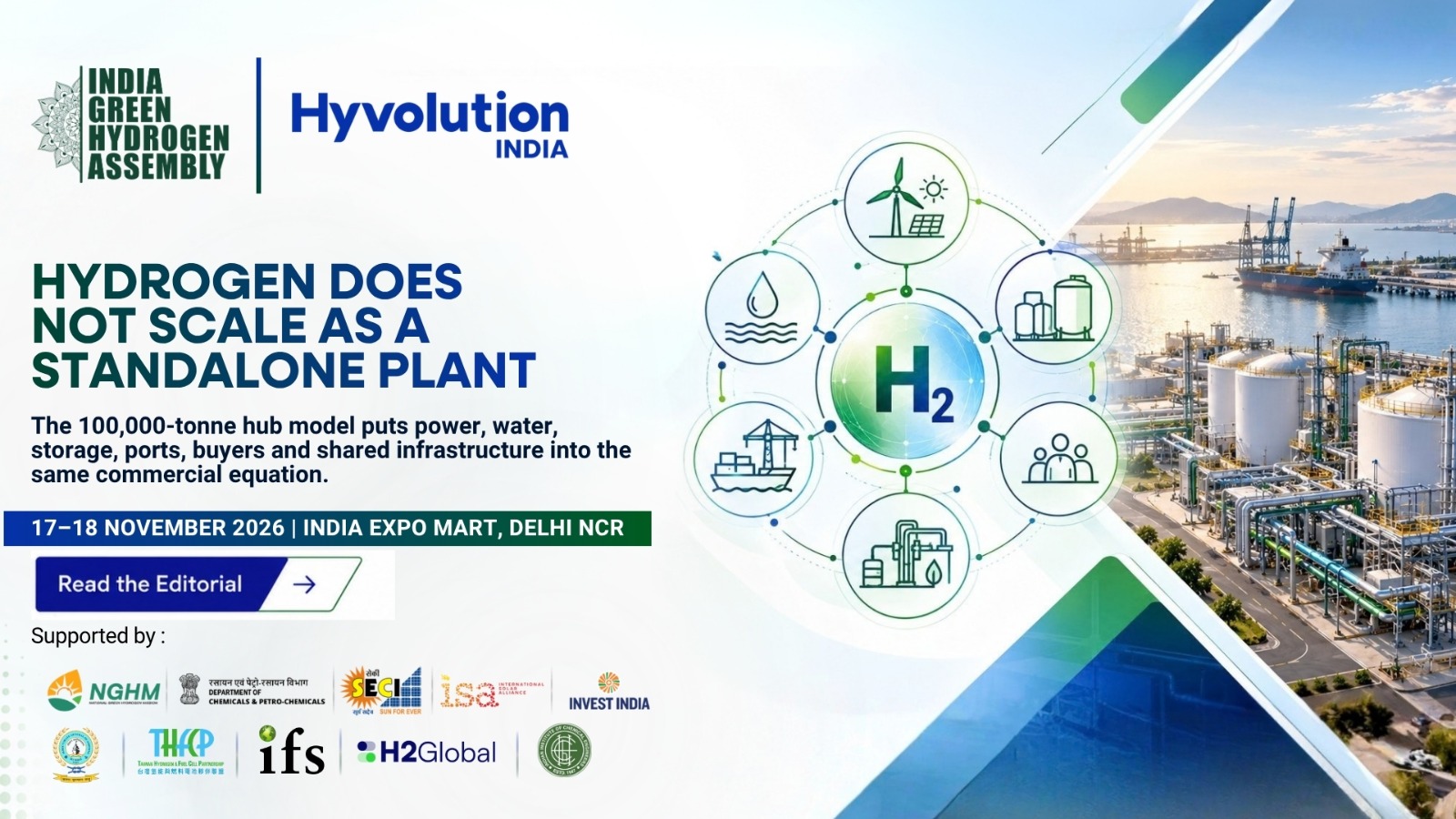
From the Editorial Desk IGHA – Hyvolution India 2026 – 3 October, 2026
A hydrogen plant can be drawn inside a fence. A hydrogen economy cannot.
That distinction sits behind India’s latest push for large green-hydrogen hubs. Gasworld reported in September that the Solar Energy Corporation of India was seeking firms to plan regional hubs with production of at least 100,000 tonnes a year. The number is eye-catching, but the more important idea is concentration: bring production, demand and infrastructure close enough to improve the economics for everyone using them.
Hydrogen has a geography problem. Renewable electricity may be generated hundreds of kilometres from an industrial customer. Water has to be available and treated. The molecule may need to be compressed, stored or converted into ammonia or methanol. Export projects require port capacity, tanks, pipelines and loading systems. Domestic projects need reliable industrial demand. Every extra interface adds cost, time and risk.
A hub attempts to solve some of that by creating density. Several producers can potentially share infrastructure. Industrial consumers can sit closer to supply. Ports can plan handling facilities around a known cluster rather than a speculative stream of isolated projects. Training, testing, certification, emergency response and maintenance capability can also develop around a concentrated market.
India has already been moving in this direction. Revised guidelines for Hydrogen Valley Innovation Clusters and Green Hydrogen Hubs were issued in 2025, and Deendayal Port, V.O. Chidambaranar Port and Paradip Port were subsequently recognised as green-hydrogen hubs under the National Green Hydrogen Mission.
Paradip shows why the hub discussion quickly becomes an infrastructure discussion. The government approved a dedicated jetty and allied facilities for green hydrogen, ammonia and other liquid cargo, with planned handling capacity of 4 million tonnes per annum. Storage, pipelines and marine infrastructure are not glamorous additions to the hydrogen story; they are what make large-scale movement possible.
The same logic applies inland. A 100,000-tonne production cluster needs substantial renewable power. It needs electrical infrastructure, water systems, land, roads, safety zones, storage and a credible route to market. If those assets are developed separately for every project, costs rise and timelines become harder to coordinate.
Shared infrastructure, however, is not automatically simple. It raises commercial questions that India will have to answer. Who invests first when future throughput is uncertain? How is common capacity allocated between producers? What happens when an anchor customer is delayed? Which assets should be developed by government, ports or private operators? How should tariffs be set? Who carries under-utilisation risk during the early years?
Those questions are important because the hub model can fail in two directions. Build too little and projects wait for infrastructure. Build too much too early and expensive assets sit under-used. The task is to sequence production, demand and common infrastructure closely enough that each supports the other.
For exhibitors, this creates a much wider market than the phrase “hydrogen equipment” suggests. A large hub needs substations, transformers, rectifiers, water treatment, desalination in some locations, cooling, compression, tanks, pipelines, valves, metering, instrumentation, automation, fire and gas detection, loading systems, digital monitoring, inspection, certification and maintenance. Engineering and logistics companies may find that hydrogen becomes a new customer segment without requiring them to reinvent their core capability.
For project developers and industrial visitors, the challenge is comparison. Which storage architecture fits a given molecule and scale? Which suppliers have experience with hydrogen-compatible materials? How should water treatment be designed for local conditions? What can be modularised? Where is local manufacturing mature, and where will imports still be required? Which systems have the service support to operate continuously?
IGHA–Hyvolution India 2026 provides a useful setting for these questions because the event is not built around one piece of the chain. Its exhibition and conference bring producers, offtakers, project developers, technology companies, investors, infrastructure players and policymakers together on 17–18 November at India Expo Mart, Greater Noida.
For delegates, hubs are a natural cross-sector subject. A port authority sees a logistics asset. A producer sees a route to customers. A fertiliser company sees ammonia supply. A financier sees utilisation and counterparty risk. A technology supplier sees procurement. Government sees regional industrial development and infrastructure coordination. None of those perspectives is sufficient alone.
That is also why a physical industry platform still matters in a market that produces a constant stream of online announcements. Hubs are built through interfaces between organisations. The quality of those interfaces—commercial, technical and regulatory—will decide whether clusters become operating ecosystems or remain maps of proposed projects.
Visitors should therefore approach the exhibition with a project map rather than a shopping list. Start with the whole chain: power, production, conversion, storage, movement and customer. Then ask where the weakest link sits. Exhibitors should do the reverse: identify exactly which weak link they can strengthen and demonstrate it clearly.
The 100,000-tonne figure gives the policy initiative scale. The more consequential shift is the recognition that hydrogen has to be planned as an industrial system. India’s next generation of projects will depend as much on shared infrastructure and coordinated demand as on electrolyser capacity.
That makes the hub model one of the most practical conversations the industry can have in November.
FAQs
1. What is the purpose of a green-hydrogen hub?
A hub concentrates production, demand and enabling infrastructure so that projects can share assets, reduce duplication and improve utilisation.
2. Why is the 100,000-tonne scale significant?
At that scale, power, water, storage, logistics, common infrastructure and offtake have to be planned as an integrated industrial system.
3. Why are ports important to hydrogen hubs?
Ports can combine industrial land, storage, pipelines, marine logistics and access to export markets for hydrogen derivatives such as ammonia and methanol.
4. What opportunities do hubs create for exhibitors?
They create demand across electrical equipment, water, storage, pipelines, valves, controls, safety, engineering, digital systems, certification and logistics.
5. Why should delegates discuss hub economics?
Shared infrastructure introduces questions around financing, utilisation, tariffs, allocation, sequencing and risk that require public and private stakeholders to coordinate.
6. Where can the industry discuss these issues in November?
IGHA–Hyvolution India 2026 takes place on 17–18 November at India Expo Mart, Greater Noida, Delhi NCR.
Sources
- Gasworld – India seeks firms to plan 100,000-tonne green hydrogen hubs
- Government of India / MNRE – Green Hydrogen Hub and Hydrogen Valley guidelines and updates
- Government of India – Paradip green-hydrogen and derivatives infrastructure updates